Evergreen notes
1. What happened
Matuschak, previously an iOS engineer at Apple and a researcher at Khan Academy, has practised and set out these disciplines on a public working-notes site that he keeps updating; its pages carry no date of writing[1]Matuschak, A. Working Notes. The three disciplines checked against the primary site. Available at notes.andymatuschak.org, continuously updated; the pages carry no date of writing. This is an individual practitioner's working notes. There is no book and no paper. They are atomic, concept-oriented and densely linked, and appear as verbatim headings on the site. Attribution note: a fourth principle, “context-free”, circulates widely but was checked and does not exist on the original site. It is a common misreport..
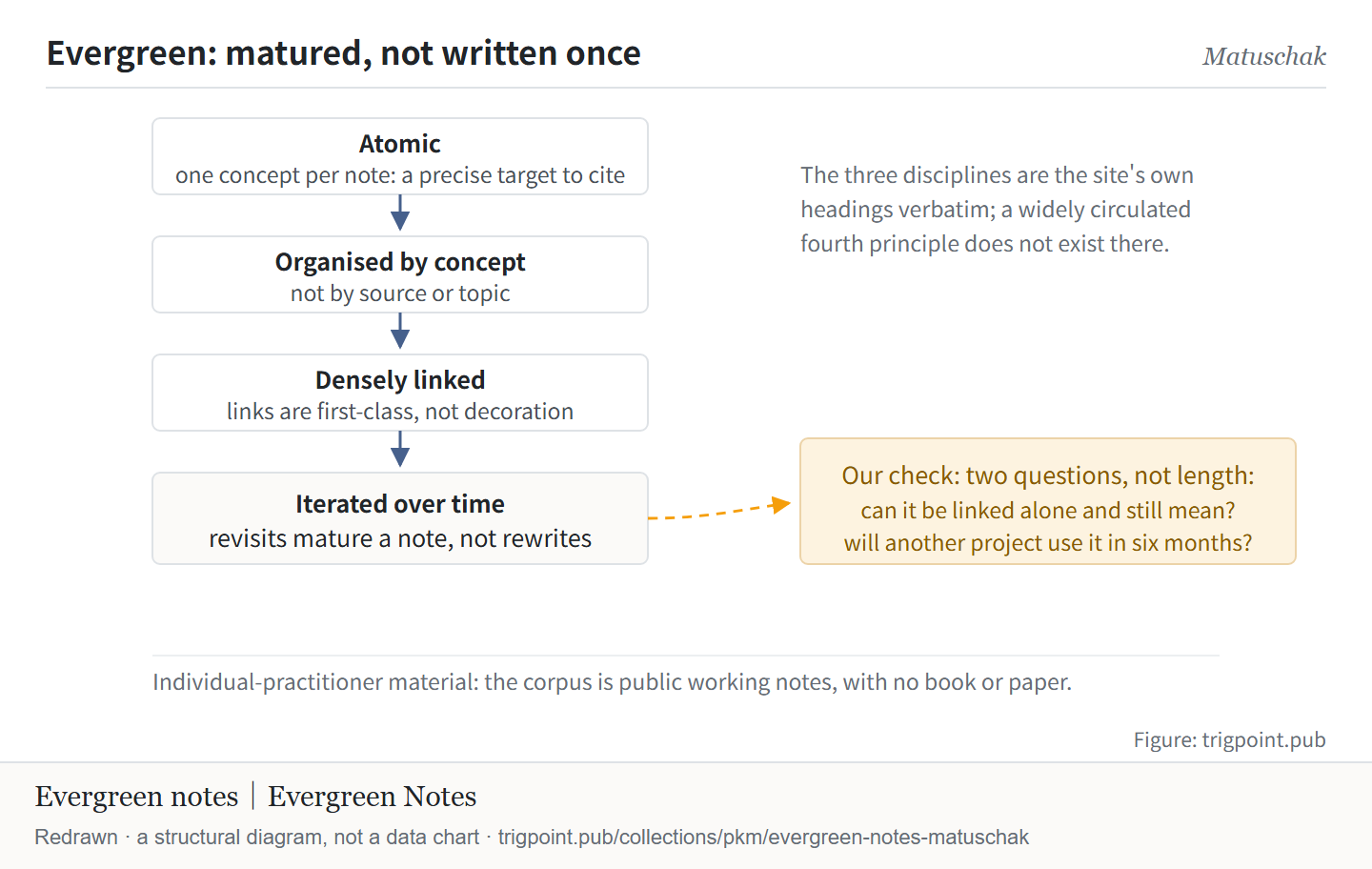
The three principles are verbatim headings on that site. A note should be atomic, one concept per node, so that a reference has a precise target, while still covering that concept as fully as possible. It should be organised by concept, since a single topic can split into several concept nodes and the concept is the unit of reuse. And it should be densely linked, with links treated as first-class rather than decorative.
He states that the concept is deeply indebted to the slip-box tradition. This is a restatement and refinement of networked note-taking for the era of digital tools, not a new invention. A fourth principle in wide circulation, that notes should be context-free, does not exist on the site; it is derivative spirit mistaken for a standalone rule; the site carries two further principle headings, neither of them context-free.
2. Why this matters to you
The intuition that more detail is better treats a note like an essay. An essay's unit is the argument; a note system's unit is the concept. Take how we work here as an example. If the useful part of an eight-hundred-word reflection is one criterion inside it, that criterion is hard to cite on its own; give it a note of its own and a link has a precise target.
We check with two questions. Can this note be linked on its own without losing its meaning? And in six months, on a different project, will it still be usable? This is our working method, not a general rule from the original site.
It also matters when to stop. The site's note "Evergreen notes should be atomic" says that fragmenting notes too far fragments the link network with them, and that where to draw the line is a matter of trade-offs with no clear test[1]Matuschak, A. Working Notes. The three disciplines checked against the primary site. Available at notes.andymatuschak.org, continuously updated; the pages carry no date of writing. This is an individual practitioner's working notes. There is no book and no paper. They are atomic, concept-oriented and densely linked, and appear as verbatim headings on the site. Attribution note: a fourth principle, “context-free”, circulates widely but was checked and does not exist on the original site. It is a common misreport.. If a concept split into pieces leaves each piece unable to say it completely, it should not be split further.
There is one position that inverts easily. Evergreen means matured, not written well the first time. Notes get there through revisits. Aiming for a perfect note at the outset tends to stop people going back to change it.
Lab cases 2 first-hand cases from our studio
Evergreen is a state, not a genre: a node is promoted only after it passes verification
We use evergreen as a state machine. A node written today counts only as distilled, and it cannot be promoted until source verification is complete. Many people read this position the other way round, taking a note to be permanent once it is long and detailed enough. Atomic, concept-oriented and densely linked are three rules about shape. When a note counts as mature is tracked in a separate state field that advances level by level, and however well written it is, an unverified note is not promoted. The full case carries the definition of each level and the conditions for promotion.
When a discipline counts as mature: the promotion gate from incubation to the main library
Promotion into the main library takes four gates. Communication studies had reached its ninth node, one short of the first gate, when a candidate came up that would make the tenth, a concept whose academic standing is contested. Taking it would clear the gate; the question was whether it belonged.
Trigpoint Pass content · includes applicable criteria
Full access to the lab cases. Trigpoint Pass ▸
How to read the source notes “Checked against the primary site” means the claim was compared with the project's own website. Definitions as of 2026-09-20.
- [1] Matuschak, A. Working Notes. https://notes.andymatuschak.org/Evergreen_notes The three disciplines checked against the primary site. Continuously updated, with no date of writing; individual practitioner working notes. ↩
Tell the editor privately: a correction, a counter-example or where it applies
An editor reviews submissions once a week. Once a note is handled, its summary and response are listed on the discussion and response record; nothing is published before then. No sign-up is needed, and the nickname may be left blank.
We have your note