Stage-based model of personal informatics
1. What happened
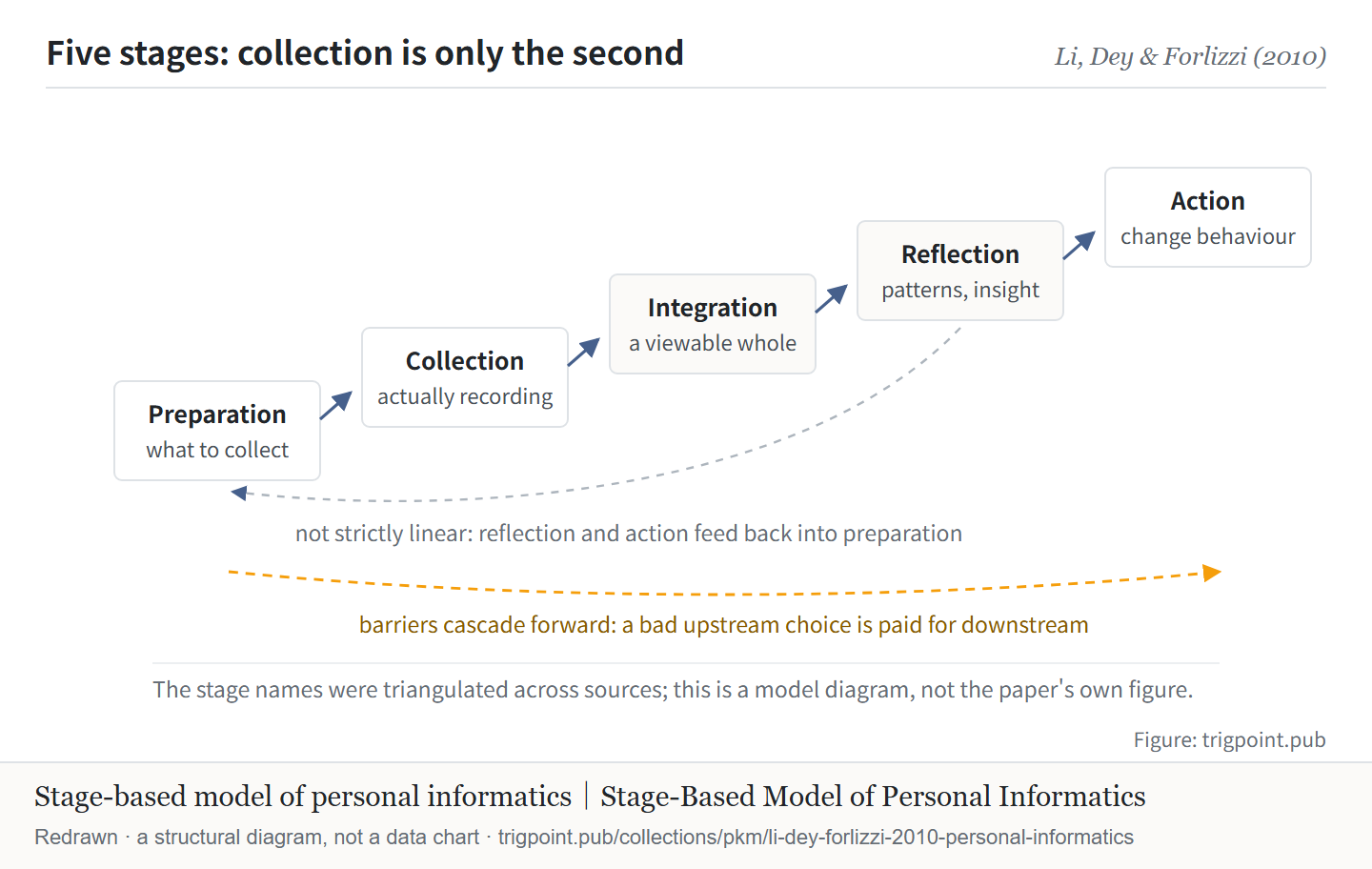
Li, Dey and Forlizzi proposed a five-stage model at a 2010 conference, built on a survey of 68 people and 11 follow-up interviews[1]Li, I., Dey, A. K., & Forlizzi, J. (2010). A Stage-Based Model of Personal Informatics Systems. CHI 2010, 557–566. DOI 10.1145/1753326.1753409. Bibliographic details cross-checked against multiple sources. Claims matched against the full text. The names of the five stages were cross-checked against the author's publication page and several indexes, and the claims were compared against the full text. Attribution note: the stage-by-stage list of barriers comes from this same paper.: preparation, deciding what to collect and which tool to use; collection, the actual recording; integration, assembling heterogeneous data into a viewable whole; reflection, finding patterns and extracting insight; and action, changing behaviour on that basis.
The model has two properties that get read past. The stages are iterative, since users change data, tools or processes as they progress. And the barriers at each stage cascade into later ones, so a wrong choice upstream is paid for downstream.
The same paper also lists the barriers stage by stage, which lets tool design intervene at a specific stage.
2. Why this matters to you
Use the five stages as a diagnostic grid. Where is your knowledge system or your self-tracking practice actually stuck?
The illusion that collecting is using comes from collection being immediately satisfying while the last three stages are not. Finishing a record feels like having done something, but integration means assembling data, reflection means holding a fixed rhythm of looking back, and action means changing behaviour. Each is a separate piece of engineering.
When designing your own system, spend the resources on the weakest stage. Buying one more collection tool usually just pushes the bottleneck further back.
The cascade property also gives you an ordering rule. Make upstream choices with downstream needs in hand: work out what you want to reflect on before deciding what to collect.
Lab cases Written only where there is evidence
No field record for this node yet.
How to read the source notes “Bibliographic details checked” means author, year, title and venue were confirmed. It does not mean the source's claims were checked. “Matched against the full text” means the claim was compared with the text of the source itself. Definitions as of 2026-09-20.
- [1] Li, I., Dey, A. K., & Forlizzi, J. (2010). A Stage-Based Model of Personal Informatics Systems. CHI 2010, 557–566. https://doi.org/10.1145/1753326.1753409 ↩
Tell the editor privately: a correction, a counter-example or where it applies
An editor reviews submissions once a week. Once a note is handled, its summary and response are listed on the discussion and response record; nothing is published before then. No sign-up is needed, and the nickname may be left blank.
We have your note