Memex
1. What happened
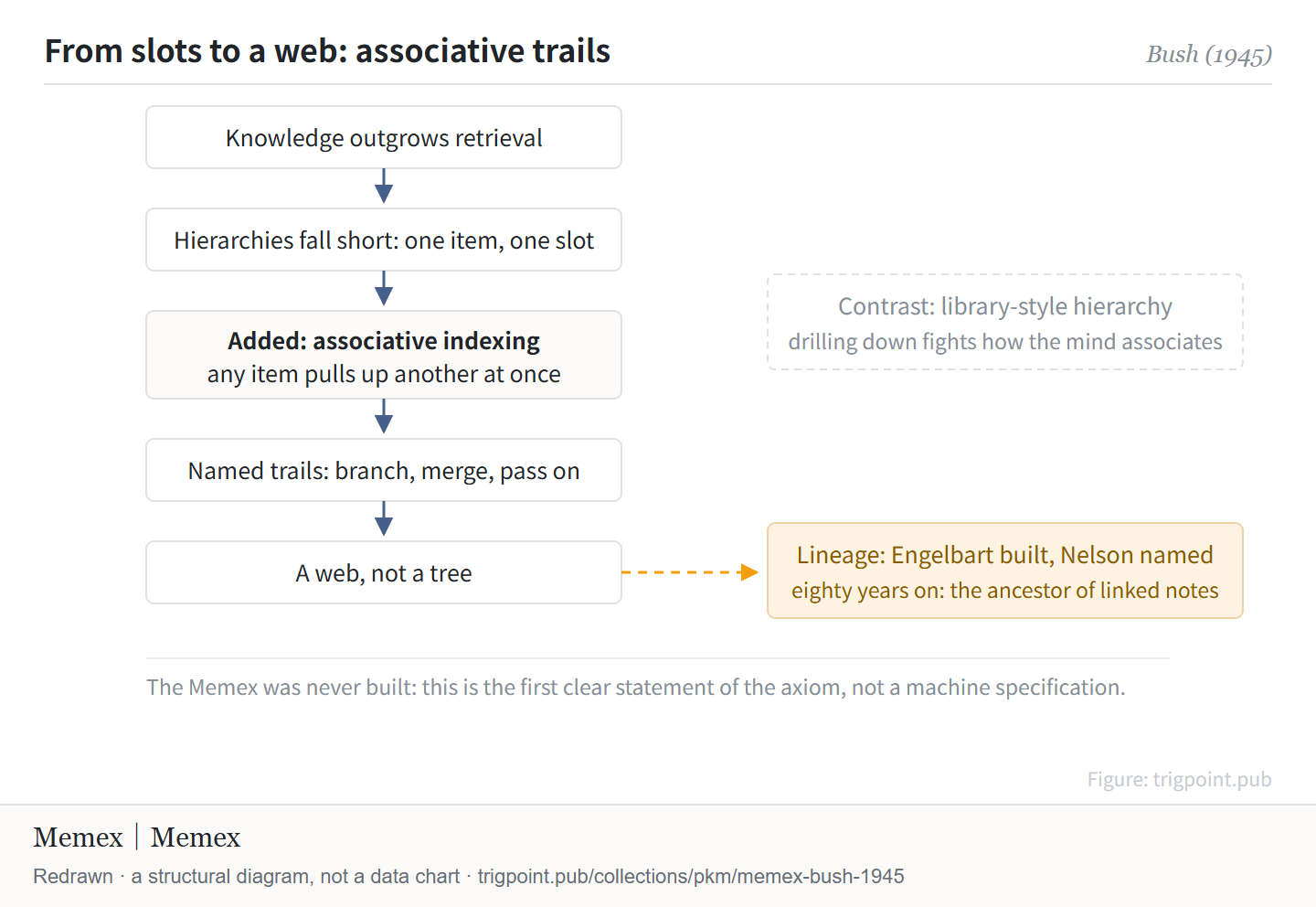
Just before the end of the Second World War, Bush published "As We May Think" in The Atlantic. Scientific knowledge was about to explode in volume, and he argued the bottleneck was retrieval rather than storage: every index is artificial, an item can only be filed in one slot, and finding it means drilling down through levels, which is not how a mind works[1]Bush, V. (1945). As We May Think. The Atlantic, 176(1), 101–108. Bibliographic details cross-checked against multiple sources. Two propositions, the Memex definition and the associative indexing proposition, were checked word for word against two web transcriptions (the Duchier 1994 edition hosted by W3C, and a PDF from the Free University of Berlin, which is a separate transcription). Neither is a scan of the print edition. A magazine article from 1945 carries no DOI, which is a structural limitation, not an omission..
He did not remove the index. Section 6 of the original says the memex still allows the record to be consulted by the usual scheme of indexing[1]Bush, V. (1945). As We May Think. The Atlantic, 176(1), 101–108. Bibliographic details cross-checked against multiple sources. Two propositions, the Memex definition and the associative indexing proposition, were checked word for word against two web transcriptions (the Duchier 1994 edition hosted by W3C, and a PDF from the Free University of Berlin, which is a separate transcription). Neither is a scan of the print edition. A magazine article from 1945 carries no DOI, which is a structural limitation, not an omission.. What he added was associative indexing. The user places two documents side by side, presses a key, and creates a named trail; afterwards one key jumps from the first to the next. Trails can branch, merge, persist, and be handed to someone else[1]Bush, V. (1945). As We May Think. The Atlantic, 176(1), 101–108. Bibliographic details cross-checked against multiple sources. Two propositions, the Memex definition and the associative indexing proposition, were checked word for word against two web transcriptions (the Duchier 1994 edition hosted by W3C, and a PDF from the Free University of Berlin, which is a separate transcription). Neither is a scan of the print edition. A magazine article from 1945 carries no DOI, which is a structural limitation, not an omission.. The Memex was a thought experiment and was never built. It is a design vision, not an engineered product.
2. Why this matters to you
Every time you hesitate over which folder a note belongs in, you are standing on the crack Bush identified. Hierarchical classification demands that each thing have exactly one home. Associative links allow one thing to have any number of routes leading to it. The core pitch of modern bidirectional-link tools was already sketched by Bush eighty years ago.
So the question worth asking of a tool is not whether it has links. It is whether retrieval can only run on classification decided in advance, or can also follow the trails you laid yourself. The Memex was about the second, but it did not throw away the first. This is how we read it here, not a claim Bush made about choosing tools.
Lab cases Written only where there is evidence
No field record for this node yet.
- 2026-10-10 · The page said associative indexing replaces library-style hierarchical indexing. Section 6 of the original says the memex still allows the record to be consulted by the usual scheme of indexing; associative indexing is a further way of retrieval added alongside it. The page now says associative trails supply routes that hierarchical indexing cannot, and the body points to the passage.
How to read the source notes “Bibliographic details checked” means author, year, title and venue were confirmed. It does not mean the source's claims were checked. Definitions as of 2026-09-20.
- [1] Bush, V. (1945). As We May Think. The Atlantic, 176(1), 101–108. https://www.theatlantic.com/magazine/archive/1945/07/as-we-may-think/303881/ ↩
- [2] Nelson, T. H. (1965). Complex Information Processing: A File Structure for the Complex, the Changing and the Indeterminate. Proceedings of the ACM 20th National Conference. https://doi.org/10.1145/800197.806036 ↩
Tell the editor privately: a correction, a counter-example or where it applies
An editor reviews submissions once a week. Once a note is handled, its summary and response are listed on the discussion and response record; nothing is published before then. No sign-up is needed, and the nickname may be left blank.
We have your note