Personal information management
1. What happened
The 2016 monograph from Bergman and Whittaker synthesises research on personal information management[1]Bergman, O., & Whittaker, S. (2016). The Science of Managing Our Digital Stuff. Cambridge, MA: MIT Press. ISBN 9780262035170. Bibliographic details cross-checked against multiple sources. Consistent with the abstract. The criticism of folders is a near-paraphrase of the publisher's blurb, not a page-anchored quotation..
Folders take a standard criticism: information hides inside nested folders, you have to remember the exact location, and information scientists therefore argue that search is more flexible. The authors see it differently: search and tags work best for public information and less well for personal information, and the user-subjective approach they argue for does not replace folders.
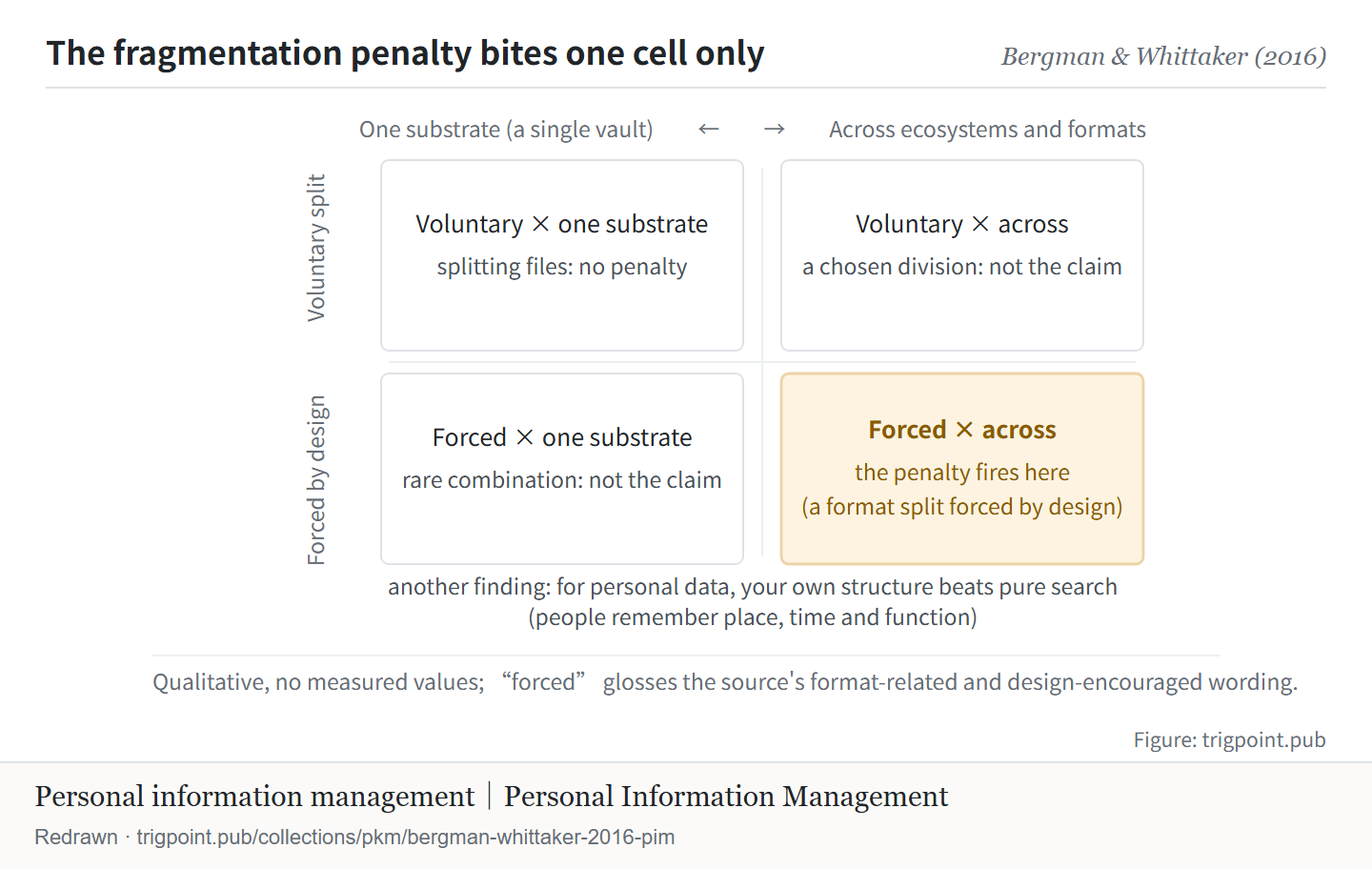
The fragmentation claim gets narrowed by evidence in the same way. A classic definition, from a 2006 CHI paper, is that material for one project is stored in separate format-related collections, documents in one place, mail in another, bookmarks in a third; a 20-user study found that whether people fragment depends on what the interface design encourages[2]Bergman, O., Beyth-Marom, R., & Nachmias, R. (2006). The project fragmentation problem in personal information management. CHI 2006, 271–274. DOI 10.1145/1124772.1124813. Bibliographic details cross-checked against multiple sources. Consistent with the abstract. This paper gives a classic definition of the fragmentation problem: the material for one project is stored separately in collections divided by format (a study of 20 people).. The problem lies in a split the system design forces, not in having many files.
2. Why this matters to you
Two design consequences. First, organising your own knowledge base is not wasted time: you are building an index for your own memory, which is exactly the part search cannot replace.
Second, run the scope test before deciding whether to merge tools. This particular definition covers splits that cross ecosystems and are forced by format. Splitting across several files inside one substrate, several files for different purposes within one vault, is not covered by the definition.
Treating a design claim as universal makes you reorganise a system to avoid a cost that is not there. Reading the boundary correctly turns "how many tools is too many" from a matter of taste into a decidable question.
One honest addition: that definition covers only the cross-tool kind. It does not mean that any internal arrangement is free.
Verification record
Records how far each claim was checked, not a guarantee that it is true.
The bibliographic layer verifies as firmly as anything here: the publisher's page, several booksellers and a journal review agree on the authors' institutions, the ISBN, the page count and the book's three-part structure[1]Bergman, O., & Whittaker, S. (2016). The Science of Managing Our Digital Stuff. Cambridge, MA: MIT Press. ISBN 9780262035170. Bibliographic details cross-checked against multiple sources. Consistent with the abstract. The criticism of folders is a near-paraphrase of the publisher's blurb, not a page-anchored quotation..
This page was not checked page by page against the book's full text, so two pieces of wording in the body are deliberately not promoted, and this page marks both.
The frequently quoted criticism of folders is in fact a near-paraphrase of the publisher's blurb rather than a page-anchorable quotation, so this page keeps it as paraphrase and does not put it in quotation marks.
And "forced" is a reasonable but sharpened gloss on the source's format-related and design-encouraged wording. It is not the authors' own term and should not be cited as their verbatim phrasing.
A classic definition of the fragmentation problem has a separate source, a 2006 conference paper, and the 2016 monograph is the milestone of empirical synthesis. Cite the two layers separately[2]Bergman, O., Beyth-Marom, R., & Nachmias, R. (2006). The project fragmentation problem in personal information management. CHI 2006, 271–274. DOI 10.1145/1124772.1124813. Bibliographic details cross-checked against multiple sources. Consistent with the abstract. This paper gives a classic definition of the fragmentation problem: the material for one project is stored separately in collections divided by format (a study of 20 people)..
Verification layer · Counter-examples and failure boundaries
Three misuses lose the boundary.
First, applying the fragmentation definition to voluntary splitting across files. The scope condition on that claim is a cross-ecosystem, cross-format split forced by system design, and several files organised by purpose within one substrate is outside the definition[2]Bergman, O., Beyth-Marom, R., & Nachmias, R. (2006). The project fragmentation problem in personal information management. CHI 2006, 271–274. DOI 10.1145/1124772.1124813. Bibliographic details cross-checked against multiple sources. Consistent with the abstract. This paper gives a classic definition of the fragmentation problem: the material for one project is stored separately in collections divided by format (a study of 20 people)..
A qualification belongs here, or the exclusion gets read as an exemption: falling outside that definition is not the same as internal splitting being free.
Second, citing "forced" as the authors' verbatim wording.
Third, citing the folder criticism as a page-anchorable quotation from the original[1]Bergman, O., & Whittaker, S. (2016). The Science of Managing Our Digital Stuff. Cambridge, MA: MIT Press. ISBN 9780262035170. Bibliographic details cross-checked against multiple sources. Consistent with the abstract. The criticism of folders is a near-paraphrase of the publisher's blurb, not a page-anchored quotation..
One failure boundary: this page was not checked page by page against the book's full text, so any use that needs its wording or a page number cannot rest on it.
Lab cases Written only where there is evidence
No field record for this node yet.
How to read the source notes “Bibliographic details checked” means author, year, title and venue were confirmed. It does not mean the source's claims were checked. “Consistent with the abstract” means the claim agrees with the paper's abstract. It does not include sentence-by-sentence checking against the full text. Definitions as of 2026-09-20.
- [1] Bergman, O., & Whittaker, S. (2016). The Science of Managing Our Digital Stuff. Cambridge, MA: MIT Press. https://doi.org/10.7551/mitpress/9780262035170.001.0001 ↩
- [2] Bergman, O., Beyth-Marom, R., & Nachmias, R. (2006). The project fragmentation problem in personal information management. CHI 2006, 271–274. https://doi.org/10.1145/1124772.1124813 ↩
Tell the editor privately: a correction, a counter-example or where it applies
An editor reviews submissions once a week. Once a note is handled, its summary and response are listed on the discussion and response record; nothing is published before then. No sign-up is needed, and the nickname may be left blank.
We have your note