CODE method
1. What happened
Treating the four steps as a single pass that ends in delivery misses two structures in the book. Tiago Forte's Building a Second Brain, published in 2022, sets out its method as four steps, one per chapter across chapters 4 to 7[1]Forte, T. (2022). Building a Second Brain. Atria Books / Simon & Schuster. ISBN 9781982167387. Bibliographic details cross-checked against multiple sources. The two-sided mapping in the chapter 8 passage on divergence and convergence (approx. p.178–180) follows secondary accounts that agree with one another..
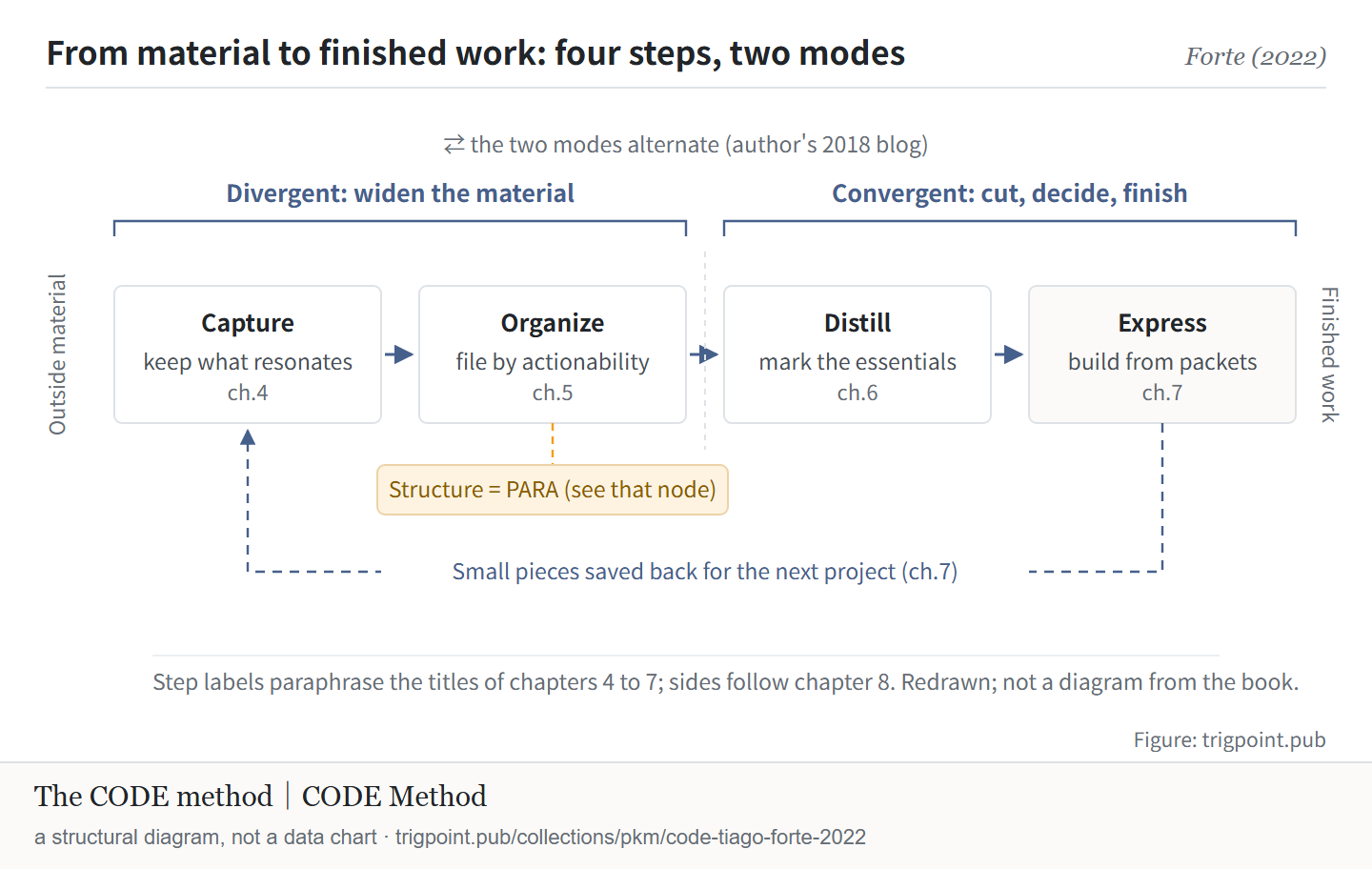
Capture keeps only material that strikes you. Organize files it by actionability rather than by topic, using the book's own PARA structure. Distill applies progressive summarisation, marking what matters in layers so it can be picked up at a glance later. Express produces work in intermediate packets: a finished piece is assembled from existing small pieces, which are saved back and can be reused in the next project[1]Forte, T. (2022). Building a Second Brain. Atria Books / Simon & Schuster. ISBN 9781982167387. Bibliographic details cross-checked against multiple sources. The two-sided mapping in the chapter 8 passage on divergence and convergence (approx. p.178–180) follows secondary accounts that agree with one another..
Chapter 8, The Art of Creative Execution, then splits the four steps into two working modes. Capture and Organize are divergent and widen the material available. Distill and Express are convergent: they cut, decide and produce the finished piece[1]Forte, T. (2022). Building a Second Brain. Atria Books / Simon & Schuster. ISBN 9781982167387. Bibliographic details cross-checked against multiple sources. The two-sided mapping in the chapter 8 passage on divergence and convergence (approx. p.178–180) follows secondary accounts that agree with one another.. In a 2018 blog post the author describes the two modes as alternating, and says the model comes from Design Thinking[2]Forte Labs. Bibliographic details checked against the official record. The two blog statements and the timing of the acronym checked against the primary site. The author's blog (fortelabs.com) and @fortelabs posts. The statements that the two modes alternate and that the model comes from Design Thinking are both from the blog, not from the book..
2. Why this matters to you
A note system usually stalls after collecting. Material keeps piling up and finished work does not appear. CODE separates storing from delivering into four steps with distinct jobs, and each can be checked on its own: has this material been distilled yet? Have the distilled points gone into a piece of finished work?
The chapter 8 split adds one more test. While you are still widening the range of options, you are diverging. Once you start cutting and deciding, you are converging.
One boundary to keep. CODE covers how material becomes finished work. Where things are kept in the Organize step is answered by PARA, which this page does not restate; see the PARA node.
Lab cases One first-hand case from our studio
One figure, two outlets: the node's own figure goes straight into the video
Figure A on this page is a small piece we arranged along the lines of intermediate packets. There are two rules. The node text is finalised first, and the figure is drawn from that text. When the video needs the same figure, it takes the node's original rather than drawing a separate version. The reason is a single source: every label in the figure traces back to the text and its references, so the video and the site cannot drift apart. Only the first half is done so far. The figure has been drawn with the node, but the video has not yet switched to it, so whether the reuse actually saves work, and whether the two outlets stay consistent, has not been observed.
Full access to the lab cases. Trigpoint Pass ▸
How to read the source notes “Bibliographic details checked” means author, year, title and venue were confirmed. It does not mean the source's claims were checked. “Checked against the primary site” means the claim was compared with the project's own website. “Follows secondary accounts” means the claim rests on sources that report it, not on the original document. Definitions as of 2026-09-20.
- [1] Forte, T. (2022). Building a Second Brain: A Proven Method to Organize Your Digital Life and Unlock Your Creative Potential. New York: Atria Books / Simon & Schuster. https://www.simonandschuster.com/books/Building-a-Second-Brain/Tiago-Forte/9781982167387 Bibliographic details cross-checked against multiple sources. The two-sided mapping in the chapter 8 passage on divergence and convergence (approx. p.178–180) follows secondary accounts that agree with one another. ↩
- [2] Forte Labs blog. Divergence and Convergence: The Two Fundamental Stages of the Creative Process (2022-05-16); Just-In-Time PM #8: Divergence and Convergence (2018-05-23). https://fortelabs.com/blog/ Bibliographic details checked against the official record. The two blog statements and the timing of the acronym checked against the primary site.
- [3] Guilford, J. P. (1956). The structure of intellect. Psychological Bulletin, 53(4), 267–293. https://doi.org/10.1037/h0040755 Bibliographic details checked against the publisher's record. The claim that 1956 is the earliest published technical use follows secondary accounts that agree with one another.
- [4] Design Council (UK). History of the Double Diamond. https://www.designcouncil.org.uk/ Bibliographic details checked against the official record. The 2003 and 2004 dates and the use of the two terms checked against the primary site.
Tell the editor privately: a correction, a counter-example or where it applies
An editor reviews submissions once a week. Once a note is handled, its summary and response are listed on the discussion and response record; nothing is published before then. No sign-up is needed, and the nickname may be left blank.
We have your note