LYT and maps of content
1. What happened
Milo released the first version of his vault template in May 2020, later renamed, and popularised the term map of content in the bidirectional-link tool community[1]Milo, N. Linking Your Thinking. Bibliographic details cross-checked against multiple sources. The LYT name and the MOC definition checked against the primary site. Available at linkingyourthinking.com. This is individual practitioner content: YouTube, templates and paid workshops. There is no book and no paper. The first version, the LYT Kit, dates from May 2020. It was later renamed Ideaverse. The line that an MOC is not a folder is a paraphrase of the concept, and the exact segment where it first appeared has not been anchored..
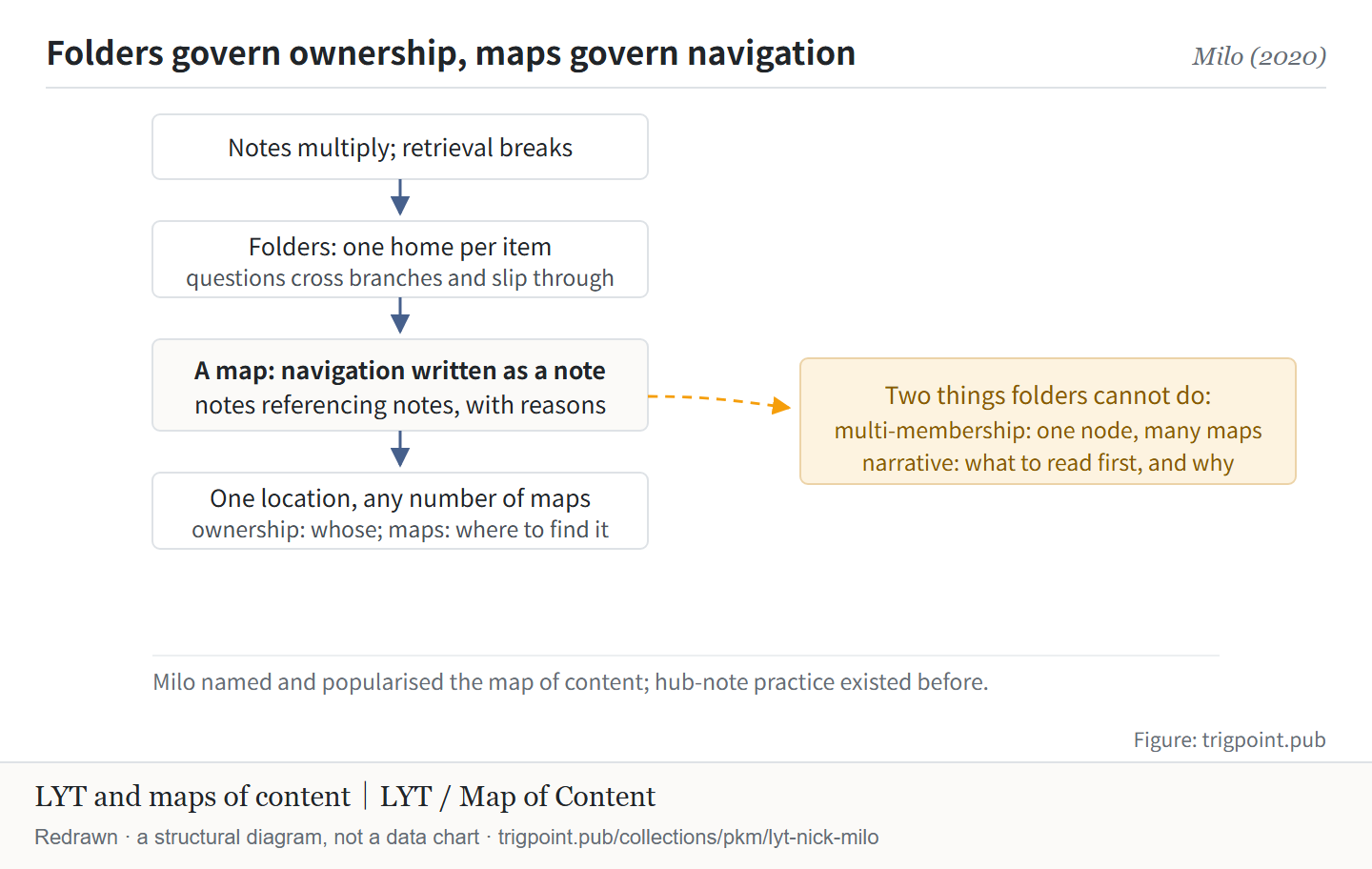
What it answers is the retrieval problem that appears once notes multiply. A folder tree demands a single home, but real questions routinely cut across branches, while tags are too flat and search requires knowing what you are looking for first.
The map's answer is to write the navigation itself as a note. One node references a set of related nodes, with a note on why they are related and in what order to read them. Maps are first-class: there can be many, they can reference each other, and they can be edited when they go stale. A folder can do none of those.
2. Why this matters to you
Reading it as a folder with a new name misses two structural properties.
The first is multiple membership. The same node joins different maps according to different questions, without copying and without having to choose between two folders.
The second is the narrative layer. A map can tell you which to read first and why these belong together. Folder ordering cannot do that.
The practical division of labour: location answers who owns this node and is always singular; a map answers which nodes to read for this class of question and can be unlimited. Mix the two layers and the vault collapses once it grows.
Lab cases 2 first-hand cases from our studio
Storage follows the branch, use follows the index: one library, two layers of map
Our knowledge base maintains two layers of map at once. The discipline layer has one overview per subject, answering what is in this subject. The problem-domain layer has a set of cross-subject indexes, answering where to look for this kind of question. Where something is stored is decided by ownership, and every node has exactly one home; but the same node may appear on any number of maps. A folder cannot answer this question spans three subjects. A map can. The full case carries the division of labour between the two layers, when to open a new map, and how a map is kept from going stale.
When a map is opened: the criteria for starting and retiring a navigation surface
In April 2026 we opened a layer of “maps”. By July the whole layer had produced one pilot map, had been frozen for 14 weeks and sat on no navigation path. Finish it, wire it into navigation, leave it as it is, or close it?
Trigpoint Pass content · includes applicable criteria
Full access to the lab cases. Trigpoint Pass ▸
How to read the source notes “Bibliographic details checked” means author, year, title and venue were confirmed. It does not mean the source's claims were checked. “Checked against the primary site” means the claim was compared with the project's own website. Definitions as of 2026-09-20.
- [1] Milo, N. Linking Your Thinking. https://www.linkingyourthinking.com/ Bibliographic details cross-checked against multiple sources. The LYT name and the MOC definition checked against the primary site. First version, LYT Kit, 2020-05, later renamed Ideaverse; individual practitioner content. ↩
Tell the editor privately: a correction, a counter-example or where it applies
An editor reviews submissions once a week. Once a note is handled, its summary and response are listed on the discussion and response record; nothing is published before then. No sign-up is needed, and the nickname may be left blank.
We have your note