Diátaxis
1. What happened
Procida published early versions of these ideas while at Divio between 2014 and 2021, later judged that several aspects of them were wrong, then took the work independent and kept refining it on its own site[1]Procida, D. Diátaxis. The two-axis derivation and the notes on the Divio years and 2021 checked against the primary site. Available at diataxis.fr. The home page, the foundations page and the colophon of the primary site were checked. The names and etymology of the four types match word for word. Attribution note: an early version was published during the author's time at Divio (2014–2021), and Procida later acknowledged that he had misjudged parts of it. “2021” refers to a Software Sustainability Institute fellowship, not the year of first publication. The breadth of adoption is the site's own account and has not been verified by a third party..
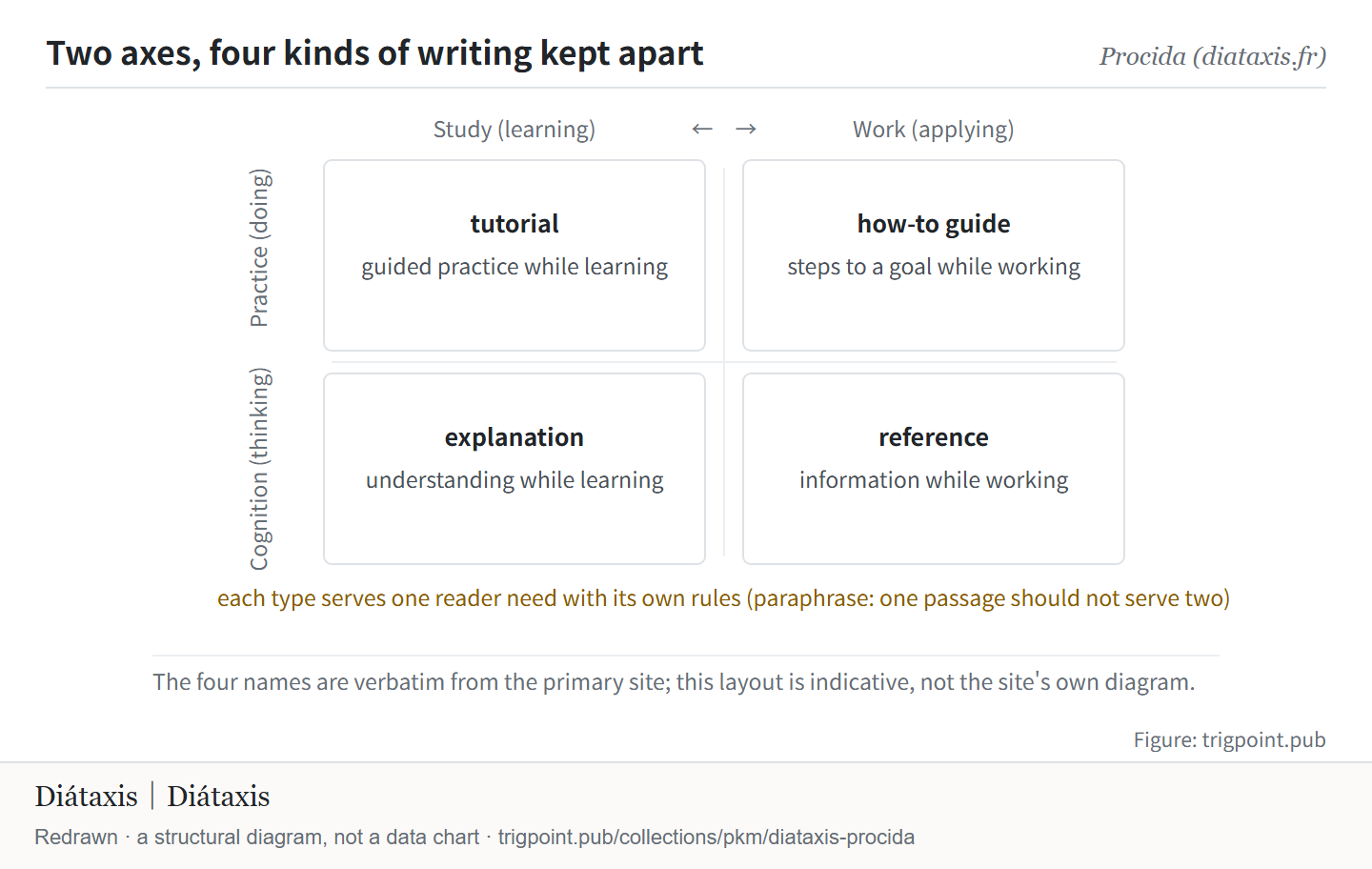
The derivation is not an arbitrary taxonomy. Reader situations divide along two axes, practice against cognition, knowing-how against knowing-that, and studying against working. Two by two yields four types, each serving one need with its own writing criteria.
A tutorial is guided practice while learning. A how-to is the steps to an outcome while working. Reference is looking information up while working. Explanation is seeking understanding while learning.
The failure mode of mixing them is one everybody has seen: a "tutorial" that opens by teaching operations, turns into a parameter table in the middle, and closes with design philosophy, so every kind of reader has to skim.
2. Why this matters to you
To decide whether a document should be split, ask which quadrant the reader is in right now, not which topic the content belongs to.
In this site's framing of knowledge system design, this is also one of three questions that routinely get answered together when they should not be: where things go, which is organisation; how you find them again, which is navigation; and what type to write, which is this framework. The three are orthogonal and answering them jointly makes each one worse.
Carrying this into personal notes is our practice, not a rule of the framework. We keep the operating manual and the conceptual explanation we write for ourselves in two files, because they update on different rhythms and fail in different ways. The framework itself asks that one passage not serve two needs at once; it does not prescribe separate files[1]Procida, D. Diátaxis. The two-axis derivation and the notes on the Divio years and 2021 checked against the primary site. Available at diataxis.fr. The home page, the foundations page and the colophon of the primary site were checked. The names and etymology of the four types match word for word. Attribution note: an early version was published during the author's time at Divio (2014–2021), and Procida later acknowledged that he had misjudged parts of it. “2021” refers to a Software Sustainability Institute fellowship, not the year of first publication. The breadth of adoption is the site's own account and has not been verified by a third party..
Lab cases Written only where there is evidence
No field record for this node yet.
How to read the source notes “Checked against the primary site” means the claim was compared with the project's own website. Definitions as of 2026-09-20.
- [1] Procida, D. Diátaxis. https://diataxis.fr/ The two-axis derivation and the notes on the Divio years and 2021 checked against the primary site. An early version was published during the author's time at Divio, 2014–2021. ↩
Tell the editor privately: a correction, a counter-example or where it applies
An editor reviews submissions once a week. Once a note is handled, its summary and response are listed on the discussion and response record; nothing is published before then. No sign-up is needed, and the nickname may be left blank.
We have your note