In three sentences
The first question in personal organisation is not what topic this belongs to. It is when you will need it. PARA arranges the answer into four tiers ordered by actionability: Projects are short-term efforts with a goal, Areas need ongoing attention, Resources are held for reference, Archives are no longer active. The same structure mirrors across every tool. Classification serves action rather than collection.
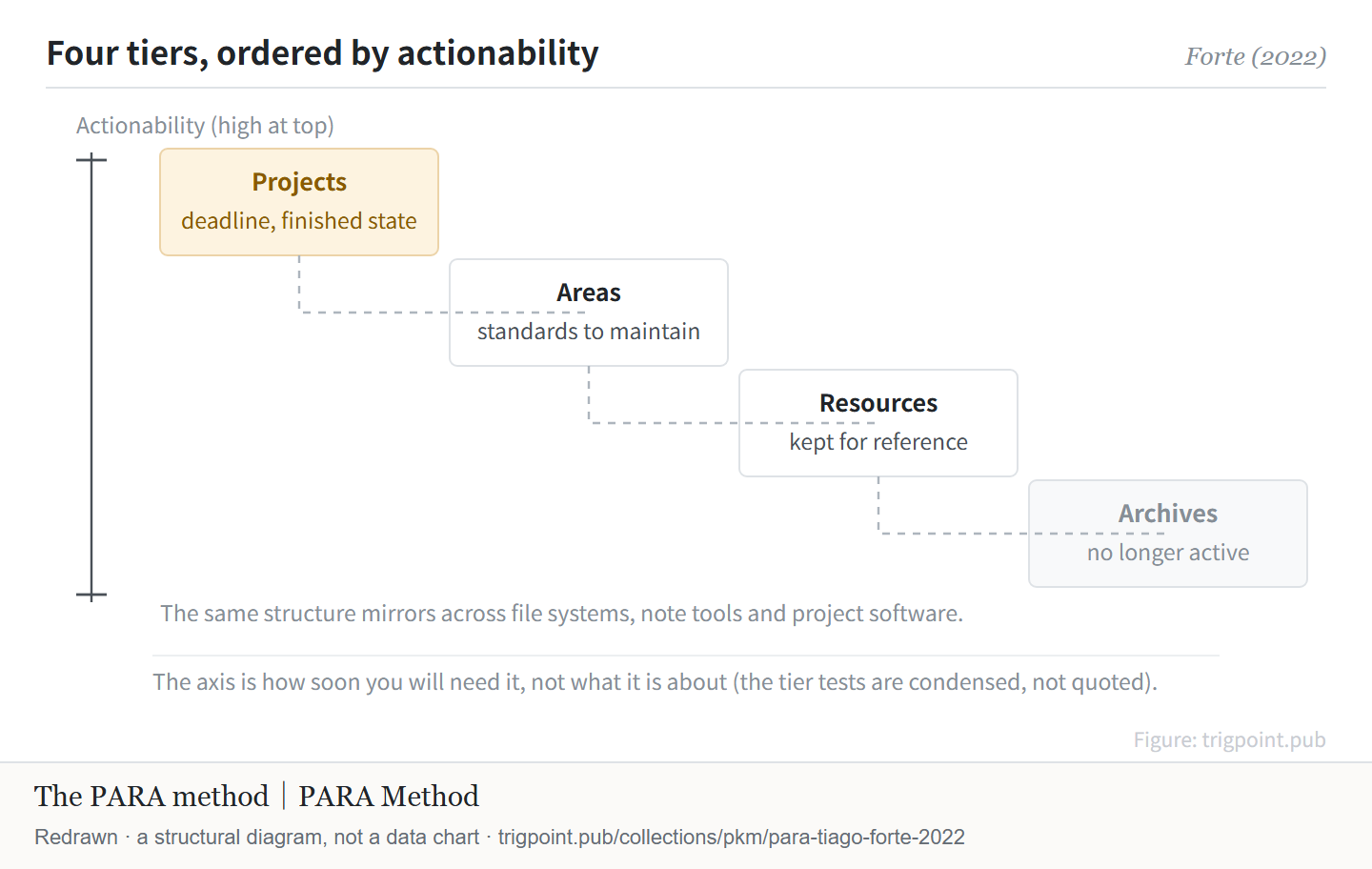
Figure 1 · Four tiers ordered by actionability, highest first: Projects as short-term efforts with a goal, Areas needing ongoing attention, Resources kept for reference, Archives no longer active. The axis is how soon you will need it, not what it is about. Redrawn; not a reproduction of the book's own diagram. View full size ▸Share PNG ▸
Forte first set out PARA in a 2017 online post (month not verified) and systematised it in Building a Second Brain in 2022[2]Forte Labs. Bibliographic details checked against the official record. The \"organize by actionability\" wording and the four tier names checked against the primary site. Blog, available at fortelabs.com/blog/para. Attribution note: PARA first appeared online in 2017 (month not verified). The current online version is a 2023 republication..
His diagnosis: filing by topic like a librarian produces a cabinet that looks tidy but cannot answer the question you actually have mid-task, which is where the material relevant to the thing in front of me is.
Attribution where due: PARA first appeared online in 2017, and the 2022 book is the milestone for systematisation and reach rather than the year of origin, so a citation to 2022 refers to the book. The expansion is usually given as the plural Archives; the author's spoken interviews and some pages on his own site have used the singular. Organise by actionability is his own phrase, while the commonly appended contrast about context does not appear on his page and reads as a paraphrase against a different productivity system; the contrast on his page is with topic-based filing. Keep the original phrase and the paraphrase apart.
2. Why this matters to you
You test an organisation system not by how tidy it is but by whether it can hand you the relevant material halfway through a task. Filing by topic is most comfortable when collecting and slowest when acting. Filing by actionability is the reverse.
It also comes with an honest decay path. A finished project drops to Archives, and an area nobody is maintaining a standard for has in fact stopped. Topic-based filing lets expired things live respectably where they are. One question about actionability exposes them immediately.
One boundary to keep. PARA governs where things go, not how they link. It does not compete with networked notes; it divides labour with them. One answers where something lives, the other answers how the concepts connect.
Verification layer · Members
The guided layer of this node is open to all readers.
Verification details and failure boundaries are for members.
Reverse engineering: putting the whole studio's task list back into four layers
At intervals we reassign every role's task list back into Projects, Areas, Resources and Archives. The most valuable finding is never a miscategorisation. It is the two things a topic-shaped list hides: tasks hanging in mid-air that belong to no project, and things marked as in progress that nobody has maintained a standard for and that are in fact Archives. One question about actionability, can this be moved forward right now, brings both classes into view immediately. The full case carries the reassignment steps, the criteria table and the spot-check cadence.
02
Trigpoint PassField record · 2026-08
Classification does not run on self-discipline: how the coverage check became a script
Classification is still a human judgement; whether that judgement reached the record is left to checking programs. One day the start-of-session surface showed “✓ nothing to clear” for four roles, while it could not read the date of a single work line. What should be done with that green tick?
Trigpoint Pass content · includes an applicable list
What the four layers cannot catch: where cross-cutting work goes
A toolkit's content had been finished for three weeks and was still unshipped: its two legs hung on two different work lines, with no single owning surface. PARA assumes every item has one home; where should cross-cutting work go so that someone closes it?
How to read the source notes “Bibliographic details checked” means author, year, title and venue were confirmed. It does not mean the source's claims were checked. “Checked against the primary site” means the claim was compared with the project's own website. “Follows secondary accounts” means the claim rests on sources that report it, not on the original document. Definitions as of 2026-09-20.
[2] Forte Labs blog. The PARA Method: The Simple System for Organizing Your Digital Life in Seconds. https://fortelabs.com/blog/para/ Bibliographic details checked against the official record. The \"organize by actionability\" wording and the four tier names checked against the primary site. First published in 2017; 2023 republished version.
Tell the editor privately: a correction, a counter-example or where it applies
An editor reviews submissions once a week. Once a note is handled, its summary and response are listed on the discussion and response record; nothing is published before then. No sign-up is needed, and the nickname may be left blank.