Personal kanban
1. What happened
Kanban comes from the Toyota production line: a signalling mechanism that landed around 1953, using physical cards to control the flow of work in progress, and one of the core components of lean production[2]Toyota Production System: Beyond Large-Scale Production. Productivity Press. Bibliographic details confirmed by two sources. Ohno, T. (1978; English translation 1988). The kanban mechanism landed on the Toyota production line around 1953. The broader Toyota Production System developed from around 1948..
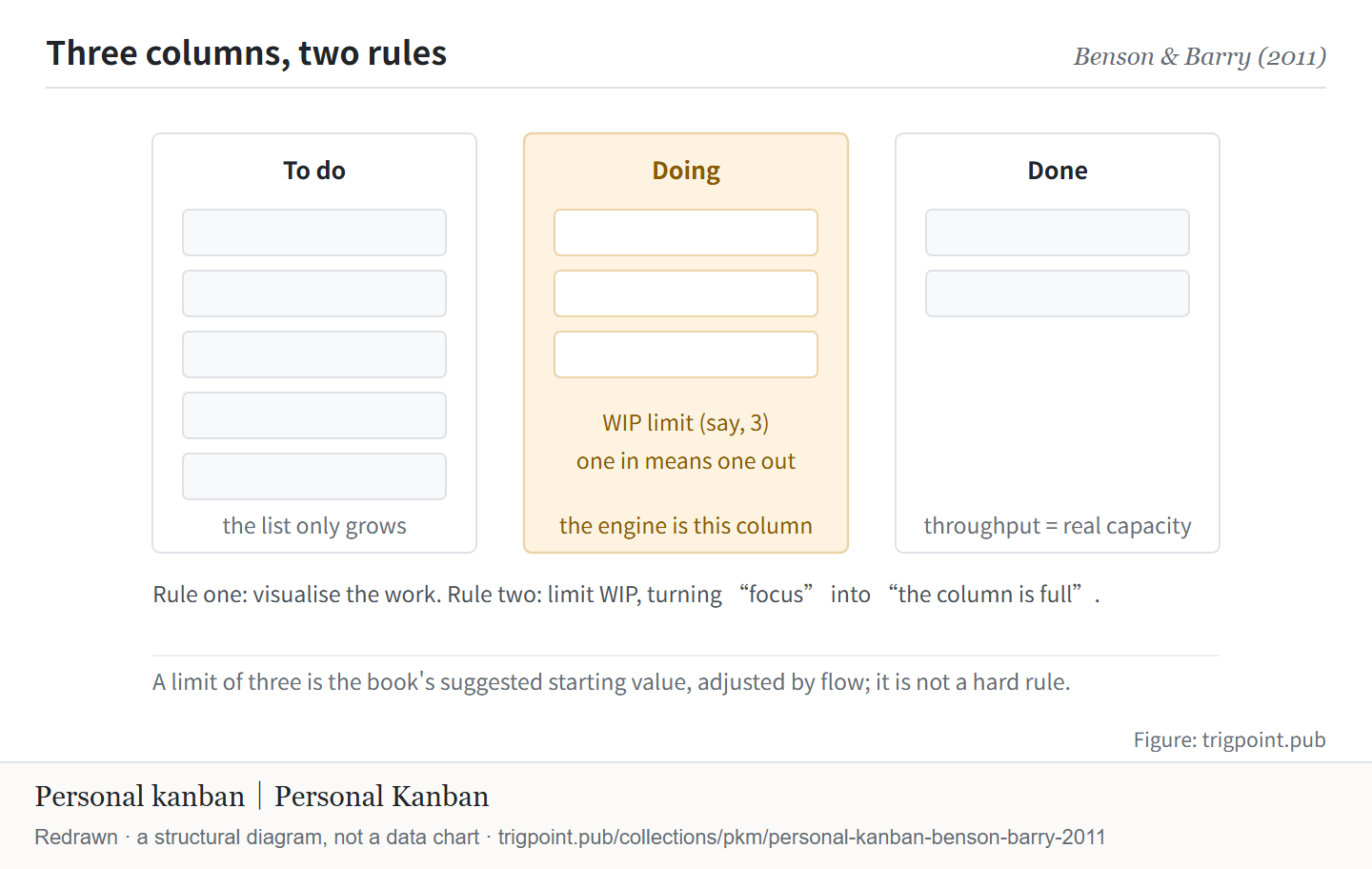
Anderson's 2010 book systematised it as a change method for software development[3]Anderson, D. J. (2010). Kanban: Successful Evolutionary Change for Your Technology Business. Blue Hole Press. Bibliographic details confirmed by two sources. This is the bridge by which kanban was transplanted from manufacturing to software development.. In 2011 Benson and Barry made it personal: one board, three columns of to do, doing and done, and two rules, visualise the work and limit work in progress[1]Benson, J., & Barry, T. D. (2011). Personal Kanban: Mapping Work | Navigating Life. Modus Cooperandi Press. ISBN 9781453802267. Bibliographic details cross-checked against multiple sources. The wording of the two core rules checked against the primary site. A wrong ISBN that does not match this book is in circulation. The suggested starting limit of three is the book's recommended value, not a hard rule.. The book suggests an individual start at a limit of three and adjust to their own throughput. That is a recommendation, not a hard rule.
The insight in the personal version is that overload in knowledge work is usually not too many tasks. It is too many tasks open at once, each one charging a switching tax.
2. Why this matters to you
The difference between a to-do list and a board is the difference between a list and flow control. A list only grows. The doing column has a ceiling, so something has to leave before something new can enter.
That constraint turns a vague question of character, be more focused, into a mechanical question of structure, the column is full.
The largest trap in practice is treating the limit as decoration. Eight cards in the column with a limit of three written above it is the same as having no limit. A limit that bites usually needs a surface that forces you to declare, rather than a daily reminder to yourself.
Visualising the work is not decorative either. A queue you can see gets settled. A queue you cannot see just ferments.
Lab cases 2 first-hand cases from our studio
Limiting work in progress without self-discipline: the three oldest open threads pushed in front of you
We do not limit work in progress by self-discipline, we limit it through the interface: the start-up surface for each role renders the three oldest open threads automatically and requires a position on each one, continue, defer with a date that must be written, or close. Before that surface existed, open threads simply accumulated quietly. With it, how much is being carried at once became a question that has to be answered every day. The full case carries the design of the surface, the rules for the deferral marker, and why threads are never closed automatically.
The weekly review of work in progress: three questions beyond the number
Once a week we read how many items are in progress at once, with a limit of 3. Then we found two places that both said “limit 3” with denominators sevenfold apart. How should the number be counted and read? The three readings below were left behind only after reading it wrong.
Trigpoint Pass content · includes an applicable list
Full access to the lab cases. Trigpoint Pass ▸
How to read the source notes “Bibliographic details checked” means author, year, title and venue were confirmed. It does not mean the source's claims were checked. “Checked against the primary site” means the claim was compared with the project's own website. Definitions as of 2026-09-20.
- [1] Benson, J., & Barry, T. D. (2011). Personal Kanban: Mapping Work | Navigating Life. Seattle: Modus Cooperandi Press. https://moduscooperandi.com/modus-cooperandi/blog/personal-kanban-the-book ↩
- [2] Ohno, T. (1988). Toyota Production System: Beyond Large-Scale Production. Cambridge, MA: Productivity Press. 2019 digital reprint: https://doi.org/10.4324/9780429273018
- [3] Anderson, D. J. (2010). Kanban: Successful Evolutionary Change for Your Technology Business. Blue Hole Press. ↩
- [4] Womack, J. P., Jones, D. T., & Roos, D. (1990). The Machine That Changed the World. Rawson Associates.
Tell the editor privately: a correction, a counter-example or where it applies
An editor reviews submissions once a week. Once a note is handled, its summary and response are listed on the discussion and response record; nothing is published before then. No sign-up is needed, and the nickname may be left blank.
We have your note