Members' shelf
All 9 nodes on Naming & Classification are for members only.
Pay with the email you sign in with here, so the Pass is linked to this account.
Members' shelf
All 16 nodes on System Protection & Threat Modeling are for members only.
Pay with the email you sign in with here, so the Pass is linked to this account.
Fabricated citations
- Holds when
- When a model hands you a neatly formatted list of references or cases, and you must decide whether to cite them.
- Evidence
- Empirical finding; Checked against the sources
- Breaks down when
- Filing it under the existing hallucination types without saying it is an extrapolation; those types were built for tasks with a clear source.
1. What happened
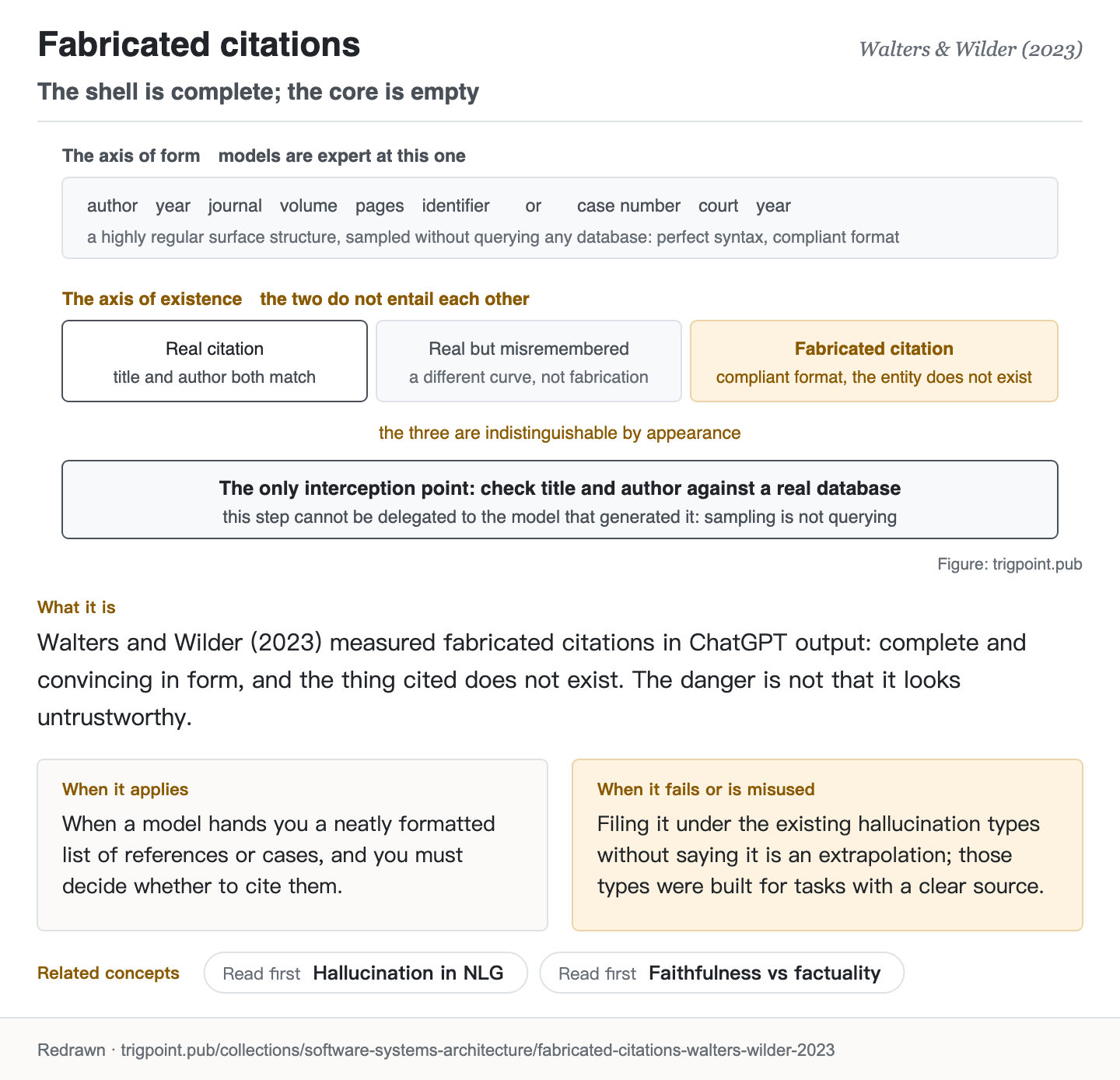
In a US federal district court case, lawyers put precedents found with a generative tool into a filing; several of them did not exist, and the court imposed a penalty. The format of a bibliographic record or a case citation is a highly regular surface structure: author, year, journal, volume, pages, identifier; or docket number, court, year. Generative models sample that structure expertly. They can produce a syntactically perfect, format-compliant citation string without having queried any actual database at all.
So something happens: the heuristic that readers and reviewers rely on, that form is credential, fails. What the judgement rests on (whether the format is proper) and what the judgement is about (whether the thing exists) are independent and do not entail each other. This is not a matter of degree. The two axes come apart entirely.
Walters and Wilder's 2023 study in Scientific Reports measured it, and its methodological definition is worth keeping word for word: a citation is treated as real (not fabricated) if a genuine work can be found that matches or approximately matches on both title and author[1]Walters, W. H., & Wilder, E. I. (2023-09-07). Fabrication and errors in the bibliographic citations generated by ChatGPT. Scientific Reports, 13, Article 14045. DOI 10.1038/s41598-023-41032-5. Bibliographic details checked against the official record. Claims matched against the full text. The methodological definition: a citation is treated as real (not fabricated) if a genuine work can be found that matches or nearly matches on both title and author.. The negative case is fabrication.
Its numbers are well known, and anyone citing them has to carry the conditions along: within that study's sample (42 topics across disciplines, 84 short papers, 636 bibliographic citations, measured in 2023), 55% of the citations from one version were fabricated, and 18% of those from a newer version[2]The same paper's measurements (anyone citing them has to carry the conditions along): within that study's sample (42 topics across disciplines, 84 short papers, 636 bibliographic citations, measured in 2023), 55% of the citations from one version were fabricated, against 18% of those from a newer version. Both figures are bound to that study, those two model versions and that point in time; detached from those conditions they become an over-generalisation.. Both figures are bound to that study, those two model versions and that point in time. Talking about what the fabrication rate is away from those conditions is itself an over-generalisation.
It also drew a distinction that is easy to overlook[3]A separate measurement in the same paper: real citations still carry substantive citation errors; that rate uses only the real citations as its denominator, is calculated apart from the fabrication rate, and must not be reported together with it.: the fabrication rate and the rate of errors among real citations are two independent curves. A genuine work with the year or the pages recorded wrongly, and a work that does not exist being generated, are not the same thing and should not be reported together.
The judicial setting supplies one instance with a definite price. In a 2023 case in a US federal district court, lawyers used a generative tool to look for precedents and put them into a filing opposing the defendant's motion to dismiss, citing several non-existent precedents, and the court found the conduct to constitute subjective bad faith under the applicable rule and imposed a joint and several penalty[4]The judicial instance: a 2023 case in a US federal district court in which lawyers used a generative tool to look for precedents and put them into a filing opposing the defendant's motion to dismiss, citing several non-existent precedents; the court found the conduct to constitute subjective bad faith under Rule 11 of the Federal Rules of Civil Procedure and imposed a joint and several penalty on the lawyers and their firm. This site does not list those fabricated case names; the court's opinion lists them one by one..
This site does not list those fabricated case names; the court's opinion lists them one by one, and that is where to check them[5]Details of the case: the docket number, the penalty amount (5,000 US dollars), the date of the ruling and the nature of the filing were checked against the text of the opinion; the reporter citation agrees across several public bibliographic sources.. That handling is itself what this page is about: whether a citation exists is settled by going back to the original.
2. Why this matters to you
This page is where the other pages of the shelf converge: the trustworthiness of a system cannot rest on its looking right.
The shape you will meet is concrete. You ask a model to find literature supporting some claim, and it returns five entries, neatly formatted, with identifiers and page numbers. Three of them genuinely exist, one exists with the author swapped, one does not exist at all. And from the outside the five are indistinguishable.
So there is one thing to do, and there is no substitute for it: go back and check existence. Not check whether the format is right, but take the title and the author to an actual database and see whether the thing is there. That step cannot be delegated to the model that generated it, because its generation process is sampling rather than querying: it does not know it is making things up.
Three moves turn straight into rules.
First, split does this thing exist and does this thing say this sentence into two independent checks. The first is existence; the second is the faithfulness axis from Faithfulness vs Factuality. Either can fail on its own.
Second, bind conditions to any rate you quote. Which study, which model version, which point in time. The rule looks fussy, and what it blocks is a typical second-hand error: a figure from 2023 being used to describe today.
Third, say how far each check went, and no further. That is this site's method and what this page is demonstrating: every source is marked as checked at the level of bibliography, abstract or full text, and nothing unchecked is written up as checked. Marking low makes the page look less complete, and that is the shape honesty takes.
Lab cases Written only where there is evidence
No field record for this node yet.
- A common account says this is a kind of citation error. It is not. A genuine work with the year or pages recorded wrongly, and a work that does not exist at all, are two categories. The original study measured them separately, and the two curves must not be reported together. #
- A common account says the model is lying. There is no intent to speak of. This is a structural side effect of the sampling mechanism, and the model does not know it is making things up. Framing it as deliberate deception is an anthropomorphic misreading, and it also sends people off repairing the wrong thing. #
- A common account says that some study found the fabrication rate to be X. The fabrication rate varies sharply with model and version. Any figure has to be bound to which study, which model version and which point in time, or it becomes an over-generalisation detached from its context. #
Records how far each claim was checked, not a guarantee that it is true.
Corrections- 2026-10-25 · Two corrections were made before the shelf opened, both against the text of the court's opinion. First, an earlier version said the lawyers used a generative tool to write a motion; it was a filing opposing the defendant's motion to dismiss. Second, an earlier version said the fabricated case names appeared only in search summaries and that the full text of the opinion could not be obtained, so details of the case were marked secondary; the opinion has now been read, it lists the case names one by one, and this page still does not list them.
How to read the source notes “Bibliographic details checked” means author, year, title and venue were confirmed. It does not mean the source's claims were checked. “Matched against the full text” means the claim was compared with the text of the source itself. Definitions as of 2026-09-20.
- [1] Walters, W. H., & Wilder, E. I. (2023). Fabrication and errors in the bibliographic citations generated by ChatGPT. Scientific Reports, 13, 14045. DOI 10.1038/s41598-023-41032-5. ↩
- [2] Walters, W. H., & Wilder, E. I. (2023). Fabrication and errors in the bibliographic citations generated by ChatGPT. Scientific Reports, 13, 14045. DOI 10.1038/s41598-023-41032-5.
- [3] Walters, W. H., & Wilder, E. I. (2023). Fabrication and errors in the bibliographic citations generated by ChatGPT. Scientific Reports, 13, 14045. DOI 10.1038/s41598-023-41032-5.
- [4] Mata v. Avianca, Inc., 678 F. Supp. 3d 443 (S.D.N.Y. 2023), No. 1:22-cv-01461 (PKC), Opinion and Order on Sanctions (22 June 2023). Bibliographic details cross-checked against multiple sources. Claims matched against the full text.
- [5] Mata v. Avianca, Inc., 678 F. Supp. 3d 443 (S.D.N.Y. 2023), No. 1:22-cv-01461 (PKC), Opinion and Order on Sanctions (22 June 2023).
Tell me when a new shelf opens
Tell me when a new shelf opens
Shelf notices are sent only when a new shelf opens or when the reading rules change.
Tell the editor privately: a correction, a counter-example or where it applies
Submissions are read only by the editor, and nothing is published before they are handled. Once a note is handled, a summary and response written by the editor are published. No sign-up is needed, and the nickname may be left blank.
We have your note