Members' shelf
All 9 nodes on Naming & Classification are for members only.
Pay with the email you sign in with here, so the Pass is linked to this account.
Members' shelf
All 16 nodes on System Protection & Threat Modeling are for members only.
Pay with the email you sign in with here, so the Pass is linked to this account.
Event sourcing
- Holds when
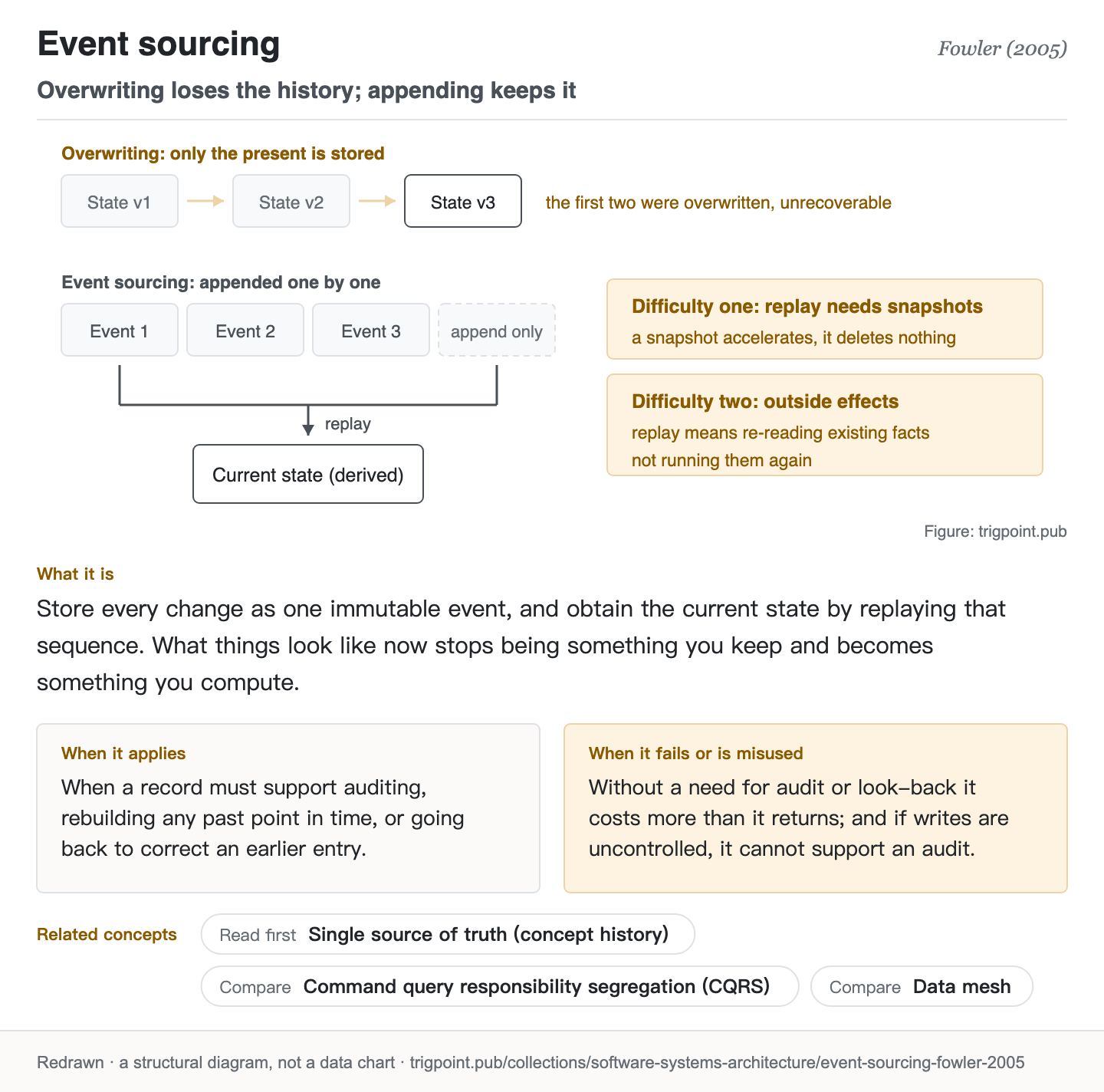
- When a record must support auditing, rebuilding any past point in time, or going back to correct an earlier entry.
- Evidence
- Conceptual framework; Checked against the sources
- Breaks down when
- Without a need for audit or look-back it costs more than it returns; and if writes are uncontrolled, it cannot support an audit.
1. What happened
The record of changes and the state at this moment are two different things: the second can be replayed from the first, and the first cannot be recovered from the second. Most systems store current state only: a record changes and the new value overwrites the old. That approach carries a quiet loss. The history of changes vanishes permanently at the moment it is overwritten. You have how things look now, and nothing about how they came to look that way. Three things become impossible at once: auditing, rebuilding any past point in time, and going back to correct an earlier error.
Event sourcing inverts the order: the sequence of events is the fact, and current state is derived from it. The original defines it as capturing every change to application state as a sequence of events[1]Fowler, M. (2005-12-12). Event Sourcing. martinfowler.com/eaaDev/EventSourcing.html. Claims matched against the full text. The original defines it as capturing all changes to an application state as a sequence of events. The same page discusses several practical difficulties: rebuilding from scratch is slow when there are many events, so a snapshot can be stored instead; an event recorded wrongly can be reversed together with the events after it, and the corrected event replayed; and outside systems cannot tell real processing from replay, so they have to be handled through a gateway.. In practice there are only two hard rules: events are appended and never modified in place, and current state is obtained by replaying all events from empty. Once those two hold, time travel comes free: replay to the kth entry and you have how things looked at that point.
The original also discusses several practical difficulties, and three of them teach more than the definition does[1]Fowler, M. (2005-12-12). Event Sourcing. martinfowler.com/eaaDev/EventSourcing.html. Claims matched against the full text. The original defines it as capturing all changes to an application state as a sequence of events. The same page discusses several practical difficulties: rebuilding from scratch is slow when there are many events, so a snapshot can be stored instead; an event recorded wrongly can be reversed together with the events after it, and the corrected event replayed; and outside systems cannot tell real processing from replay, so they have to be handled through a gateway.. First, rebuilding from scratch gets slow when there are many events, so you need snapshots: store the state at some point and replay forward from there. Second, when an earlier event turns out to be wrong, the original's approach is to reverse it and the events after it, then replay with the corrected event; reversal is easiest when an event is written as a difference (add 10 rather than set to 110).
Third, and this is where things go wrong most: if processing an event triggers an effect outside the system (sending a letter, taking a payment), then replay cannot actually run it again, or you charge twice and the result stops being reproducible. The semantics of replay must be reading existing facts again, not running the thing again.
2. Why this matters to you
The thing in your workflow closest to this pattern is your record of decisions.
Most people hold their criteria in overwrite mode: the rule changed, so delete the old sentence and write the new one. A year later you hold a set of rules that looks very clean, and zero entries explaining how it came to be that way. This is fine while you remember. It leaves you with no material at all the moment you have forgotten, or need to convince someone else, or need to judge whether the reason behind a rule still holds.
The event sourcing move is this: the page of rules is a derivation, and the entry-by-entry record of changes is the fact. When you change a rule you append an entry (what changed, why, what triggered it), and the derived page is regenerated. A year later you have two things: a readable current value, and a traceable provenance. Before you start, choose: keep records this way only for the things someone will later ask you to explain.
Three rules transfer directly, each adapted from the difficulties above. First, never edit an old entry. When you find you recorded something wrongly, append a correction rather than going back to fix it: allow going back to fix things and the whole record loses the only value it had. Second, add a summary layer when it gets long, and never let the summary replace the record. That is a snapshot, not a deletion.
Third, replay is not redo. You go back and read old decisions to understand the judgement of the time, not to carry it out again, and the premises of the time may no longer hold.
That third rule is easy to trip over with a model. Feed a whole run of historical decisions in and ask it to continue in this pattern, and it will very obligingly carry the expired premises along with everything else.
Lab cases Written only where there is evidence
No field record for this node yet.
- A common account treats event sourcing as part of command query responsibility segregation. Fowler's 2005 piece does not mention the latter anywhere. The two appear together as a result of later practitioner advocacy, not a dependency in the definition. You can use either one alone. #
- A common account says the author invented the approach. In the original he himself gives version control systems as a common example and says he has seen strong examples in accounting systems. This site therefore marks him as recording it systematically, not as its inventor; whether the name originated with him has not been checked here. Keep the two apart. #
- A common account treats the original as a mature piece of architecture literature. The page still carries the author's own draft notice, saying this body of writing stopped in the mid-2000s and will not be revised until he can return to it. It is often treated as the standard reference, and it declares itself a draft. #
How to read the source notes “Matched against the full text” means the claim was compared with the text of the source itself. Definitions as of 2026-09-20.
- [1] Fowler, M. (2005). Event Sourcing. martinfowler.com/eaaDev/EventSourcing.html. Published 12 December 2005 (draft status per author's own notice). ↩
Tell me when a new shelf opens
Tell me when a new shelf opens
Shelf notices are sent only when a new shelf opens or when the reading rules change.
Tell the editor privately: a correction, a counter-example or where it applies
Submissions are read only by the editor, and nothing is published before they are handled. Once a note is handled, a summary and response written by the editor are published. No sign-up is needed, and the nickname may be left blank.
We have your note