Members' shelf
All 9 nodes on Naming & Classification are for members only.
Pay with the email you sign in with here, so the Pass is linked to this account.
Members' shelf
All 16 nodes on System Protection & Threat Modeling are for members only.
Pay with the email you sign in with here, so the Pass is linked to this account.
Modularity and thin crossing points
- Holds when
- When deciding where to cut a piece of work or a system, and how hard each exchange is can be observed in advance.
- Evidence
- Conceptual framework; Bibliography checked
- Breaks down when
- Assuming finer is better and never revisiting a cut: shared rules become hard to change, and boundaries drift out of place as traffic changes.
1. What happened
The intuition behind modularity is old: cut a complex system into pieces, let each piece govern its own inside, and have the pieces deal with one another through agreements.
What Baldwin and Clark's 2000 book Design Rules did was something else: it raised modularity from an engineering intuition to an economic theory[1]Baldwin, C. Y. & Clark, K. B. (2000). Design Rules, Volume 1: The Power of Modularity. MIT Press. ISBN 9780262024662. Bibliographic details confirmed by two sources. The split between design rules and hidden modules and its option value follows secondary accounts that agree with one another. Raises modularity from an engineering intuition to an economic theory: visible design rules are separated from hidden modules, so the modules form a set of real options. The book's content was checked here only through several agreeing secondary accounts.. The core structure divides design information in two: visible design rules that everyone has to obey, and implementation hidden inside a module. After that division, each module becomes a real option that can be replaced independently. You can swap one piece to try something without touching the whole. So the value of modularity is not only that it is easier to maintain. It is that you can run many local experiments cheaply.
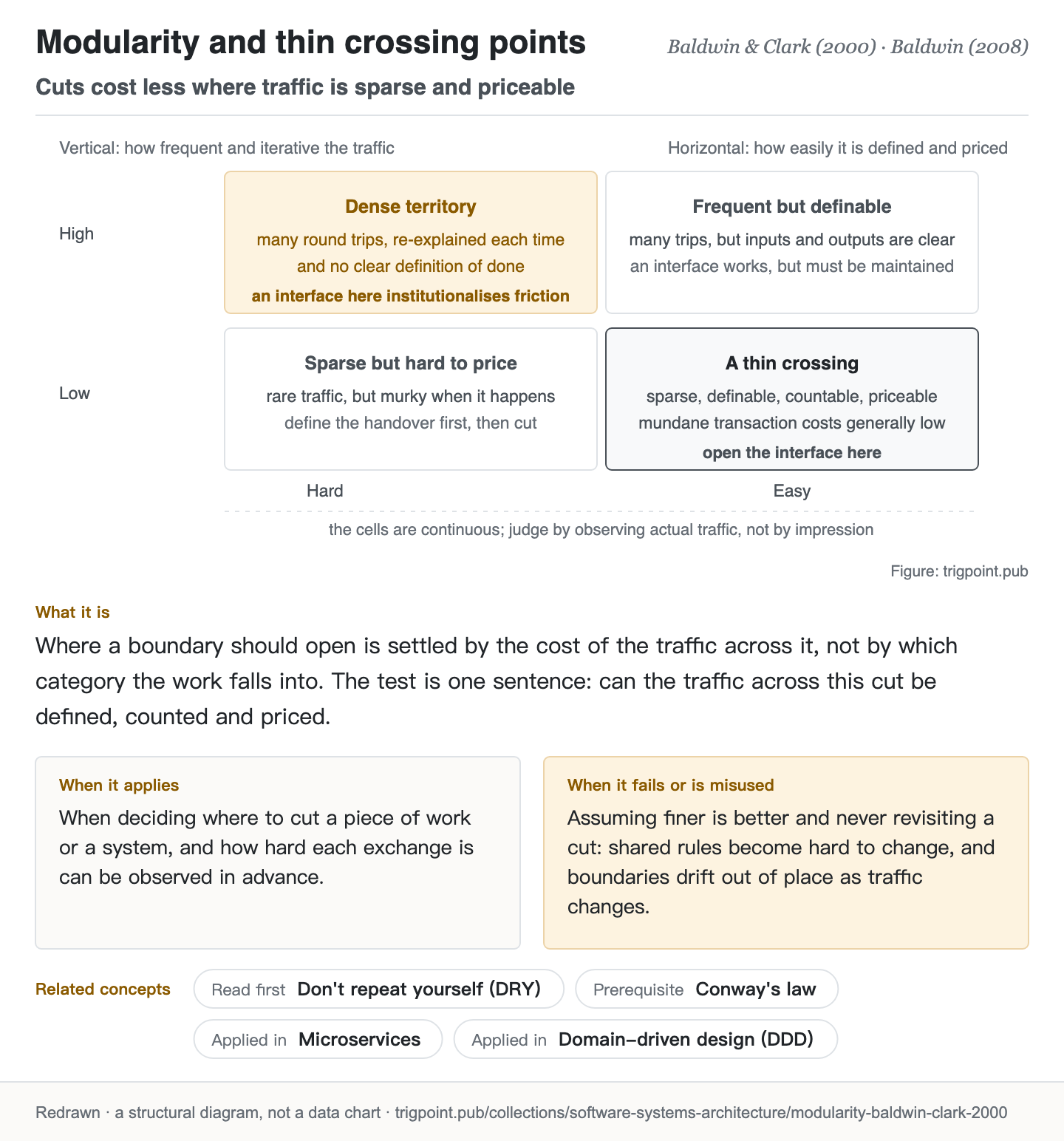
What pins the criterion down, though, is Baldwin's 2008 paper. It asks a question that comes earlier: why does a boundary fall here rather than there. The answer is the cost of traffic. In a network of tasks, the places where exchanges are easy to define, easy to count and easy to pay for are where those mundane transaction costs are generally low, and module boundaries (along with firm boundaries) correspond to those thin crossing points[2]Baldwin, C. Y. (2008). Where Do Transactions Come from? Modularity, Transactions, and the Boundaries of Firms. Industrial and Corporate Change, 17(1), 155–195. Bibliographic details checked against the official record. Consistent with the abstract. From the abstract, verbatim: “The costs of this work (labeled mundane transaction costs) are generally low at the thin crossing points of the task network, which correspond to module boundaries.”. In regions where the traffic is dense, iterative and hard to price, forcing an interface into the middle institutionalises the friction.
The criterion has one very usable property: you can apply it before you start. Classification by function only becomes visible once the system exists. The cost of traffic can be observed in advance. You do not have to cut wrongly once in order to learn where the cut belongs.
2. Why this matters to you
Most of the boundary decisions you make daily are cuts along which category does this belong to. This page asks you to cut along how expensive is this handover instead.
The difference shows up most clearly when handing work to a model. Suppose you want to cut a piece of work out. If the traffic across that cut is I give a definite input, it returns a definite output, and I can tell whether it is right, that is a thin crossing point, and handing it over is cheap, because the handover itself can be defined and accepted.
If the traffic is I have to explain a pile of background, we go back and forth several times, and I have no simple way to judge whether the result is right, that is dense territory. Open an interface there and you will spend most of your time maintaining the interface.
The same criterion explains a familiar frustration: why some work goes slower after it is contracted out. It is rarely that the other party is not up to it. It is that you opened the boundary in dense territory.
Three usable questions fall straight out of the criterion. First, can I state clearly what counts as finished for the output of this handover. Second, how long does accepting it take me, and does that beat doing it myself. Third, how many round trips does this line carry in a week: if the answer is many, and each one requires explaining things again, the line does not belong there.
More lines cut out is not better, either: each one is another handover to maintain, and lines already cut are worth walking through these three questions again from time to time.
Lab cases Written only where there is evidence
No field record for this node yet.
- A common account says modularity was proposed by these two authors. The concept is at least thirty to forty years older (for example, near-decomposability in 1962 and information hiding in 1972). What the two contributed is the economic formalisation; the theory of where boundaries go comes from a 2008 paper by one of them, Baldwin. Do not cite them as the originators of the concept. #
- A common account says thin and thick are two classes, so judging is classifying. The original's criteria are how dense and complex the traffic is, and how much work it takes to define, count and pay for what crosses. These are matters of degree, and a verdict needs actual observation of the traffic. Treating it as a binary leads people to sort by impression. #
How to read the source notes “Bibliographic details checked” means author, year, title and venue were confirmed. It does not mean the source's claims were checked. “Consistent with the abstract” means the claim agrees with the paper's abstract. It does not include sentence-by-sentence checking against the full text. “Follows secondary accounts” means the claim rests on sources that report it, not on the original document. Definitions as of 2026-09-20.
Tell me when a new shelf opens
Tell me when a new shelf opens
Shelf notices are sent only when a new shelf opens or when the reading rules change.
Tell the editor privately: a correction, a counter-example or where it applies
Submissions are read only by the editor, and nothing is published before they are handled. Once a note is handled, a summary and response written by the editor are published. No sign-up is needed, and the nickname may be left blank.
We have your note