Members' shelf
All 9 nodes on Naming & Classification are for members only.
Pay with the email you sign in with here, so the Pass is linked to this account.
Members' shelf
All 16 nodes on System Protection & Threat Modeling are for members only.
Pay with the email you sign in with here, so the Pass is linked to this account.
Faithfulness vs factuality
- Holds when
- When a model works from material you supplied, and you check separately whether the material says it and whether it is true.
- Evidence
- Conceptual framework; Checked against the sources
- Breaks down when
- Checking with two rulers assumes material you supplied; without any material, the method applies only by extrapolation.
1. What happened
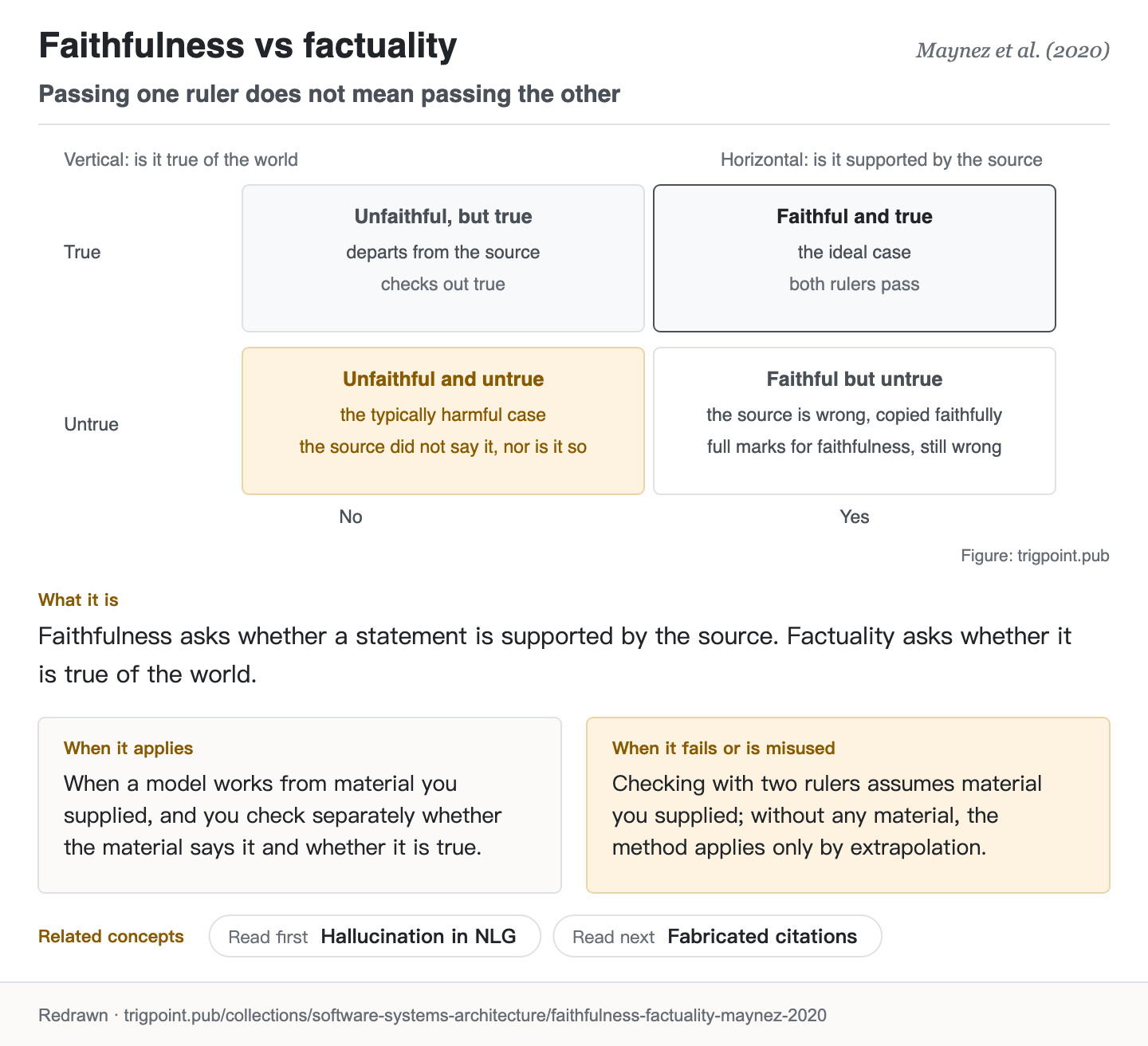
Whether an output is supported by its source and whether it is true of the world have to be judged on two separate lines. This 2020 paper pulled apart something that had long been used interchangeably.
The test for faithfulness is triggered: if a piece of output contains a span not supported by the input document, it counts as hallucination[1]Maynez, J., Narayan, S., Bohnet, B., & McDonald, R. (2020). On Faithfulness and Factuality in Abstractive Summarization. Proceedings of the 58th Annual Meeting of the Association for Computational Linguistics (ACL 2020), 1906–1919. DOI 10.18653/v1/2020.acl-main.173. Bibliographic details checked against the official record. Claims matched against the full text. The triggered definition for faithfulness: a summary containing a span not supported by the input document counts as hallucinated. The separate clause for factuality: a summary containing information not found in the document that is factually correct contains a factual hallucination. The same paper states its own position: content in a summary that departs from the source is acceptable if it leads to a better summary, one that is true with respect to the document and the relevant background knowledge; it also notes that the research community has no consensus on this.. Note that this test asks nothing about the world. It asks only about the source.
The test for factuality is a separate clause: if a piece of output contains information not in the document that is factually correct, then it contains factual hallucination[1]Maynez, J., Narayan, S., Bohnet, B., & McDonald, R. (2020). On Faithfulness and Factuality in Abstractive Summarization. Proceedings of the 58th Annual Meeting of the Association for Computational Linguistics (ACL 2020), 1906–1919. DOI 10.18653/v1/2020.acl-main.173. Bibliographic details checked against the official record. Claims matched against the full text. The triggered definition for faithfulness: a summary containing a span not supported by the input document counts as hallucinated. The separate clause for factuality: a summary containing information not found in the document that is factually correct contains a factual hallucination. The same paper states its own position: content in a summary that departs from the source is acceptable if it leads to a better summary, one that is true with respect to the document and the relevant background knowledge; it also notes that the research community has no consensus on this.. That wording is worth pausing on. It concedes that a piece of output can be both unfaithful to its source and true of the world, and that this still counts as a kind of hallucination, because it is not what the source said.
The two axes cross into four cases, and each of them really occurs: faithful and correct (the ideal); faithful but incorrect (the source itself is wrong, you transcribe it accurately, the verdict is still faithful, and you have passed an error along); unfaithful but correct (generated away from the source, yet confirmed true); unfaithful and incorrect (the typically harmful case).
The practical value of the split is that it points at different repairs: a faithfulness problem is distortion in transcription, treatable with entailment checks or enforced citation; a factuality problem is an error in world knowledge, treatable only by outside checking or retrieval. Blend them into one score and you will pick up the wrong tool.
The paper also gives the intrinsic and extrinsic distinction for the summarisation setting: intrinsic is misrepresenting information already in the document, extrinsic is generating entirely away from the source material[2]The same paper's intrinsic and extrinsic distinction for summarisation: intrinsic is misrepresenting information already in the document; extrinsic is generating entirely away from the source material..
2. Why this matters to you
This page is the acceptance instrument this shelf hands you, and you can use it today.
You ask a model to work up some material, and once the result comes back, most people ask is this right. This page asks you to split that into two questions, and the order matters.
Ask first: did the material I supplied say this. That question is cheap, quick and binary: go back and compare. It catches distortion in transcription.
Ask second: is this right. That question is expensive and needs outside knowledge or a second source. It catches errors in world knowledge.
The order matters because the first question filters out most of the problems, and its cost is low enough to run every time. The second belongs to the assertions that actually carry weight. The other way round, if you gave the model no material at all, decide what you will compare against before you start checking.
The second practical point is the quadrant that gets overlooked most: faithful but incorrect. The material you supplied was wrong, the model transcribed it accurately, and it is entirely faithful while you hold a wrong conclusion. That cell is the reminder that scoring a hundred on fidelity to a source will never correct an error in the source. So even in a retrieval-augmented workflow, the quality of the corpus is still the ceiling.
The third, and the least intuitive sentence here, is this site's position, and the paper itself takes the other side. The paper says outright that summarisation systems may draw on background knowledge: content that departs from the source is acceptable if it leads to a better summary, one that is true with respect to the document and the relevant background knowledge; it also notes that the research community has no consensus on this[1]Maynez, J., Narayan, S., Bohnet, B., & McDonald, R. (2020). On Faithfulness and Factuality in Abstractive Summarization. Proceedings of the 58th Annual Meeting of the Association for Computational Linguistics (ACL 2020), 1906–1919. DOI 10.18653/v1/2020.acl-main.173. Bibliographic details checked against the official record. Claims matched against the full text. The triggered definition for faithfulness: a summary containing a span not supported by the input document counts as hallucinated. The separate clause for factuality: a summary containing information not found in the document that is factually correct contains a factual hallucination. The same paper states its own position: content in a summary that departs from the source is acceptable if it leads to a better summary, one that is true with respect to the document and the relevant background knowledge; it also notes that the research community has no consensus on this.. For summarisation that makes sense, since a good summary naturally brings in its author's background knowledge. This page, though, is about acceptance: you hand over material and ask the model to work from it. In that setting, the cell where output departs from the source and is still true should not be read as a lucky escape. It means your process has no binding force at that position, and next time that same position may not be true. Being right by chance is a false negative for a failing process, not a success.
Lab cases Written only where there is evidence
No field record for this node yet.
- A common account says being faithful and being correct are the same thing. They are two independent lines of judgement. Output entirely faithful to its source can be wrong (the source itself is wrong), and output that departs from the source can still be right. Mixing them up sends you off repairing the wrong thing. #
- A common account says this pair of axes was invented by this paper out of nothing. The concern predates it (for example, a 2019 critique of evaluation already listed factual correctness as a gap), but setting the two axes as orthogonal and using faithfulness and factuality as a pair are what this site credits this paper with formalising. Origination and formalisation should be booked separately. #
- A common account says intrinsic and extrinsic mean the same thing in every paper. This paper's original wording (misrepresenting content already present, versus generating entirely away from the source) is not word-for-word equivalent to the simplified wording of later general surveys. When tracing a definition, know which version you are holding. #
Records how far each claim was checked, not a guarantee that it is true.
Corrections- This page does not quote the paper's specific percentages: this site did not check its statistics table by table, and makes only qualitative statements.
How to read the source notes “Bibliographic details checked” means author, year, title and venue were confirmed. It does not mean the source's claims were checked. “Matched against the full text” means the claim was compared with the text of the source itself. Definitions as of 2026-09-20.
- [1] Maynez, J., Narayan, S., Bohnet, B., & McDonald, R. (2020). On Faithfulness and Factuality in Abstractive Summarization. Proceedings of ACL 2020, 1906–1919. ↩
- [2] Maynez, J., Narayan, S., Bohnet, B., & McDonald, R. (2020). On Faithfulness and Factuality in Abstractive Summarization. Proceedings of ACL 2020, 1906–1919.
Tell me when a new shelf opens
Tell me when a new shelf opens
Shelf notices are sent only when a new shelf opens or when the reading rules change.
Tell the editor privately: a correction, a counter-example or where it applies
Submissions are read only by the editor, and nothing is published before they are handled. Once a note is handled, a summary and response written by the editor are published. No sign-up is needed, and the nickname may be left blank.
We have your note