Members' shelf
All 9 nodes on Naming & Classification are for members only.
Pay with the email you sign in with here, so the Pass is linked to this account.
Members' shelf
All 16 nodes on System Protection & Threat Modeling are for members only.
Pay with the email you sign in with here, so the Pass is linked to this account.
Data mesh
- Holds when
- When there are many domains changing fast, and changing a shared definition means first waiting on one person or one decision.
- Evidence
- Conceptual framework; Bibliography checked
- Breaks down when
- Splitting without product guarantees or a platform yields islands; federating a small team mostly adds coordination cost.
1. What happened
Whether data should be managed by one central team or left in the hands of the domains that produce it is a trade-off at enterprise scale. This is the one node on this shelf that argues explicitly with Single Source of Truth, and the way it argues is worth looking at closely.
Its diagnosis starts from an operational phenomenon: the central data team becomes the bottleneck, and an integrated reservoir explodes in integration complexity at enterprise scale. The reason is not that the technology is inadequate. It is structural: every new requirement has to pass through the same people and the same model.
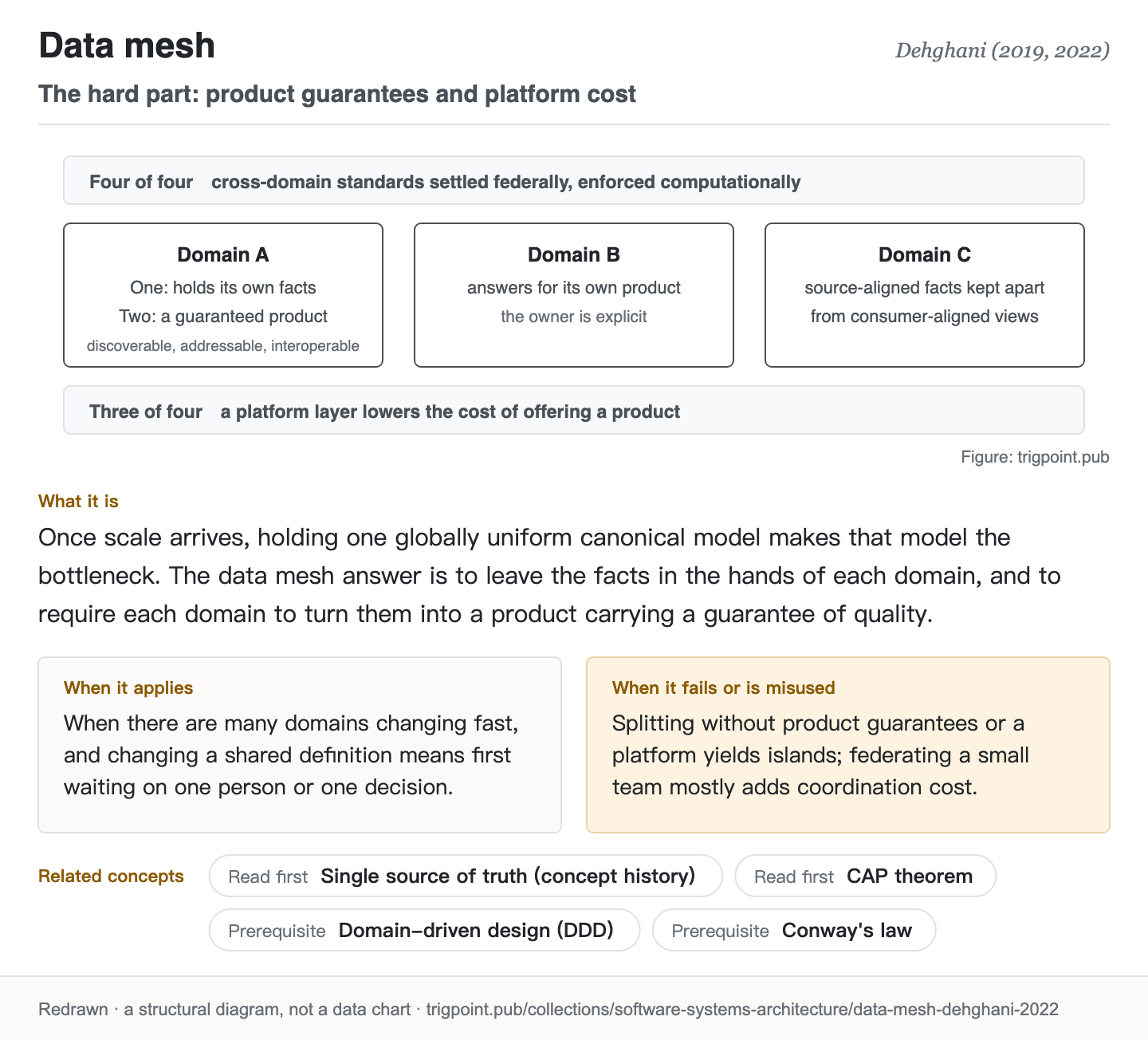
Its answer is four things[2]Dehghani, Z. (2022). Data Mesh: Delivering Data-Driven Value at Scale. O'Reilly. Bibliographic details confirmed by two sources. Provenance double-checked across models. This sentence was once confirmed word for word against an early release: “Data Mesh must depart from data myths such as a single source of truth, or one tightly-controlled canonical model.” The early release places the passage in a chapter titled After the Inflection Point; in the final edition's contents that title is chapter 7, and chapter 2 has a section titled Embrace the Most Relevant Domain Data: Don’t Expect a Single Source of Truth. Chapter and page in the final edition were not checked here.. First, domains hold their own data. Second, data is made into a product: discoverable, addressable, interoperable with others, which means it carries a guarantee of quality rather than being a file thrown over the wall. Third, a platform layer has to drive down the cost of offering one product, or autonomy is merely a transfer of burden onto the domains. Fourth, standards across domains are settled federally and enforced computationally rather than dictated centrally.
Its most direct sentence: a data mesh has to leave behind data myths such as the single source of truth, or a single rigorously controlled canonical model[2]Dehghani, Z. (2022). Data Mesh: Delivering Data-Driven Value at Scale. O'Reilly. Bibliographic details confirmed by two sources. Provenance double-checked across models. This sentence was once confirmed word for word against an early release: “Data Mesh must depart from data myths such as a single source of truth, or one tightly-controlled canonical model.” The early release places the passage in a chapter titled After the Inflection Point; in the final edition's contents that title is chapter 7, and chapter 2 has a section titled Embrace the Most Relevant Domain Data: Don’t Expect a Single Source of Truth. Chapter and page in the final edition were not checked here..
It also draws a useful distinction[1]Dehghani, Z. (2019-05-20). How to Move Beyond a Monolithic Data Lake to a Distributed Data Mesh. martinfowler.com. Bibliographic details checked against the publisher's record. Claims matched against the full text. Provenance double-checked across models. Confirmed word for word in the article: source-aligned domain datasets must be separated from the internal source systems' datasets; they have a much larger volume, represent immutable timed facts, and change less frequently than their systems.: between source-aligned datasets (the immutable, time-stamped facts each domain produces) and consumer-aligned datasets (views transformed and worked up for downstream purposes). Those two should not be managed together: the first is fact, the second is derivation. That distinction is worth reading against Event Sourcing: both separate fact from derivation, fact in one place, derivations as many as you like; event sourcing makes the split inside a single system, and this makes it across an organisation's data.
2. Why this matters to you
This page is what gives you a sense of scale, and a sense of scale is usually harder to come by than the principles themselves.
The Single Source of Truth page says that each element is maintained in one place and referred to from everywhere else. That is almost always right inside your own knowledge base. This page says that once the number of domains and the rate of change pass a certain point, holding one globally uniform canonical model makes that model the bottleneck. Both pages are correct, and what separates them is scale and headcount.
There is a practical signal for telling which side you are on: if changing a shared definition means finding a person first, or waiting for a decision, that shared definition is already the bottleneck. A system with one person in it does not have this problem (that person is you). A system with two or three starts to. A system with ten certainly does. The other way round, if your system has only you, or two or three people, in it, there is no hurry to hand shared definitions out to domains.
What this page really wants you to take away is the two of data mesh's four principles that get skipped most easily.
Made into a product matters more than autonomy does. Leaving facts in the hands of each domain is easy. What is hard is requiring each one to be discoverable, to have a named owner, and to carry a commitment about quality. Without that, decentralisation degrades into a scatter of islands: you have traded a bottleneck for being lost.
The platform driving down cost is what decides the outcome. If offering one acceptable product is expensive, domains will do it badly or route around it entirely. The equivalent at personal scale: if your filing discipline is too much trouble, you will not follow it, and then you will blame your own lack of discipline when what wants repairing is the cost.
Lab cases Written only where there is evidence
No field record for this node yet.
- A common retelling, data mesh just means breaking the data lake into a few small lakes: two of the four principles have nothing to do with splitting (product-grade quality guarantees, federated governance). Split without governing and what you get is a handful of islands each going its own way. #
- A common retelling, federated governance means no governance: it means that standards for interoperating across domains are decided jointly by the participants and enforced computationally, not that standards are abolished. What separates it from central dictation is who decides, not whether there are standards. #
- A common retelling, data mesh already has a settled academic definition: a 2024 systematic review in a computing surveys journal gathers 114 industry grey-literature articles, and its abstract notes that while practitioner writing is plentiful, academic attempts at defining and building on the concept are still lacking. #
Records how far each claim was checked, not a guarantee that it is true.
Corrections- This page does not use a certain widely requoted sentence: the depth review could not locate it word for word in the version searched, the nearest thing being a section heading, so the sentence is judged a paraphrase rather than a quotation, and its status is unresolved. This site does not quote sentences whose status is unresolved.
How to read the source notes “Bibliographic details checked” means author, year, title and venue were confirmed. It does not mean the source's claims were checked. “Matched against the full text” means the claim was compared with the text of the source itself. Definitions as of 2026-09-20.
Tell me when a new shelf opens
Tell me when a new shelf opens
Shelf notices are sent only when a new shelf opens or when the reading rules change.
Tell the editor privately: a correction, a counter-example or where it applies
Submissions are read only by the editor, and nothing is published before they are handled. Once a note is handled, a summary and response written by the editor are published. No sign-up is needed, and the nickname may be left blank.
We have your note