Members' shelf
All 9 nodes on Naming & Classification are for members only.
Pay with the email you sign in with here, so the Pass is linked to this account.
Members' shelf
All 16 nodes on System Protection & Threat Modeling are for members only.
Pay with the email you sign in with here, so the Pass is linked to this account.
Microservices
- Holds when
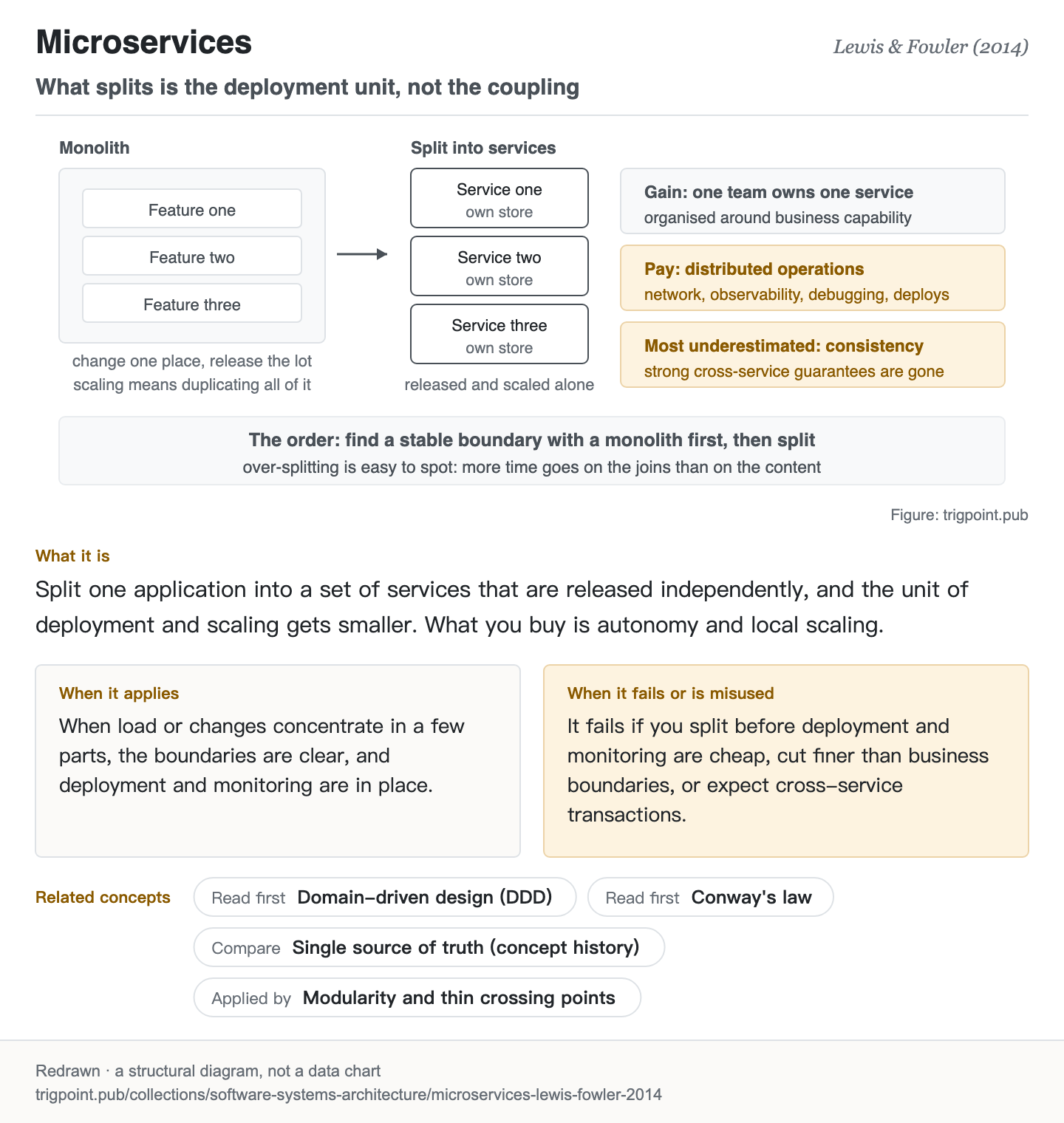
- When load or changes concentrate in a few parts, the boundaries are clear, and deployment and monitoring are in place.
- Evidence
- Conceptual framework; Checked against the sources
- Breaks down when
- It fails if you split before deployment and monitoring are cheap, cut finer than business boundaries, or expect cross-service transactions.
1. What happened
The problem with a monolith is not that it is large. It is that it is coupled at the level of deployment: any small change anywhere means releasing the whole package again, and scaling means duplicating all of it even when the load falls on one feature.
This 2014 article by Lewis and Fowler pinned down the alternative: build a single application as a set of small services, each running in its own process and communicating through lightweight mechanisms[1]Lewis, J. & Fowler, M. (2014-03-25). Microservices: a definition of this new architectural term. martinfowler.com/articles/microservices.html. Bibliographic details checked against the publisher's record. Claims matched against the full text. The article's definition: building a single application as a suite of small services, each running in its own process and communicating with lightweight mechanisms, often an HTTP resource API. The same article lists nine common characteristics and notes that not every microservice architecture has all of them.. The article also lists nine common characteristics and notes that not every microservice architecture has all nine[1]Lewis, J. & Fowler, M. (2014-03-25). Microservices: a definition of this new architectural term. martinfowler.com/articles/microservices.html. Bibliographic details checked against the publisher's record. Claims matched against the full text. The article's definition: building a single application as a suite of small services, each running in its own process and communicating with lightweight mechanisms, often an HTTP resource API. The same article lists nine common characteristics and notes that not every microservice architecture has all of them.. This page dwells on three of them: organised around business capabilities, componentised as independently deployable services, and decentralised in both data and governance.
Organised around business capabilities buckles straight back to Conway's Law: service boundaries mirror team communication boundaries, so the ideal shape is one cross-functional small team owning one service entirely. That is not a coincidence; the article cites that law explicitly.
Decentralised data is the item underestimated most. Each service manages its own storage, so consistency across services stops being free: the guarantee you used to get from a single database transaction disappears, and what replaces it is eventual consistency, compensating flows and distributed debugging.
One last thing. The same author gave a piece of counsel elsewhere that gets needed more often than the whole list of characteristics: use a monolith to find a stable boundary first, and split afterwards[5]Fowler, M. (2015-06-03). MonolithFirst. martinfowler.com/bliki/MonolithFirst.html. Bibliographic details checked against the publisher's record. Claims matched against the full text. A short piece by the same author in 2015 argues that a new project should not start with microservices, and should use a monolith to find stable boundaries between services first; microservices work well only when those boundaries are stable, and pay off only for more complex systems..
2. Why this matters to you
What this page is useful for is not services. It is the timing of a split.
You will badly want to break your workflow into small pieces: one that writes outlines, one that looks things up, one that polishes, one that checks citations. Each piece is simple on its own and easy to test on its own, which sounds entirely right. What this page says is that the return on splitting depends on a set of preconditions, and without them a split is pure overhead.
What are the preconditions? Another short piece by the same author lists three: rapid provisioning, basic monitoring and rapid deployment[6]Fowler, M. (2014-08-28). MicroservicePrerequisites. martinfowler.com/bliki/MicroservicePrerequisites.html. Bibliographic details checked against the publisher's record. Claims matched against the full text. A short piece by the same author in August 2014 lists three baseline capabilities to have before adopting: rapid provisioning, basic monitoring and rapid application deployment; without these baseline competencies, the microservice style should not be considered.. Translated to you: do you have a cheap way to connect those pieces up, to see what state they are in, and to find out which one went wrong when something breaks in the middle. If running the whole flow means moving output by hand three times, and finding a fault means walking back through each piece, the coordination cost you pay already exceeds what the split saved.
The second thing is the finer is better misreading. Small is a contrast with the monolith, not a target. The symptom of over-splitting is easy to recognise: you spend more time on the joins than on the content.
The third, and the most practical, is the counsel to use a monolith to find a stable boundary first, translated directly: do not split before the boundary is clear. Get the whole thing working in one place first, until you can say which stretches are stable and which are different every time, then split along the stable seams. Do it the other way round, splitting before you have felt the boundary, and you will build interfaces in the wrong places, and those interfaces are hard to remove afterwards. That is exactly what the criterion in Modularity & Thin Crossing Points is describing.
Lab cases Written only where there is evidence
No field record for this node yet.
- A common retelling, microservices were proposed by those two authors: the article itself says the term was discussed at a workshop in May 2011 and settled on by that group in May 2012. This site marks the two authors as the ones who crystallised and popularised the definition. Secondary accounts report a related coinage as early as 2005, from a different technical line. #
- A common retelling, small is the point and smaller is better: small is a contrast with the monolith, not an order to cut as fine as possible. The article notes that remote interfaces have to be coarser than in-process calls; the same author's other piece argues for starting with a monolith and splitting once the boundaries are stable. #
- A common retelling, this is the authoritative definition of the term: the article itself says there is no precise definition, describes common characteristics only, and offers its definition as a leading candidate. #
How to read the source notes “Bibliographic details checked” means author, year, title and venue were confirmed. It does not mean the source's claims were checked. “Matched against the full text” means the claim was compared with the text of the source itself. Definitions as of 2026-09-20.
- [1] Lewis, J. & Fowler, M. (2014). Microservices: a definition of this new architectural term. martinfowler.com/articles/microservices.html. Published 25 March 2014. ↩
- [5] Fowler, M. (2015). MonolithFirst. martinfowler.com/bliki/MonolithFirst.html. Published 3 June 2015. ↩
- [6] Fowler, M. (2014). MicroservicePrerequisites. martinfowler.com/bliki/MicroservicePrerequisites.html. Published 28 August 2014. ↩
Tell me when a new shelf opens
Tell me when a new shelf opens
Shelf notices are sent only when a new shelf opens or when the reading rules change.
Tell the editor privately: a correction, a counter-example or where it applies
Submissions are read only by the editor, and nothing is published before they are handled. Once a note is handled, a summary and response written by the editor are published. No sign-up is needed, and the nickname may be left blank.
We have your note