Trigpoint
Collections › Software & Systems Architecture › Single source of truth (concept history)
“Single version of the truth” concedes other versions exist; “only one place” does not.

Single source of truth (concept history)

Single Source of Truth (concept history) · Devlin & Murphy (1988) → Loshin (2008)
Bibliography checked ✓ Lab case ✓ Software architecture · data governance Read first: Don't repeat yourself (DRY) Tell the editor privately ▸
In three sentences A single source of truth says that every element is maintained in one place and everywhere else refers to it. It is a choice of structure rather than a choice of location. And it fails most easily in the references that point at it.

↳ Seen a counter-example?

Holds when
When one criterion has scattered into several copies, and you need to be able to say which single place is the one maintained.
Evidence
Conceptual framework; Bibliography checked
Breaks down when
Once an organisation spans many departments, insisting on one place of maintenance may turn from a remedy into an obstacle.
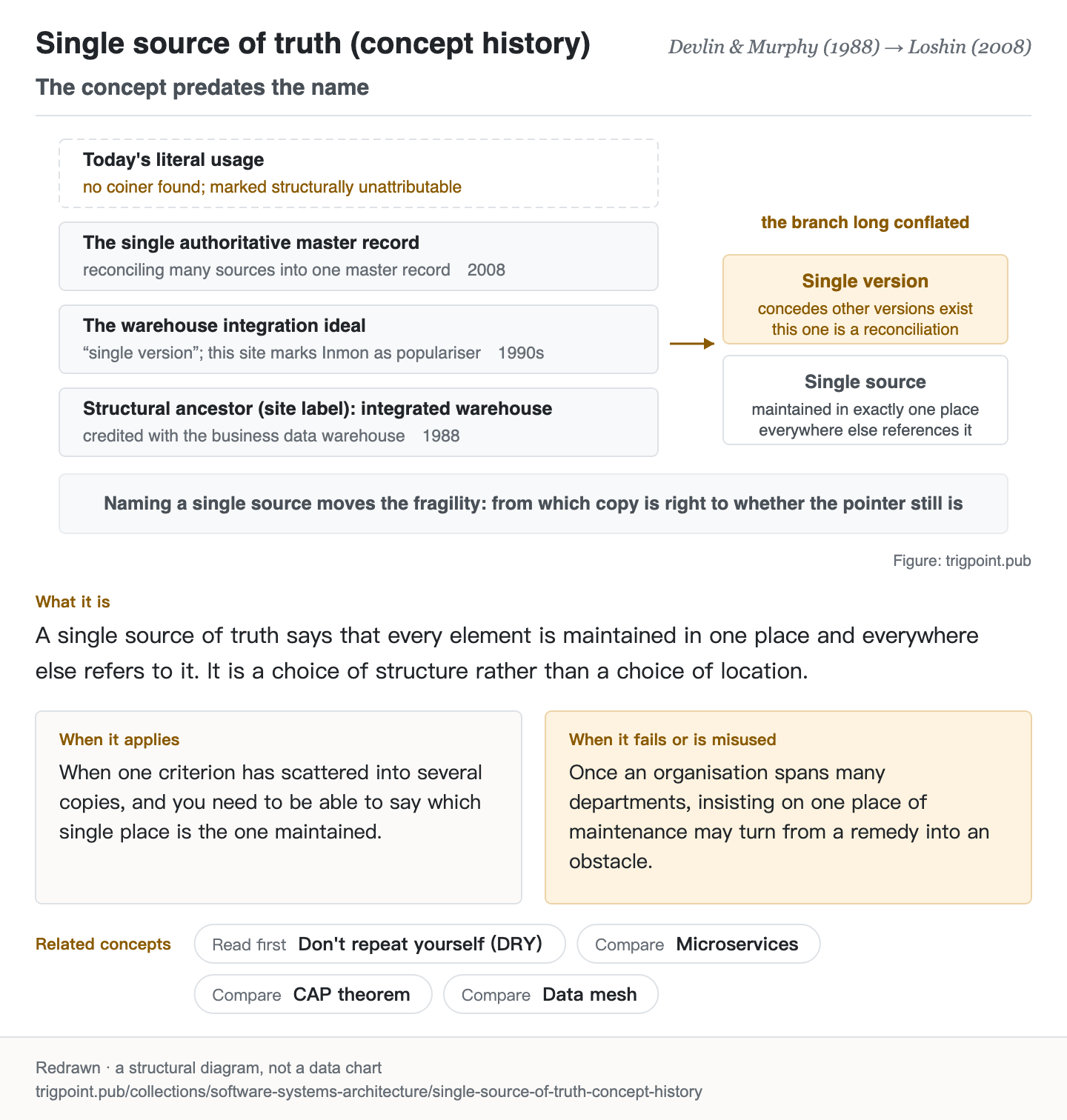
Single source of truth (concept history) Devlin & Murphy (1988) → Loshin (2008) The concept predates the name Today's literal usage no coiner found; marked structurally unattributable The single authoritative master record reconciling many sources into one master record 2008 The warehouse integration ideal “single version”; this site marks Inmon as populariser 1990s Structural ancestor (site label): integrated warehouse credited with the business data warehouse 1988 Single version concedes other versions exist this one is a reconciliation Single source maintained in exactly one place everywhere else references it the branch long conflated Naming a single source moves the fragility: from which copy is right to whether the pointer still is Figure: trigpoint.pub
Figure 1 · Four layers of concept history, read from the bottom up. The integrated warehouse of 1988 is the structural ancestor this site marks. Above it sits the warehouse ideal that concedes other versions exist elsewhere. Above that, the engineering practice of reconciling many sources into one authoritative master record. At the top, today's literal usage. The branch that matters is marked on the right: conceding that other versions exist elsewhere, and there genuinely being only one place, are not the same thing. The layers are a concept history, with no proportions or measured numbers; the years are confirmed publication years. The top layer is dashed because the search for its coiner returned unattributable, not because it was skipped. View full size ▸

1. What happened

Two things are often taken as one when people speak of a single source of truth: keeping one reconciled, authoritative version[3]Loshin, D. (2008). Master Data Management. Morgan Kaufmann / OMG Press. ISBN 978-0-12-374225-4. Bibliographic details checked against the official record. One of the representative works that set out reconciling many sources into one authoritative master record as engineering practice., and maintaining something in one place only. By the 1990s the phrase single version of the truth was already going around the data-warehousing industry[2]Smith, S. J. (2018, June 5). Single Version of the Truth - Not Optional. Eckerson Group. Claims matched against the full text. The author recalls meeting the idea of the single version of the truth in the business intelligence industry around 1995, and notes that it is not mentioned in the indexes or tables of contents of Kimball's or Inmon's original books on data warehousing. The phrase is commonly associated with Inmon's corporate information factory writing; this site marks Inmon as a populariser, not the coiner. That label is this site's own; the article says nothing about who coined or popularised the phrase., and by 2006 it was the title of a book[4]Dyché, J. & Levy, E. (2006). Customer Data Integration: Reaching a Single Version of the Truth. Wiley. Bibliographic details checked against the official record. The phrase appears here as a book title, not in Loshin..

Note the word version. It concedes something: the operational systems that feed a warehouse hold other versions, and the warehouse is merely the one reconciled out of them. That differs in meaning from there genuinely being only one place, and the two have been used interchangeably for a long time.

What a single source of truth requires is genuinely maintaining something in one place only: nominate one place as the sole point of maintenance, have every other position refer to it rather than copy it, and normalise the data to one standard form, so that which copy is right stops being a question anyone has to ask. Its opposite is there are two copies and both can be edited; one extra copy on its own does not break it.

The principle has an explicit opponent. Dehghani's 2022 book Data Mesh gives a whole section of chapter 2 to the argument that you should not expect a single source of truth[6]Dehghani, Z. (2022). Data Mesh: Delivering Data-Driven Value at Scale. O'Reilly. Bibliographic details checked against the official record. Chapter 2, on the principle of domain ownership, has a section titled Embrace the Most Relevant Domain Data: Don't Expect a Single Source of Truth. See this site's data mesh page., and the reason has to do with scale. This shelf includes that page so that it can turn round and argue with this one.

Attribution where due: The structural ancestor traces to Devlin and Murphy, An architecture for a business and information system, IBM Systems Journal, 1988[1]Devlin, B. A. & Murphy, P. T. (1988). An architecture for a business and information system. IBM Systems Journal, 27(1), 60–80. DOI 10.1147/sj.271.0060. Bibliographic details checked against the official record. This paper is generally credited with proposing the architecture of a business data warehouse: pulling scattered operational data into a single warehouse. This site takes it as the traceable engineering ancestor of the concept.; the literal term is unattributable[5]For the literal term, in the sense software architecture uses it, this site found no single coiner and marks it unattributable: widely used, with no agreed point of origin..

2. Why this matters to you

You almost certainly have a which version is current problem already. It just goes by another name.

Where is the current version of a criterion? If the answer is in my head, and the other three places hold stale copies, you are maintaining four of them. What the principle asks is that you turn those three into links. Deleting them outright invites someone to transcribe it again; linking makes people jump across.

What this page really wants you to leave with, though, is not that. It is the shape of the failure. Once you nominate a single source, the fragile point in the system moves: from which copy is right, to whether the line pointing across is still correct. And that second failure is silent, because the line looks like it is still there.

With a model in the loop this amplifies quickly. You nominate a spec as authoritative, then write see the spec in ten places. Six months later the spec has been renamed, or moved, or one of its sections has been split into another document. Those ten references raise no error. They simply point at something that no longer says the same thing. And a model reading them will very obligingly do what it finds there.

So the practice this page offers is two questions. First: where is the sole maintenance point for this element, and can you say it out loud. Second: those lines pointing across, when were they last checked. The second is harder to answer than the first, and it matters more.

Verification layer · Members
The guided layer of this node is open to all readers.
Verification details and failure boundaries are for members.
US$8.25 a month on average · or subscribe monthly ▸

Lab cases 3 first-hand cases from our studio

01
Open previewField record · 2026-07

The source was recorded in two fields, and one batch job split them apart

Situation: our knowledge base is built on this principle: every concept node is maintained in one place, and everywhere else links to it rather than copying the content. Each node also records where its verification came from, in a field that points at the report used to check its sources. On 16 July 2026 a batch job added new-format verification fields to 56 old-format nodes, including a new source pointer; the old-format source field was left in place. The new field was filled, across the board, with the report the batch as a whole relied on, and was never changed to each node's own evidence file. From that day, where a node's evidence lives was recorded twice on every node.

Decision point: on 6 August 2026, while opening the report behind each pointer for a new shelf, we found a node on bounded rationality whose new field pointed at a report with zero hits on the concept. The report named in the old field held the real evidence, and both reports sat in the same folder.

There were at least four workable options. One, change the new field to the old field's value on the spot and carry on with the shelf. Two, shelve the node at its recorded tier and leave the pointer for later. Three, take the node off the shelf and report the finding, with the location of both reports, to the line of work that maintains the nodes, and leave the fix to them. Four, halt the whole shelf and first sweep the entire knowledge base for the same problem.

What we did and what happened: we took the third option; under our division of work, the shelf side reads nodes and does not change them. Three days later, on 9 August, the check on their side found the same defect in more than one place: on 9 nodes the new field carried the batch's report, and for 6 of them that report had zero hits on the topic. All 6 were repointed to the evidence file named in the old field, each one checked. On 5 further nodes the new field was already right, so the old field, which held more detail, was moved up into it and then removed. 11 duplicate fields were cleared in one pass.

The negative result: as of 25 October, 7 nodes from the same batch still carry both fields. Their new field originally pointed at a file name that does not exist. On 24 July it was changed to match the old field, but the duplication itself was never removed.

Take-away: if a format migration records the same fact in an old field and a new one, fill the new field node by node from the old one and check it, then delete the old field that same day. Filling one value across a whole batch writes an unchecked pointer onto every node.

02
Trigpoint PassField record · 2026-07

Two checks: why reading one field is not enough

In August 2026 we checked the verification records of two shelves node by node within three days. On the first shelf, one node's source pointer named the wrong file. On the second, every pointer was right, yet several nodes had tier fields reading complete while the depth review had never touched their sources. Before work on the third shelf began, there were at least four workable options, and they differ in how many fields to check on each node and how deep to go.

Trigpoint Pass content · includes applicable steps

Read the member edition ▸

03
Trigpoint PassField record · 2026-11

Seven in ten broken links came from our own file moves: redirecting at read time

In November 2026 we put this page's second question to our own knowledge base: when were the links pointing across last checked? Nobody could say. When we measured, nearly one link in ten would not resolve, and seven in ten of those came from the knowledge base's own file-moving routines. There were four workable ways to deal with them, differing in whether the change went into the files, the links, the specification, or the step that reads them.

Trigpoint Pass content · includes applicable steps

Read the member edition ▸

Full access to the lab cases. Trigpoint Pass ▸

Common misreadings

Page verification: Bibliography checked ✓ · Content last revised 2026-11-20 · Corrections ↓

  • A common account says the single source of truth was put forward by the 1992 data-warehousing classic. There is no evidence that the book uses the literal term; one industry article notes that even the closer phrase, single version of the truth, appears in neither its index nor its table of contents. Single version of the truth also means something different: it concedes that other versions exist elsewhere. Today's literal term has no single coiner, while single version of the truth was already the title of a 2006 book on customer data integration. Which term, and whom to credit, are two separate questions. #
  • A common account says that achieving a single source of truth means centralising the data into one database. The principle is that each element has one designated place of maintenance and is referenced everywhere else. It governs structure, and a distributed, synchronised system can satisfy it just as well. #
Verification record

Records how far each claim was checked, not a guarantee that it is true.

Corrections
  • 2026-11-06 · An earlier version of this page said in two places that Data Mesh is 'the last page of this shelf'. That was wrong: the page belongs to the section What you gave up once you distributed it, not to the end of the shelf. The position was removed from What happened, and Counter-examples and failure boundaries now names Data Mesh directly.
References

How to read the source notes “Bibliographic details checked” means author, year, title and venue were confirmed. It does not mean the source's claims were checked. “Matched against the full text” means the claim was compared with the text of the source itself. Definitions as of 2026-09-20.

  1. [1] Devlin, B. A. & Murphy, P. T. (1988). An architecture for a business and information system. IBM Systems Journal, 27(1), 60–80. ↩
  2. [2] Smith, S. J. (2018, June 5). Single Version of the Truth - Not Optional. Eckerson Group. ↩
  3. [3] Loshin, D. (2008). Master Data Management. Morgan Kaufmann / OMG Press. ISBN 978-0-12-374225-4. ↩
  4. [4] Dyché, J. & Levy, E. (2006). Customer Data Integration: Reaching a Single Version of the Truth. Wiley. ISBN 978-0-471-91697-0. ↩
  5. [5] Editorial note with no external source; the full text is in note [5] of the body.
  6. [6] Dehghani, Z. (2022). Data Mesh: Delivering Data-Driven Value at Scale. O'Reilly. Chapter 2. ↩

↳ Is a citation wrong?

Tell me when a new shelf opens

Tell me when a new shelf opens

Shelf notices are sent only when a new shelf opens or when the reading rules change.

Trial

Tell the editor privately: a correction, a counter-example or where it applies

Submissions are read only by the editor, and nothing is published before they are handled. Once a note is handled, a summary and response written by the editor are published. No sign-up is needed, and the nickname may be left blank.

What are you submitting?
Set a public name to be credited by name ▸
Submit anonymously, without signing in

Signing in lets you follow the status on your page. What you have written is kept.

You are signed in: this note is linked to your account, visible only to you and the editor, so you can follow its status on your page. The text is never published. Full privacy policy ▸

Submit anonymously instead, not linked to your account ▸

No email is collected. Your original text and nickname are read only by the editor and are never published; the site publishes only a summary the editor writes. The human check is provided by Cloudflare Turnstile. To limit abuse, the system keeps a hash of your IP address, not the address itself. Your original text is stored with our cloud provider and can be deleted on request. Full privacy policy ▸