Members' shelf
All 9 nodes on Naming & Classification are for members only.
Pay with the email you sign in with here, so the Pass is linked to this account.
Members' shelf
All 16 nodes on System Protection & Threat Modeling are for members only.
Pay with the email you sign in with here, so the Pass is linked to this account.
Model-view-controller (MVC)
- Holds when
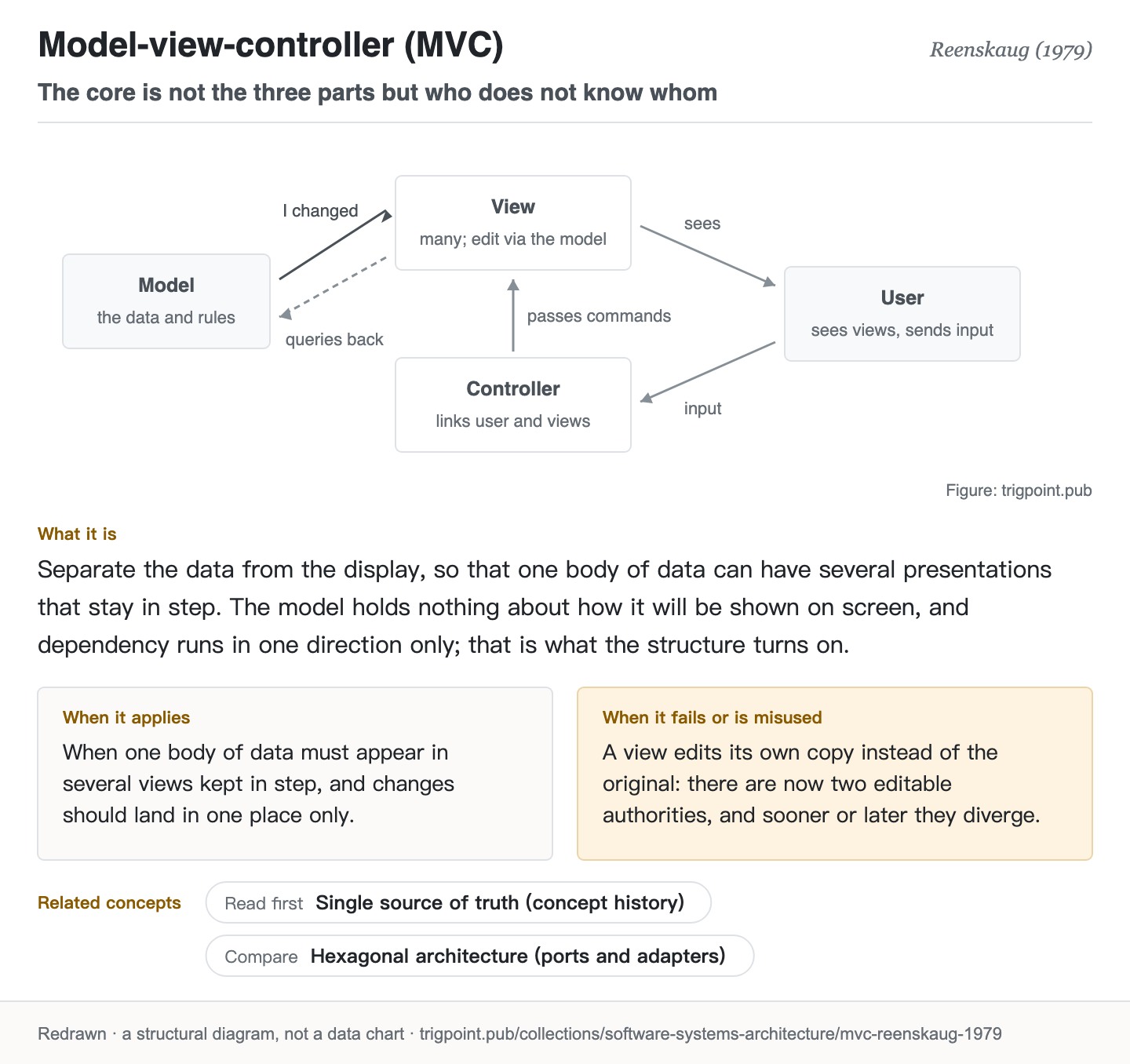
- When one body of data must appear in several views kept in step, and changes should land in one place only.
- Evidence
- Conceptual framework; Checked against the sources
- Breaks down when
- A view edits its own copy instead of the original: there are now two editable authorities, and sooner or later they diverge.
1. What happened
Between 1978 and 1979 a visiting researcher at Xerox PARC was working on a problem[5]Reenskaug, T. (n.d.). MVC: Xerox PARC 1978-79. Author's web page, University of Oslo. The visiting period, the naming history and the statement of purpose checked against the primary site. The author's own MVC page.: users needed to see several presentations of the same body of data at once (a diagram, a table, an input field), and those presentations had to stay in step.
His answer was to separate the data itself from its presentation. The May 1979 memo states that the model contains no information about how the information may be shown on the screen[1]Reenskaug, T. (1979, May 12). Thing-Model-View-Editor: An Example from a Planningsystem. Technical note, Xerox PARC. Bibliographic details confirmed by two sources. Claims matched against the full text. The earlier naming of the two original memos, four words in order: thing, model, view, editor. The first word means something of interest to the user, which can be concrete or an abstract idea. The memo also states that the model contains no information about how the information may be shown on the screen.; a view, for its part, asks the model questions to get the data it presents[2]Reenskaug, T. (1979, December 10). Models - Views - Controllers. Technical note, Xerox PARC. Bibliographic details confirmed by two sources. Claims matched against the full text. Of the two original memos, this is where today's three-word naming first appears. A view gets the data it presents by asking the model questions, and may also send the model messages to update it; the controller is the link between the user and the system.. The author's 2003 handout writes the synchronisation up as a pattern: a view registers with the model as a dependent, and the model notifies its dependents whenever it changes, without needing to know what kind of view they are; the view then goes back and queries for what it needs[3]Reenskaug, T. (2003). The Model-View-Controller (MVC): Its Past and Present. Handout, JavaZone (Oslo) and JAOO (Aarhus), September 2003. Draft of August 20, 2003. Bibliographic details confirmed by two sources. Claims matched against the full text. A self-published handout draft for two industry conferences, not peer reviewed. Its abstract gives the top-level goal as supporting the user's mental model of the relevant information and enabling the user to inspect and edit it. The handout writes up the arrangement in which a view registers as a dependent of the model and is notified whenever the model changes as the solution of a pattern (synchronising model and view), giving the Smalltalk-80 class library and the author's OOram tool as two examples.. The handout gives two implementations: the change notification in the Smalltalk-80 class library, and the author's own OOram tool, which accumulates changes and then notifies the views once[3]Reenskaug, T. (2003). The Model-View-Controller (MVC): Its Past and Present. Handout, JavaZone (Oslo) and JAOO (Aarhus), September 2003. Draft of August 20, 2003. Bibliographic details confirmed by two sources. Claims matched against the full text. A self-published handout draft for two industry conferences, not peer reviewed. Its abstract gives the top-level goal as supporting the user's mental model of the relevant information and enabling the user to inspect and edit it. The handout writes up the arrangement in which a view registers as a dependent of the model and is notified whenever the model changes as the solution of a pattern (synchronising model and view), giving the Smalltalk-80 class library and the author's OOram tool as two examples.. That one-directional dependency yields a property: however many presentations there are, and however many get added later, the integrity of the data end is untouched.
2. Why this matters to you
Your workflow almost certainly holds several presentations of the same thing: a spec and its slide version, a list and its board view, a raw record and its monthly summary. That is where this separation earns its keep. The design question is not whether to have several presentations (you should), but whether a presentation edits the original or a copy of its own. If it edits a copy, you now hold two editable authorities, and the rest is just waiting for them to diverge. The original design's answer: a view may ask for a change, but the change is sent as a message back to the model and made there, in the model's own terms[2]Reenskaug, T. (1979, December 10). Models - Views - Controllers. Technical note, Xerox PARC. Bibliographic details confirmed by two sources. Claims matched against the full text. Of the two original memos, this is where today's three-word naming first appears. A view gets the data it presents by asking the model questions, and may also send the model messages to update it; the controller is the link between the user and the system.; if a view keeps some of the data at hand, that is only a copy kept for faster display[1]Reenskaug, T. (1979, May 12). Thing-Model-View-Editor: An Example from a Planningsystem. Technical note, Xerox PARC. Bibliographic details confirmed by two sources. Claims matched against the full text. The earlier naming of the two original memos, four words in order: thing, model, view, editor. The first word means something of interest to the user, which can be concrete or an abstract idea. The memo also states that the model contains no information about how the information may be shown on the screen.. There is one authority.
It becomes a burden mostly when it is treated as a fixed template, or when today's framework conventions are taken for the original design.
Lab cases Written only where there is evidence
No field record for this node yet.
- A common account says the point of the separation is to make the model the single source of truth. Checked item by item, that sentence is not in the two 1979 memos, nor in the author's own 2003 retrospective (a self-published handout draft written for industry conferences). The author gives the essential purpose as bridging the gap between the user's mental model and the digital model in the computer, starting from the problem of users controlling a large and complex body of data. The frame was attached later by the community. #
- A common account says the controller holds the application logic. The December 1979 memo describes it as the link between the user and the system: it arranges the views and translates the user's commands into messages for them, and it should never supplement the views. Concentrating application logic in the controller is what many later web frameworks did; the author has also said the problem has more facets than he realised in 1979. The two need to be told apart. #
- A common account says it was already called model-view-controller in 1979. The May 1979 memo used four words, the last of which was editor; today's three-word name appears in the December memo of the same year, changed after a discussion with another researcher. #
How to read the source notes “Bibliographic details checked” means author, year, title and venue were confirmed. It does not mean the source's claims were checked. “Matched against the full text” means the claim was compared with the text of the source itself. “Checked against the primary site” means the claim was compared with the project's own website. Definitions as of 2026-09-20.
- [1] Reenskaug, T. (1979). Thing-Model-View-Editor — an Example from a planningsystem. Xerox PARC Technical Note, May 12, 1979. ↩
- [2] Reenskaug, T. (1979). Models — Views — Controllers. Xerox PARC Technical Note, December 10, 1979. ↩
- [3] Reenskaug, T. (2003). The Model-View-Controller (MVC): Its Past and Present. JavaZone / JAOO 2003 handout (self-published draft). ↩
- [5] Reenskaug, T. (n.d.). MVC: Xerox PARC 1978-79. Author's web page, University of Oslo. ↩
Tell me when a new shelf opens
Tell me when a new shelf opens
Shelf notices are sent only when a new shelf opens or when the reading rules change.
Tell the editor privately: a correction, a counter-example or where it applies
Submissions are read only by the editor, and nothing is published before they are handled. Once a note is handled, a summary and response written by the editor are published. No sign-up is needed, and the nickname may be left blank.
We have your note