Members' shelf
All 9 nodes on Naming & Classification are for members only.
Pay with the email you sign in with here, so the Pass is linked to this account.
Members' shelf
All 16 nodes on System Protection & Threat Modeling are for members only.
Pay with the email you sign in with here, so the Pass is linked to this account.
Conway's law
- Holds when
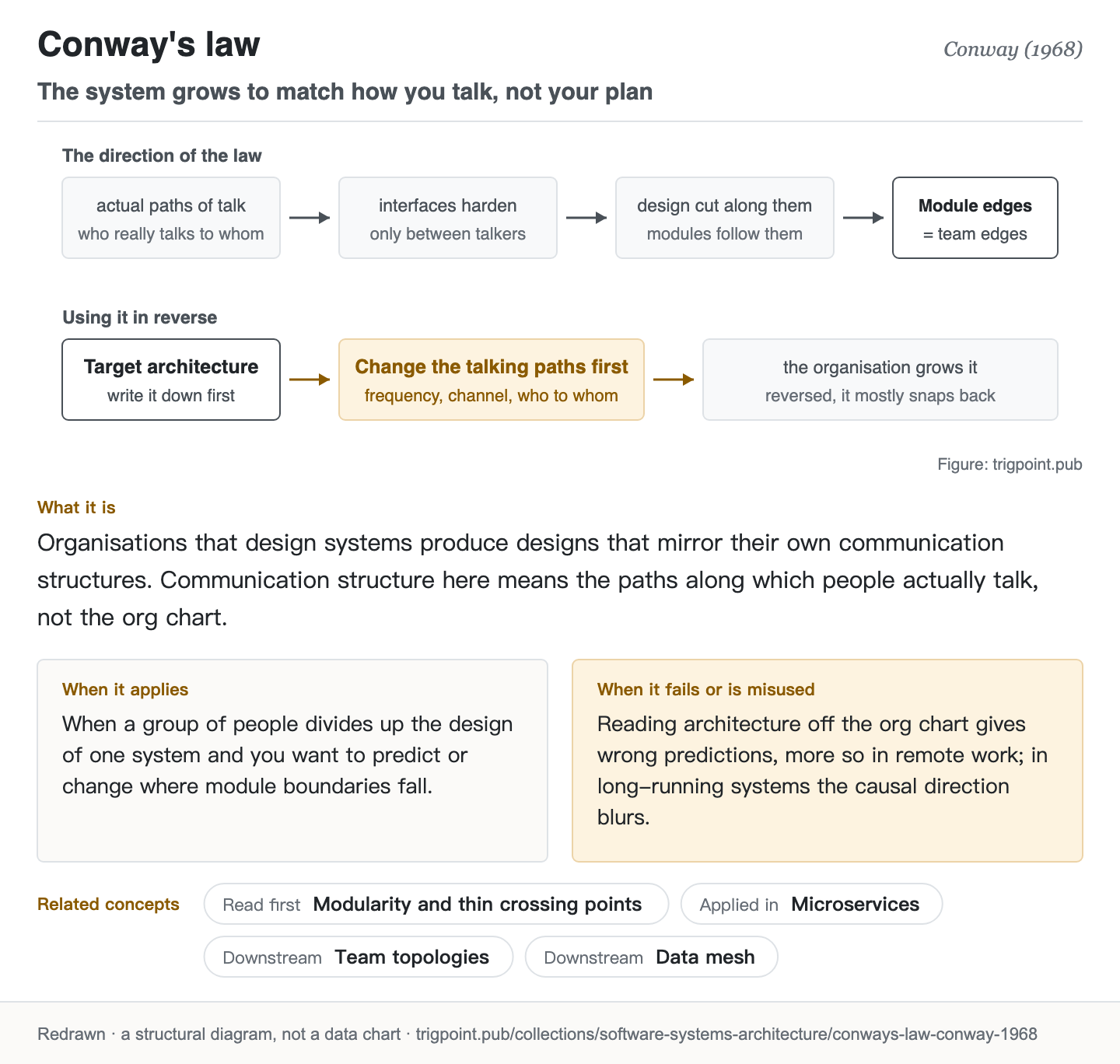
- When a group of people divides up the design of one system and you want to predict or change where module boundaries fall.
- Evidence
- Conceptual framework; Abstracts checked
- Breaks down when
- Reading architecture off the org chart gives wrong predictions, more so in remote work; in long-running systems the causal direction blurs.
1. What happened
The communication structure in this law means who actually talks to whom; the lines on the org chart are a different map. Conway's 1968 paper How Do Committees Invent? makes one claim: organisations that design systems are constrained to produce designs that are copies of the communication structures of those organisations[1]Conway, M. E. (1968). How Do Committees Invent? Datamation, 14(4), 28–31. Bibliographic details confirmed by two sources. Claims matched against the full text. Published in the April 1968 issue. The sentence carrying the claim is confirmed word for word against the full text: organizations which design systems (in the broad sense used here) are constrained to produce designs which are copies of the communication structures of these organizations..
The mechanism is not mysterious. Once a division of labour is settled, fixed interfaces of communication form with it: who talks to whom every day, who talks to whom once a quarter, who never talks to whom at all. And an interface between two modules can only be negotiated between people who can communicate.
Two people who speak daily will negotiate a fine-grained interface they can adjust at any time. Between two people who do not speak, what appears is a coarse, hard-coded interface that neither dares touch. The boundaries of the system therefore grow into the boundaries of the teams.
The claim has since been tested empirically: a 2012 study found that loosely coupled organisations produce significantly more modular products[4]MacCormack, A., Baldwin, C., & Rusnak, J. (2012). Exploring the duality between product and organizational architectures: A test of the “mirroring” hypothesis. Research Policy, 41(8), 1309–1324. Bibliographic details checked against the official record. Consistent with the abstract. Empirical test of the mirroring hypothesis. The abstract reports that, comparing matched pairs of products, in every pair the product developed by the more loosely coupled organisation was significantly more modular. This site checked the abstract of the working-paper version under the same title, not the full text of the journal article.. So it is more than a serviceable metaphor; it has quantitative support.
Its most valuable use is the reverse one. If architecture mirrors communication structure, then to get a particular architecture you go and build that communication structure, letting the organisation grow the shape you want rather than pushing a design that sits crosswise to it. In practice this reverse use is what turns the law from an observation into an instrument.
2. Why this matters to you
The most direct sentence this page has for you: your working system will grow into the shape of how you talk, not into the shape of your plan.
Concretely. How you collaborate with a model decides what tools you end up building. If your habit is to open a new conversation each time and paste the background in again, you will build a stock of prompt templates. If your habit is to let one context accumulate, you will build state files. Those two products are not a difference of taste. They are a mirror of two ways of communicating.
The same thing is more visible with people. With a collaborator you speak to daily, the interface between you will be vague and flexible (use your judgement). With one you speak to monthly, the interface turns into a written-down specification. Both interfaces are products of the frequency of communication rather than products of a design decision. And when you complain that the specification is too rigid, what actually wants changing may be how often you talk.
So this page offers two questions and one ordering.
First question: is my current working structure something I designed, or a copy of how I communicate. Most of the time it is the second, and the second grows faster than the first.
Second question: what paths of communication would the structure I want need in order to grow. If the answer is daily conversation and you actually speak once a week, that structure will not appear, and forcing it will not make it appear.
The ordering: move communication first, then wait for structure. Doing it the other way round, changing structure and expecting communication to follow, is nearly always pulled back into shape by organisational inertia, which is the other half of the law talking.
When does it get in the way? When you rush to draw system boundaries from the org chart in your hand, or when a stuck team uses it to persuade itself that the structure is just how things are. In the first case, look first at who each person actually works with; in the second, change one talking path first and see whether the structure loosens.
Counter-examples and failure boundaries
The first boundary is that a constraint is not a fate, and this is the most common direction of misreading. The law states a tendency to mirror, not something that cannot be resisted. Deliberate organisational design can work against it, and the reverse use is the evidence. Treating it as therefore the architecture cannot be changed turns an observation into an excuse.
The second boundary is the difference between communication structure and the org chart. The law is about the paths along which people actually talk, and those often disagree with the formal hierarchy: two people in different departments may collaborate daily, two in the same department may not speak for six months. Apply an org chart to an architecture and you get the wrong prediction. This shows up more sharply in remote and asynchronous work, where formal structure and actual paths diverge further.
The third boundary is ambiguity of direction. The law says organisation constrains design, and the reverse also holds: an existing system structure hardens communication paths, because you can only interface with the people you have to interface with. So in a system that has been running for years, telling whether the organisation produced the structure or the structure produced the organisation is difficult. That makes causal argument delicate and does not affect the practical use: when both directions hold, moving communication first is still the cheaper move.
Lab cases 2 first-hand cases from our studio
Our system grew into the shape of how we talk
Situation: our work is split into several lines, each with its own working sessions and its own folder. The team architecture document records one fact as a “current limitation”: the lines of work have no direct communication with each other, and every handoff is relayed by hand through the person running the studio. Three things grew under that limitation. The first is an inbox for each line. A handoff note can only be dropped into it, and only with the go-ahead of the person running the studio.
The second is a central handoff ledger, set up on 16 May 2026, recording who passed each handoff to whom, when, by when it should be done, and whether it has closed; by 25 October 2026 it held over seven hundred entries. The third is a coordination board that a program generates from the ledger and the work records; from 7 June 2026 it replaced two earlier boards. No line connects directly to another. On 6 July 2026 the limitation went onto a list of things we expressly do not do. Changing it needs the approval of the person running the studio, and the stated reason is that direct communication would remove the control point of the decision rights structure.
Decision point: on 29 August 2026 we took stock of the built-in features our tool environment had gained over the previous few months. One of them let working sessions message each other directly, so the original limitation no longer existed in technical terms. There were at least four workable options. One, use direct messages as the channel for handoffs between lines and retire the relay through the person running the studio. Two, run direct messages alongside the ledger and record each message there. Three, try it for a while and decide later. Four, use none of it between lines and keep the inbox and the ledger as they were.
What we did and what happened: the stock-take settled on the fourth option and recorded it as permanent rather than deferred. Its overall finding was that our existing mechanisms are there because governance needs them, whether or not a matching built-in feature existed at the time. On 15 October 2026 the tool environment added a feature by which a child working session reports back automatically to the session that started it. We adopted it and recorded at the same time that it only saves the person running the studio the step of passing on “done”. It does not authorise direct communication between lines, and every handoff is still recorded in the ledger.
Take-away: if the structure of a working system grew under some communication limitation, then when that limitation disappears in technical terms, first list the parts of the structure that depend on it (who may drop a note, who keeps the record, who rules). If they can be listed, write the limitation down as an explicit rule before assessing the new channel, rather than connecting it simply because it can now be done.
The division of labour moves first, the structure follows
On 18 May 2026 a product line of work that had existed for less than a month was retired entirely, and its responsibilities folded into the brand line. Moving its folder was only one part of the job: the old division of labour was also written down elsewhere, and not all of it was in plain view. What had to be decided on the day was how to find it. There were at least four workable approaches, and each would have found a different set of places.
Trigpoint Pass content · includes an applicable list
- A common retelling, Conway named it Conway's law himself: the name was given by others. One account has people at a 1968 symposium already calling it that; another, on the author's own website, has a widely read software engineering book (first edition 1975) giving it the name when citing the paper. What the author put forward was a claim and a paper, not the name. #
- A common retelling, architecture mirrors the org chart: the law is about actual communication paths, who really talks to whom, and these often disagree with the formal hierarchy. Fitting an org chart to an architecture leads to misjudgement. #
- A common retelling, it is an iron law, so changing the architecture is pointless: it is a constraint, not a fate. Deliberate design of the communication structure can turn it to use in reverse, which is its most valuable use. #
Records how far each claim was checked, not a guarantee that it is true.
Corrections- This site gives the issue as 14(4), in line with most bibliographic records; another source gives 14(5).
How it was checked
The anchor for this page belongs to the single-model tool-grounded batch of mid-June 2026: no second model was run over it. The upstream has an explicit reason (settled disciplinary common knowledge, low cost of error), and this site marks it as it stands without upgrading it.
Four findings fold into the page. First, the author, year, periodical and issue of Conway's 1968 paper were checked against two bibliographic records, and the sentence carrying the claim is confirmed word for word against the full text[1]Conway, M. E. (1968). How Do Committees Invent? Datamation, 14(4), 28–31. Bibliographic details confirmed by two sources. Claims matched against the full text. Published in the April 1968 issue. The sentence carrying the claim is confirmed word for word against the full text: organizations which design systems (in the broad sense used here) are constrained to produce designs which are copies of the communication structures of these organizations.[3]Issue: most bibliographic records give 14(4), and this site follows them; volume 14 of the periodical ran to 12 issues in 1968. Another source gives 14(5).. That item counts as strong on this shelf: most nodes here rest on blogs or self-published files, and this page rests on a paper in a contemporary periodical.
Second, the attribution of the name was checked and corrected to a name given by others; there are two accounts of who gave it, and this page sets both out[2]Attribution of the name: the author did not name it himself, and there are two accounts. The IEEE Computer Society's pioneer biography records that George Mealy named it at a symposium on modular programming in July 1968; the author's own website records that Brooks called it Conway's law when citing the paper in The Mythical Man-Month. This site sets both accounts side by side and does not rule between them.. Third, the conflicting issue number (another source gives 14(5)) is listed as it stands, and this page follows most records with 14(4)[3]Issue: most bibliographic records give 14(4), and this site follows them; volume 14 of the periodical ran to 12 issues in 1968. Another source gives 14(5).. Fourth, the empirical test of the mirroring hypothesis was checked at the level of its abstract: the abstract reports that in every matched pair the product of the more loosely coupled organisation was significantly more modular; the full text was not checked[4]MacCormack, A., Baldwin, C., & Rusnak, J. (2012). Exploring the duality between product and organizational architectures: A test of the “mirroring” hypothesis. Research Policy, 41(8), 1309–1324. Bibliographic details checked against the official record. Consistent with the abstract. Empirical test of the mirroring hypothesis. The abstract reports that, comparing matched pairs of products, in every pair the product developed by the more loosely coupled organisation was significantly more modular. This site checked the abstract of the working-paper version under the same title, not the full text of the journal article., so this page says only that there is quantitative support and quotes none of its numbers.
One residual. This page makes no statement about how strong the mirroring is. The empirical study by MacCormack and colleagues reports significantly more modular, and this site has not checked its effect size or sample conditions, so no strength is reported at all. If someone asks how accurate the law is, the correct answer is that this page cannot say.
How to read the source notes “Bibliographic details checked” means author, year, title and venue were confirmed. It does not mean the source's claims were checked. “Consistent with the abstract” means the claim agrees with the paper's abstract. It does not include sentence-by-sentence checking against the full text. “Matched against the full text” means the claim was compared with the text of the source itself. Definitions as of 2026-09-20.
- [1] Conway, M. E. (1968). How Do Committees Invent? Datamation, 14(4), 28–31. ↩
- [2] Brooks, F. P. (1975). The Mythical Man-Month: Essays on Software Engineering. Addison-Wesley.
- [3] Conway, M. E. (1968). How Do Committees Invent? Datamation, 14(4), 28–31.
- [4] MacCormack, A., Baldwin, C., & Rusnak, J. (2012). Exploring the duality between product and organizational architectures: A test of the “mirroring” hypothesis. Research Policy, 41(8), 1309–1324. ↩
Tell me when a new shelf opens
Tell me when a new shelf opens
Shelf notices are sent only when a new shelf opens or when the reading rules change.
Tell the editor privately: a correction, a counter-example or where it applies
Submissions are read only by the editor, and nothing is published before they are handled. Once a note is handled, a summary and response written by the editor are published. No sign-up is needed, and the nickname may be left blank.
We have your note