In three sentences
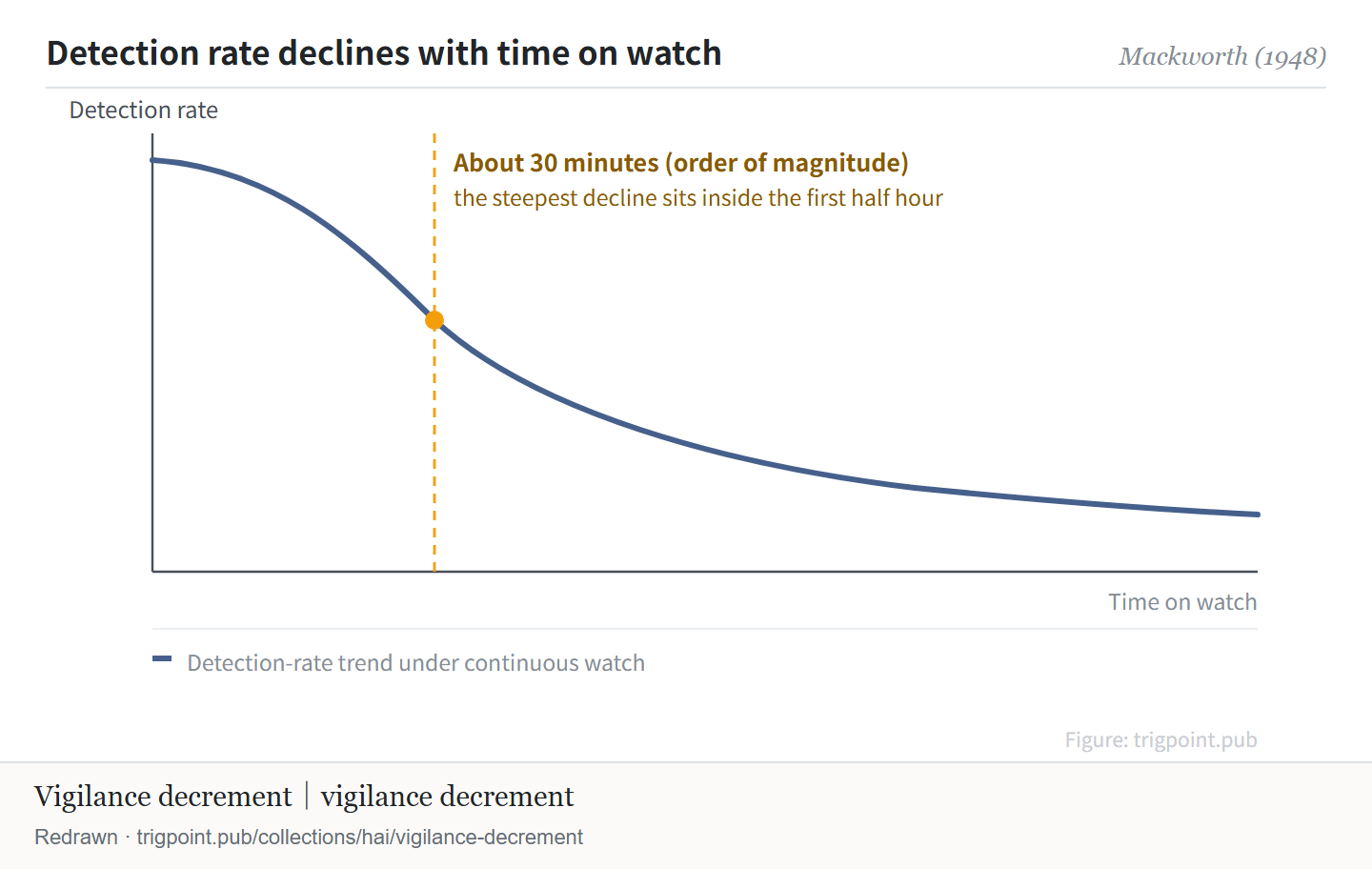
When a person watches a signal source that rarely changes, detection rate declines over time; in Mackworth's experiment it had dropped measurably within about thirty minutes (an order of magnitude, reported secondhand). So when the only safeguard is having someone watch the automation, the risk of a miss grows with time on watch, and the timing and size need calibrating to your own situation. This is not a discipline problem. It is a limit of human attention, and the fix belongs in the design, not in trying harder.
Figure 1 · Decay of detection rate during sustained monitoring. As reported secondhand, in Mackworth's radar-clock experiment detection rate falls sharply within roughly the first thirty minutes and then continues to decline slowly. The trend is redrawn; the primary data were not checked, so the shape is shown without a numeric scale. View full size ▸Share PNG ▸
During the Second World War, airborne radar operators of the British RAF Coastal Command were missing submarine signals in the back half of a watch. Mackworth reproduced the effect with a clock face whose hand jumped in steps: the subject watched the pointer and reported the occasional double jump.
Attribution where due: "Vigilance" as a neurological concept appears earlier, in Henry Head (1923). What Mackworth contributed in 1948 is the first systematic experiment and the quantified curve. Predecessors are predecessors; the experiment is the experiment.
2. Why this matters to you
Handing an AI agent's output to "someone will keep an eye on it" bets the reliability of the system on a curve that slides the longer the watch runs. Your attention depletes. So a human-oversight design that amounts to asking someone to watch is not a safety mechanism. It is safety theatre.
The question is not who watches. It is how the monitoring surface should be built so that it still catches things once the human has slackened: rotation, sampling, and pushing anomalies to the person rather than waiting for the person to find them.
Boundary: "about thirty minutes" is an order of magnitude and not a constant, reaches us through secondary reporting, and must be calibrated against your own data before it goes into a shift specification; this page does not supply the numeric shape of the curve.
False alarm P0: how one false warning blunted a whole monitoring surface
The start-up briefing reported a backlog of 13 to 15 days for several days running. The real figure was 0 days, and the root cause was one line that assumed an order. The most expensive loss was not that bug. It was noticing that we had started skipping the red warnings automatically. The fix was not to tell anyone to read more carefully, it was to change the detection to a mechanism that does not depend on order. The full case carries the incident timeline, the correction diff, and the spot-check rule adopted afterwards.
02
Trigpoint PassField record · doctrine clause level
Redesigning the monitoring surface: how the thirty minute ceiling became a rule
We wrote the Mackworth curve straight into governance: which surfaces may keep a standing monitor, which must switch to push notification, and how the spot-check frequency is set.
Trigpoint Pass content · includes an applicable clause template
How to read the source notes “Bibliographic details checked” means author, year, title and venue were confirmed. It does not mean the source's claims were checked. Definitions as of 2026-09-20.
[1] Mackworth, N. H. (1948). The breakdown of vigilance during prolonged visual search. Quarterly Journal of Experimental Psychology, 1(1), 6–21. https://doi.org/10.1080/17470214808416738↩
[2] Head, H. (1923). The conception of nervous and mental energy (II): 'Vigilance'; a physiological state of the nervous system. British Journal of Psychology, 14, 126–147. https://doi.org/10.1111/j.2044-8295.1923.tb00122.x
[3] Parasuraman, R., & Manzey, D. H. (2010). Complacency and bias in human use of automation. Human Factors, 52(3), 381–410. https://doi.org/10.1177/0018720810376055
Tell the editor privately: a correction, a counter-example or where it applies
An editor reviews submissions once a week. Once a note is handled, its summary and response are listed on the discussion and response record; nothing is published before then. No sign-up is needed, and the nickname may be left blank.