Levels of automation
1. What happened
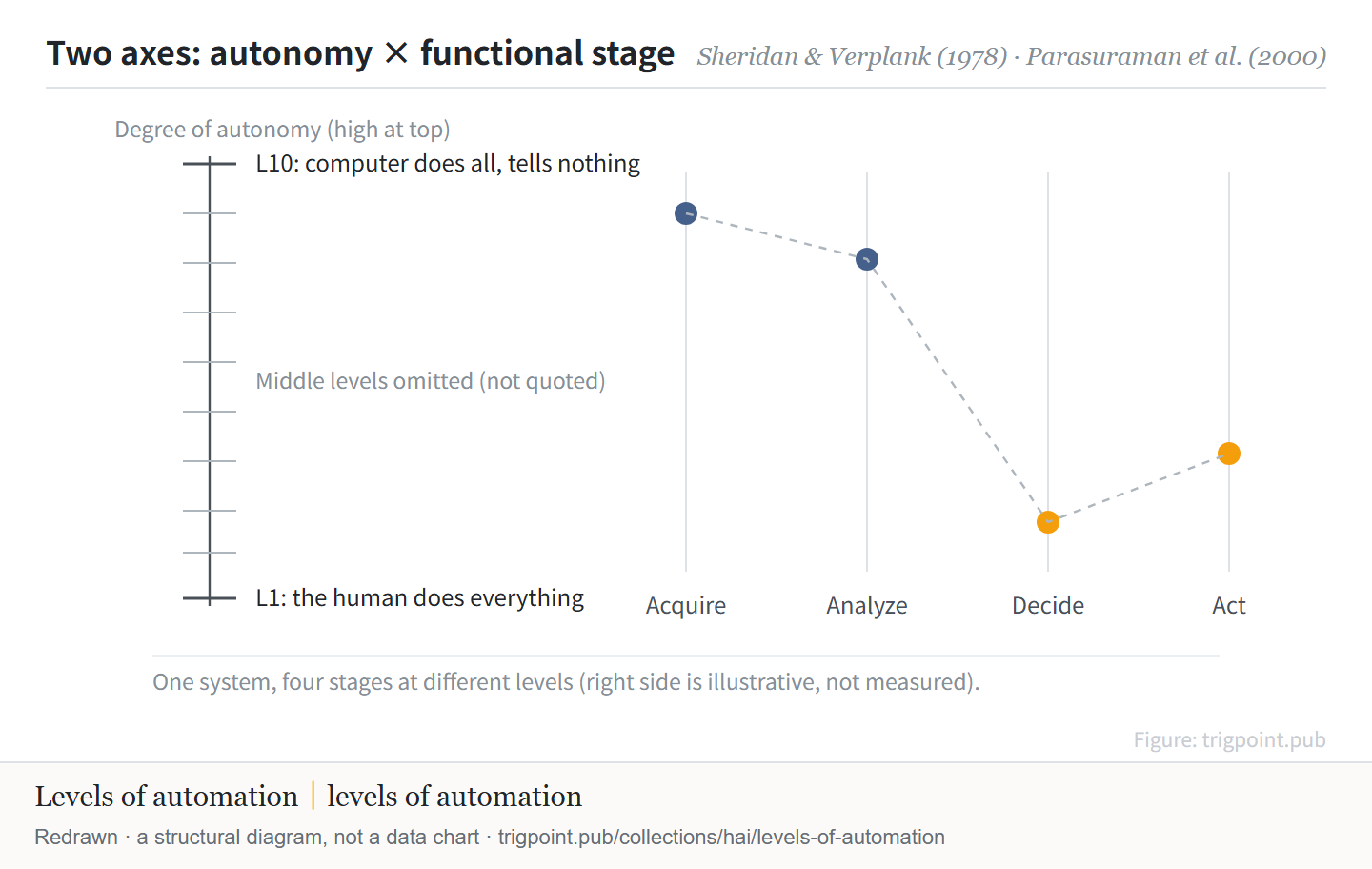
Treating automation as a switch misses one thing: different stages of the same system can sit at different levels. In 1978 Sheridan and Verplank proposed a ten-point scale of autonomy in a research report on undersea teleoperation, running from level one, where the human does everything, to level ten, where the computer acts and does not inform the human[1]Sheridan, T. B., & Verplank, W. L. (1978). Human and Computer Control of Undersea Teleoperators. MIT Man-Machine Systems Laboratory. Bibliographic details checked against the official record. Provenance double-checked across models. This page does not quote the original wording level by level..
In 2000 Parasuraman, Sheridan and Wickens added a second axis: automation acts on four classes of information processing (acquisition, analysis, decision, action), and each class can be set independently[2]Parasuraman, R., Sheridan, T. B., & Wickens, C. D. (2000). A Model for Types and Levels of Human Interaction with Automation. IEEE Transactions on Systems, Man, and Cybernetics, Part A, 30(3), 286–297. Bibliographic details checked against the official record. Provenance double-checked across models..
There is evidence on the cost side too. Endsley and Kaber (1999) had 30 participants work a dynamic control task at different levels of automation. Performance gains came mainly from automating the implementation stage, and only under normal operation. Once the human was removed from implementation, recovery after an automation failure suffered. When human and computer generated options together, performance fell below either one alone. Automating the decision stage, meaning the choice among options, brought lower workload and higher situation awareness, with only a slight gain in performance[3]Endsley, M. R., & Kaber, D. B. (1999). Level of automation effects on performance, situation awareness and workload in a dynamic control task. Ergonomics, 42(3), 462–492. Bibliographic details checked against the official record. Provenance double-checked across models. The sentences reporting experimental results follow the paper's abstract.. So "how automated should this be" is a stage-by-stage trade-off, not a case of higher being better.
2. Why this matters to you
The most useful move when granting authority to an AI agent is to split the work into the four stages and ask about each one. Can gathering be fully automated? Can analysis? What about the decision? What about execution? For most situations the answers differ: gathering and analysis can sit high on the scale, while decisions and irreversible actions stay low. A blanket "trust the AI" or "do not trust the AI" gives you nothing to act on inside this framework.
Boundary: moving up the scale is a trade. In the same experiment, implementation-stage automation raised performance under normal operation but left recovery from failure worse, and joint option generation lowered performance. The ten-point scale was written for 1978 undersea teleoperation, so confirm your setting is comparable before reusing it.
Verification record
Records how far each claim was checked, not a guarantee that it is true.
All three bibliographic anchors hold. Parasuraman, Sheridan and Wickens 2000 (IEEE Trans SMC-A 30(3):286–297)[2]Parasuraman, R., Sheridan, T. B., & Wickens, C. D. (2000). A Model for Types and Levels of Human Interaction with Automation. IEEE Transactions on Systems, Man, and Cybernetics, Part A, 30(3), 286–297. Bibliographic details checked against the official record. Provenance double-checked across models. and Endsley and Kaber 1999 (Ergonomics 42(3):462–492)[3]Endsley, M. R., & Kaber, D. B. (1999). Level of automation effects on performance, situation awareness and workload in a dynamic control task. Ergonomics, 42(3), 462–492. Bibliographic details checked against the official record. Provenance double-checked across models. The sentences reporting experimental results follow the paper's abstract. match field for field. The experimental results attributed to Endsley and Kaber come from the paper's abstract; the full text was not checked. The ten-point scale does originate in the 1978 Sheridan and Verplank report from MIT rather than in the 1980 or 1992 sources it is sometimes cited to, and that dating converges across the DTIC record, the WorldCat entry, and the secondary citation record[1]Sheridan, T. B., & Verplank, W. L. (1978). Human and Computer Control of Undersea Teleoperators. MIT Man-Machine Systems Laboratory. Bibliographic details checked against the official record. Provenance double-checked across models. This page does not quote the original wording level by level..
One further check concerns where the four stages came from. That skeleton was not invented in 2000; the paper says it builds on the existing human information processing tradition, and a deeper pass also corrected a bibliographic mispairing from the first check, where the publisher and the ISBN prefix for Wickens 1984 had been matched to the wrong house.
One item stays unverified: the table number and pagination inside the 1978 report were not checked against the primary source, so this page places the scale in Chapter 8 on the strength of secondary citations and does not commit to a table number[1]Sheridan, T. B., & Verplank, W. L. (1978). Human and Computer Control of Undersea Teleoperators. MIT Man-Machine Systems Laboratory. Bibliographic details checked against the official record. Provenance double-checked across models. This page does not quote the original wording level by level..
Verification layer · Counter-examples and failure boundaries
Both misuses come from flattening the two axes into one. The first is treating level of automation as one setting for a whole system, which throws away the stage-by-stage resolution that is the entire contribution of the framework. The second is merging autonomy level and processing stage into a single axis, which puts you back in switch-style binary thinking after a longer route.
Two further boundaries. In that experiment, implementation-stage automation improved performance under normal operation, but removing the human from implementation left recovery after a failure worse, and joint option generation lowered performance[3]Endsley, M. R., & Kaber, D. B. (1999). Level of automation effects on performance, situation awareness and workload in a dynamic control task. Ergonomics, 42(3), 462–492. Bibliographic details checked against the official record. Provenance double-checked across models. The sentences reporting experimental results follow the paper's abstract.. Moving up the scale is therefore a trade to be weighed, not a free upgrade. And the ten-point scale itself was written in 1978 for undersea teleoperation, with its individual level wordings never checked against the primary source. Before treating it as a general-purpose set of settings, confirm that your situation is comparable to remote manipulation.
Lab cases 2 first-hand cases from our studio
Suggest, do not execute: every automated step is locked below the decision layer
The automated review surfaces in the studio share one red line: the machine offers suggestions, lists and warnings, and the flipping of a state is always left to a person. This is not distrust of automation. It is allocation by stage: information acquisition and analysis are set high, decision and irreversible action are locked low. The full case carries where the red line came from, which surfaces tried to cross it, and how it was held.
The four-stage allocation table: which stages may be fully automated and which may not
The four stages, acquisition, analysis, decision and execution, are split apart, and every automated surface fills in one row with its level and the reason alongside.
How to read the source notes “Bibliographic details checked” means author, year, title and venue were confirmed. It does not mean the source's claims were checked. Definitions as of 2026-09-20.
- [1] Sheridan, T. B., & Verplank, W. L. (1978). Human and Computer Control of Undersea Teleoperators. Cambridge, MA: MIT Man-Machine Systems Laboratory. https://doi.org/10.21236/ADA057655 ↩
- [2] Parasuraman, R., Sheridan, T. B., & Wickens, C. D. (2000). A Model for Types and Levels of Human Interaction with Automation. IEEE Transactions on Systems, Man, and Cybernetics, Part A, 30(3), 286–297. https://doi.org/10.1109/3468.844354 ↩
- [3] Endsley, M. R., & Kaber, D. B. (1999). Level of automation effects on performance, situation awareness and workload in a dynamic control task. Ergonomics, 42(3), 462–492. https://doi.org/10.1080/001401399185595 ↩
Tell the editor privately: a correction, a counter-example or where it applies
An editor reviews submissions once a week. Once a note is handled, its summary and response are listed on the discussion and response record; nothing is published before then. No sign-up is needed, and the nickname may be left blank.
We have your note