Function allocation
1. What happened
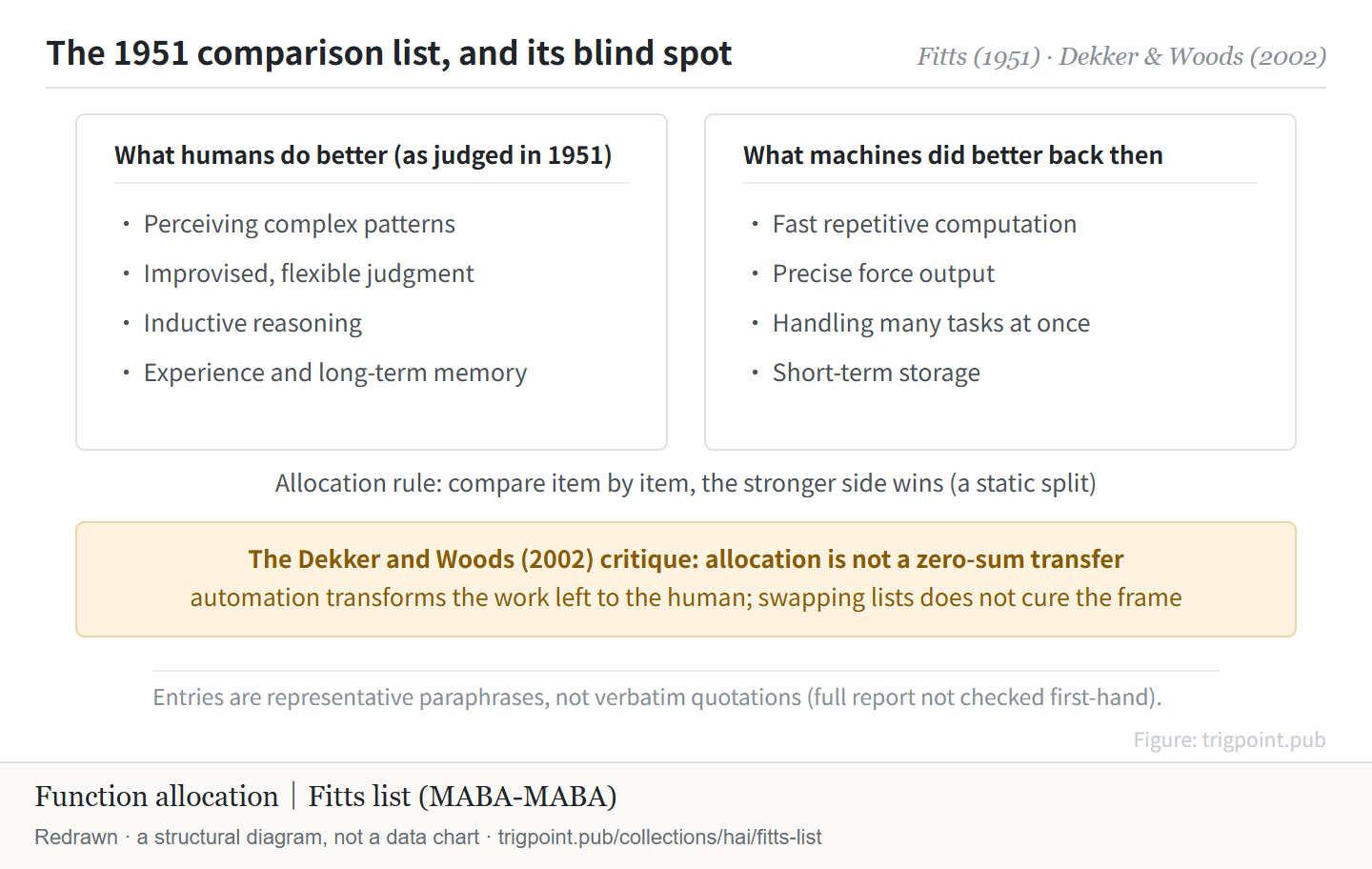
On the face of it, dividing work means handing each task to whichever side does it better. In 1951 a National Research Council report edited by Fitts gave the designers of air navigation and traffic control systems a comparison list. Humans were better at perceiving patterns, improvising judgement, and adapting to the unexpected; the machines of that decade were better at high-speed repetition, precise force, and running several channels at once[1]Fitts, P. M. (Ed.) (1951). Human Engineering for an Effective Air-Navigation and Traffic-Control System. Washington, DC: National Research Council. Bibliographic details cross-checked against multiple sources. The content of the list follows secondary accounts that agree with one another.. Later readers took this as a direct design rule: compare item by item, and the stronger side takes the function. The 1951 report itself is more guarded and says it cannot foresee what machines will be built to do.
Half a century later Dekker and Woods identified the problem underneath. The framework assumes allocation is a zero-sum transfer, moving a task from the human column into the machine column and leaving the rest as it was[2]Dekker, S. W. A., & Woods, D. D. (2002). MABA-MABA or Abracadabra? Progress on Human-Automation Co-ordination. Cognition, Technology & Work, 4(4), 240–244. Bibliographic details confirmed by two sources. The summary of the core claims follows secondary accounts that agree with one another.. The real effect of automation is qualitative. It reshapes the work that remains and forces people to rebuild their skills and routines. An outdated list can be replaced. The defect in the frame cannot.
2. Why this matters to you
Every "these go to the AI, those stay with us" list repeats Fitts's assumption. Hand data cleanup to an agent and the remainder is a different job: checking data that something else cleaned. The question a delegation design has to answer is not "which of these does it do better than me". It is "once I hand this over, what has my own work become". The list only starts being useful after you can answer the second question.
Boundary: the entries age, but what actually fails is the interchangeable-container assumption; the eleven-statement structure has not been quote-verified, so do not build a method on its exact wording.
Lab cases Written only where there is evidence
No field record for this node yet.
How to read the source notes “Bibliographic details checked” means author, year, title and venue were confirmed. It does not mean the source's claims were checked. “Follows secondary accounts” means the claim rests on sources that report it, not on the original document. Definitions as of 2026-09-20.
- [1] Fitts, P. M. (Ed.) (1951). Human Engineering for an Effective Air-Navigation and Traffic-Control System. Washington, DC: National Research Council, Committee on Aviation Psychology. ↩
- [2] Dekker, S. W. A., & Woods, D. D. (2002). MABA-MABA or Abracadabra? Progress on Human-Automation Co-ordination. Cognition, Technology & Work, 4(4), 240–244. https://doi.org/10.1007/s101110200022 ↩
Tell the editor privately: a correction, a counter-example or where it applies
An editor reviews submissions once a week. Once a note is handled, its summary and response are listed on the discussion and response record; nothing is published before then. No sign-up is needed, and the nickname may be left blank.
We have your note