Adaptive automation
1. What happened
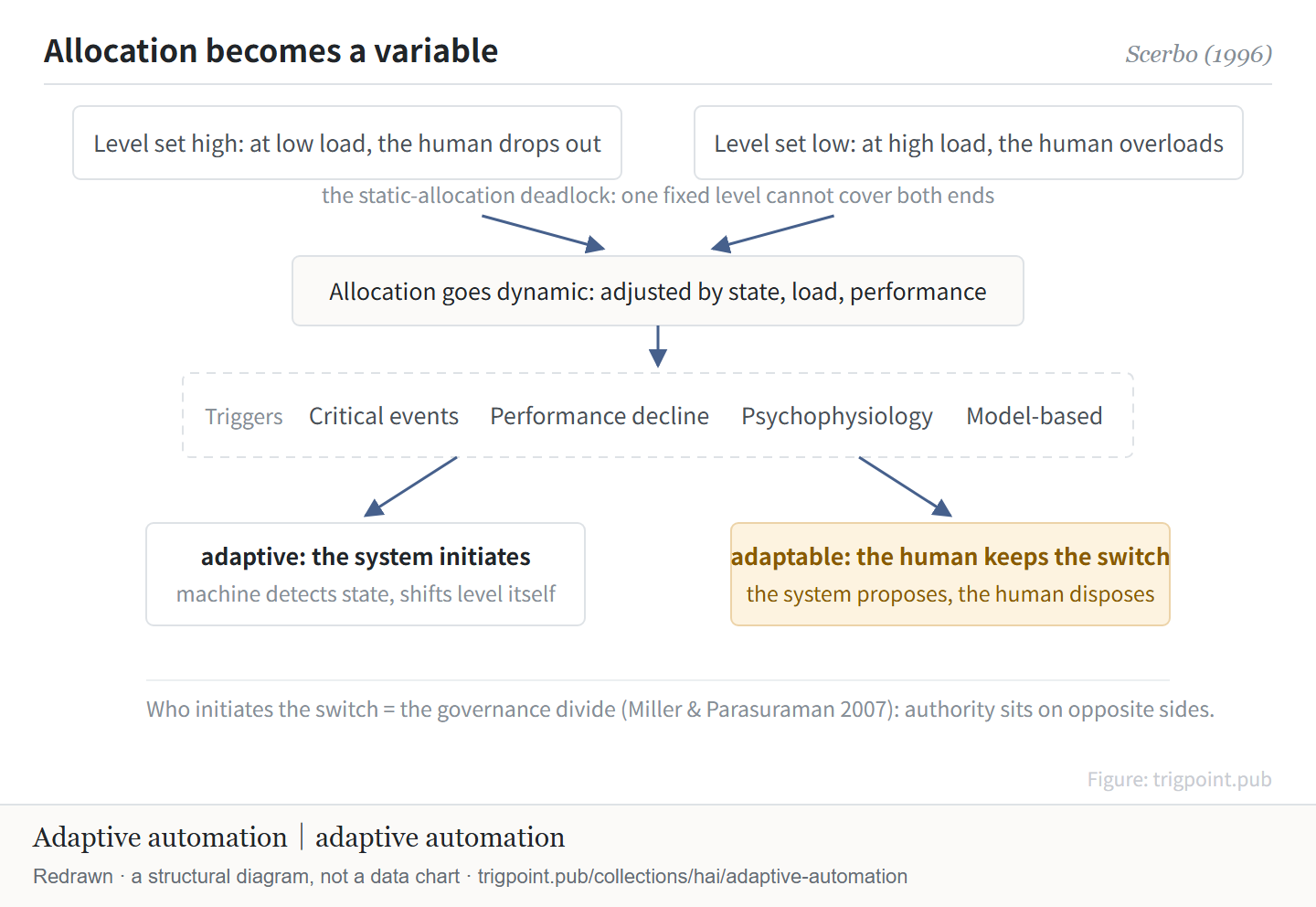
Static levels have a deadlock. Set the level high and the operator is out of the loop when load is low; set it low and the operator is overloaded when load is high. One setting cannot cover both ends. In 1996 Scerbo consolidated the theoretical form: let the allocation vary over time[1]Scerbo, M. W. (1996). Theoretical Perspectives on Adaptive Automation. In Parasuraman & Mouloua (Eds.), Automation and Human Performance: Theory and Applications (pp. 37–63). Erlbaum. Bibliographic details cross-checked against multiple sources. The summary of the core claims follows secondary accounts that agree with one another.. Triggers commonly discussed in the literature include critical events, performance degradation, psychophysiological measures and model-based estimates.
Kaber and Endsley later showed empirically that the level itself remains the main driver of performance, while adaptive switching mainly affected subjective workload and secondary task performance, with little effect on primary task performance or situation awareness. The study switched on a predefined schedule, not on the operator's state in the moment[2]Kaber, D. B., & Endsley, M. R. (2004). The Effects of Level of Automation and Adaptive Automation on Human Performance, Situation Awareness and Workload in a Dynamic Control Task. Theoretical Issues in Ergonomics Science, 5(2), 113–153. Claims matched against the full text.. The two lines act on different things. Miller and Parasuraman then drew the critical line: adaptive means the system initiates the switch, adaptable means the person keeps that authority, and the two have opposite power structures[3]Miller, C. A., & Parasuraman, R. (2007). Designing for Flexible Interaction Between Humans and Automation. Human Factors, 49(1), 57–75. Bibliographic details confirmed by two sources. The distinction between adaptive and adaptable automation follows secondary accounts that agree with one another..
2. Why this matters to you
"Let the system decide when to take over" sounds like the most intelligent option, and it also means handing over the switch. For a one-person studio that line is the core of governance: the automated surface can have schedules, triggers and recommendations, but who presses the switch decides where responsibility and awareness sit when something goes wrong. Wherever the judgement needs human input, the switch should not stay with the system.
Boundary: adaptive means the system initiates the switch and adaptable keeps that authority with the person, and the two are not interchangeable; moving does not automatically beat staying still, since in the evidence adaptive switching mainly shifted subjective workload rather than primary task performance or situation awareness; the canonical definitions are not quoted on this page.
Lab cases 2 first-hand cases from our studio
We took three recurring reviews off the scheduler
Three reviews, weekly, monthly and quarterly, used to run unattended on a scheduler. The problem surfaced later: a review that needs human judgement degrades into an unreviewed formality once it sits on a schedule. The ruling changed the allocation. The scheduler now only sends the reminder, and a person starts the review. This is the field version of handing the switch back from the system to the operator. The full case carries how the ruling was reached and the difference before and after.
Who holds the switch: the criteria for shifting the level up or down
Which triggers can be left to the system, and which shifts must be started by a person. We wrote the criteria out class by class.
Trigpoint Pass content · includes a list of criteria
Full access to the lab cases. Trigpoint Pass ▸
- 2026-09-27 · The page said that Kaber and Endsley 2004 showed the effect of adaptive switching varying with the switching cycle, and that badly timed switching adds coordination cost. Against Table 3 and the conclusion of the full text: the switching cycle had no significant main effect on any of the three levels of situation awareness, and adaptive switching mainly affected subjective workload and secondary task performance, with little effect on primary task performance or situation awareness; nothing in the paper supports the coordination cost sentence. The result sentence was rewritten, the coordination cost sentence removed, and a note added that the study switched on a predefined schedule.
How to read the source notes “Bibliographic details checked” means author, year, title and venue were confirmed. It does not mean the source's claims were checked. “Matched against the full text” means the claim was compared with the text of the source itself. “Follows secondary accounts” means the claim rests on sources that report it, not on the original document. Definitions as of 2026-09-20.
- [1] Scerbo, M. W. (1996). Theoretical Perspectives on Adaptive Automation. In R. Parasuraman & M. Mouloua (Eds.), Automation and Human Performance: Theory and Applications (pp. 37–63). Mahwah, NJ: Lawrence Erlbaum Associates. https://doi.org/10.1201/9781315137957 ↩
- [2] Kaber, D. B., & Endsley, M. R. (2004). The Effects of Level of Automation and Adaptive Automation on Human Performance, Situation Awareness and Workload in a Dynamic Control Task. Theoretical Issues in Ergonomics Science, 5(2), 113–153. https://doi.org/10.1080/1463922021000054335 ↩
- [3] Miller, C. A., & Parasuraman, R. (2007). Designing for Flexible Interaction Between Humans and Automation: Delegation Interfaces for Supervisory Control. Human Factors, 49(1), 57–75. https://doi.org/10.1518/001872007779598037 ↩
Tell the editor privately: a correction, a counter-example or where it applies
An editor reviews submissions once a week. Once a note is handled, its summary and response are listed on the discussion and response record; nothing is published before then. No sign-up is needed, and the nickname may be left blank.
We have your note