Ironies of automation
1. What happened
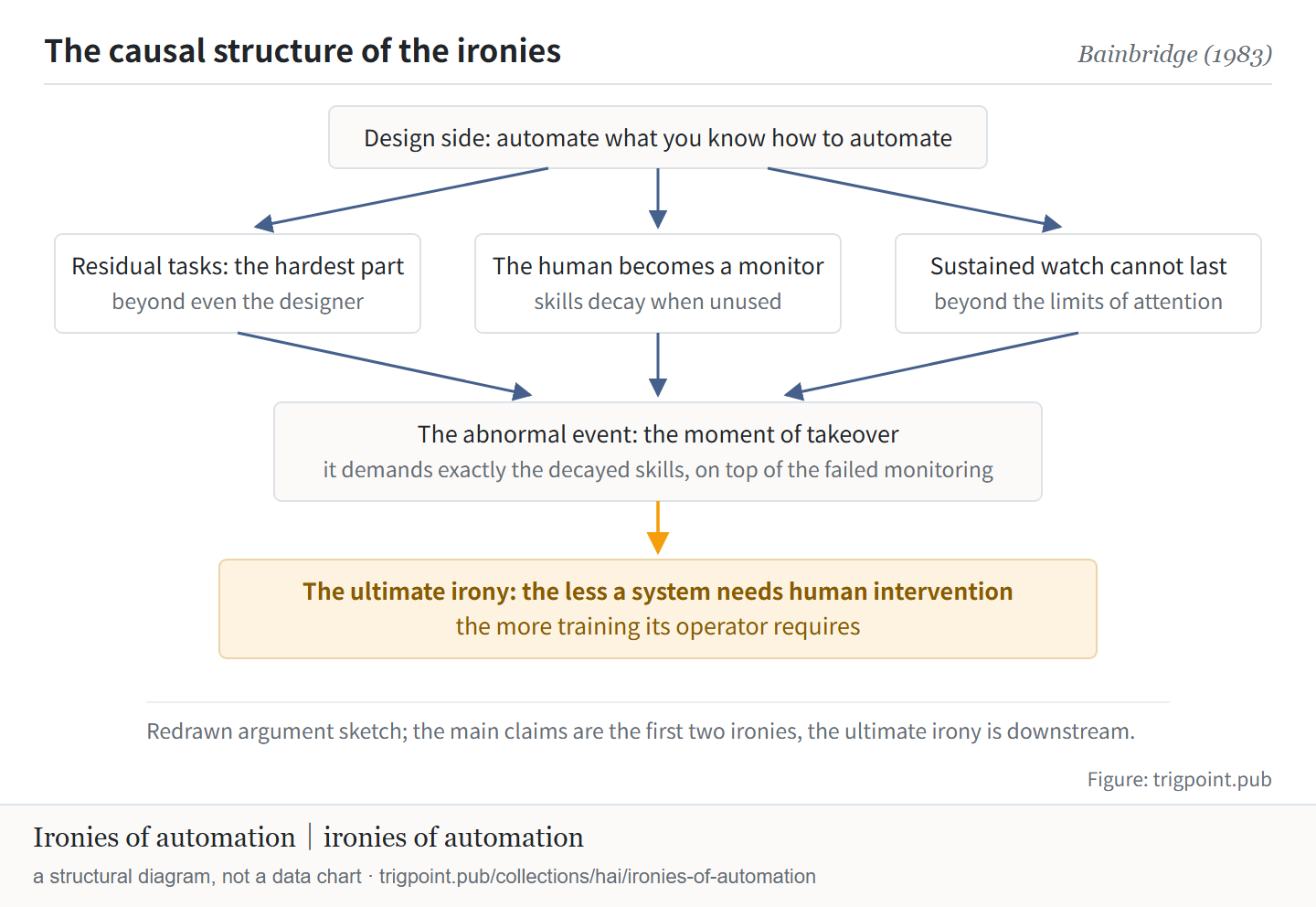
The obvious way to make a system more reliable is to take people out of it. In 1983 Bainbridge, a psychologist at UCL, used five pages to take apart the central assumption of automation design[1]Bainbridge, L. (1983). Ironies of Automation. Automatica, 19(6), 775–779. Bibliographic details cross-checked against multiple sources. Claims matched against the full text.. Designers treat the operator as unreliable and try to design the human out, and she finds two ironies in that attitude. First, designer errors can themselves be a major source of operating problems. Second, a designer can only automate the parts they can see how to automate. What is left over is exactly the set of problems the designer could not solve, and all of it falls back on the operator.
At the same time the human is demoted to monitor. Hands-off for long stretches, manual skill decays. Sustained monitoring is itself beyond human attention, so even noticing that a takeover is needed becomes unreliable. When something finally goes wrong, the system needs the decayed skill and the failed monitoring at the same moment.
Discussing training, she adds one more irony, hedged as an inference: the most successful automated systems, needing manual intervention rarely, may be the ones that need the greatest investment in operator training.
2. Why this matters to you
Hand work to an AI agent and your role does not disappear. It changes shape: from doing the work to handling its exceptions. Handling exceptions is precisely what requires you to keep a feel for the work. So the question a delegation design has to answer is not "can this step be automated". It is "after it is automated, can a human still do what is left".
Keeping a channel where you periodically do the work by hand is not inefficiency. It is the cost of retaining the ability to take over. The more smoothly the automation runs, the more that channel is worth.
Boundary: this is a causal argument with no answer to which level to pick; the half-hour figure is an order of magnitude to reason with.
Verification record
Records how far each claim was checked, not a guarantee that it is true.
This is one of the few nodes where the primary full text was obtained. The 1983 PDF was extracted and checked claim by claim, and after correction all seven substantive claims are present in the original (the pre-publication check found two misreadings, a dropped hedge and a missing first irony, both fixed against the full text): both opening ironies, skill decay, the roughly half-hour ceiling on sustained monitoring, and the hedged inference, made while discussing training, that the most successful automated systems may need the greatest investment in operator training (the original reads "Perhaps … may"; this page keeps the hedge)[1]Bainbridge, L. (1983). Ironies of Automation. Automatica, 19(6), 775–779. Bibliographic details cross-checked against multiple sources. Claims matched against the full text..
Zero corrections to the citation. This pass added the author's full name, Lisanne Bainbridge, her department at UCL, and one guard against a common misdating: the paper was presented at the IFAC conference in Baden-Baden in September 1982 and published in Automatica in 1983. Cite the later year.
One residual: the half-hour figure is Bainbridge citing Mackworth's 1950 research report. This page did not go back to that report independently, so the number stands on her reporting of it. The vigilance-decrement node on this shelf cites Mackworth's 1948 paper, which first reported the radar-clock experiment: detection falls sharply within the first half hour and then keeps declining slowly. It does not switch off at the thirty-minute mark.
Verification layer · Counter-examples and failure boundaries
The most common misuse is reading the paper as an argument against automation. Bainbridge argues for treating the residual human role as a first-class design problem[1]Bainbridge, L. (1983). Ironies of Automation. Automatica, 19(6), 775–779. Bibliographic details cross-checked against multiple sources. Claims matched against the full text..
Three failure boundaries follow. First, this is a causal argument. It explains why raising the level of automation rebounds on the human; which level to pick belongs to levels of automation, and neither substitutes for the other.
Second, the training irony is a hedged downstream inference. Treating it as the thesis strips the argument of its premises, which are the two ironies stated at the opening.
Third, the half-hour figure reaches us through one author's citation of another. Use it as an order of magnitude: it marks the period in which detection drops sharply, not a switch-off point (the experimental curve is on the vigilance-decrement node). Go back to Mackworth's original research before writing it into a specification.
Lab cases Written only where there is evidence
No field record for this node yet.
How to read the source notes “Bibliographic details checked” means author, year, title and venue were confirmed. It does not mean the source's claims were checked. “Matched against the full text” means the claim was compared with the text of the source itself. “Cited as reported in” means the original was not read here; the citation is taken from the source named. Definitions as of 2026-09-20.
- [1] Bainbridge, L. (1983). Ironies of Automation. Automatica, 19(6), 775–779. https://doi.org/10.1016/0005-1098(83)90046-8 ↩
- [2] Mackworth, N. H. (1950). Researches on the Measurement of Human Performance. Cited as reported in Bainbridge (1983).
Tell the editor privately: a correction, a counter-example or where it applies
An editor reviews submissions once a week. Once a note is handled, its summary and response are listed on the discussion and response record; nothing is published before then. No sign-up is needed, and the nickname may be left blank.
We have your note