Situation awareness
1. What happened
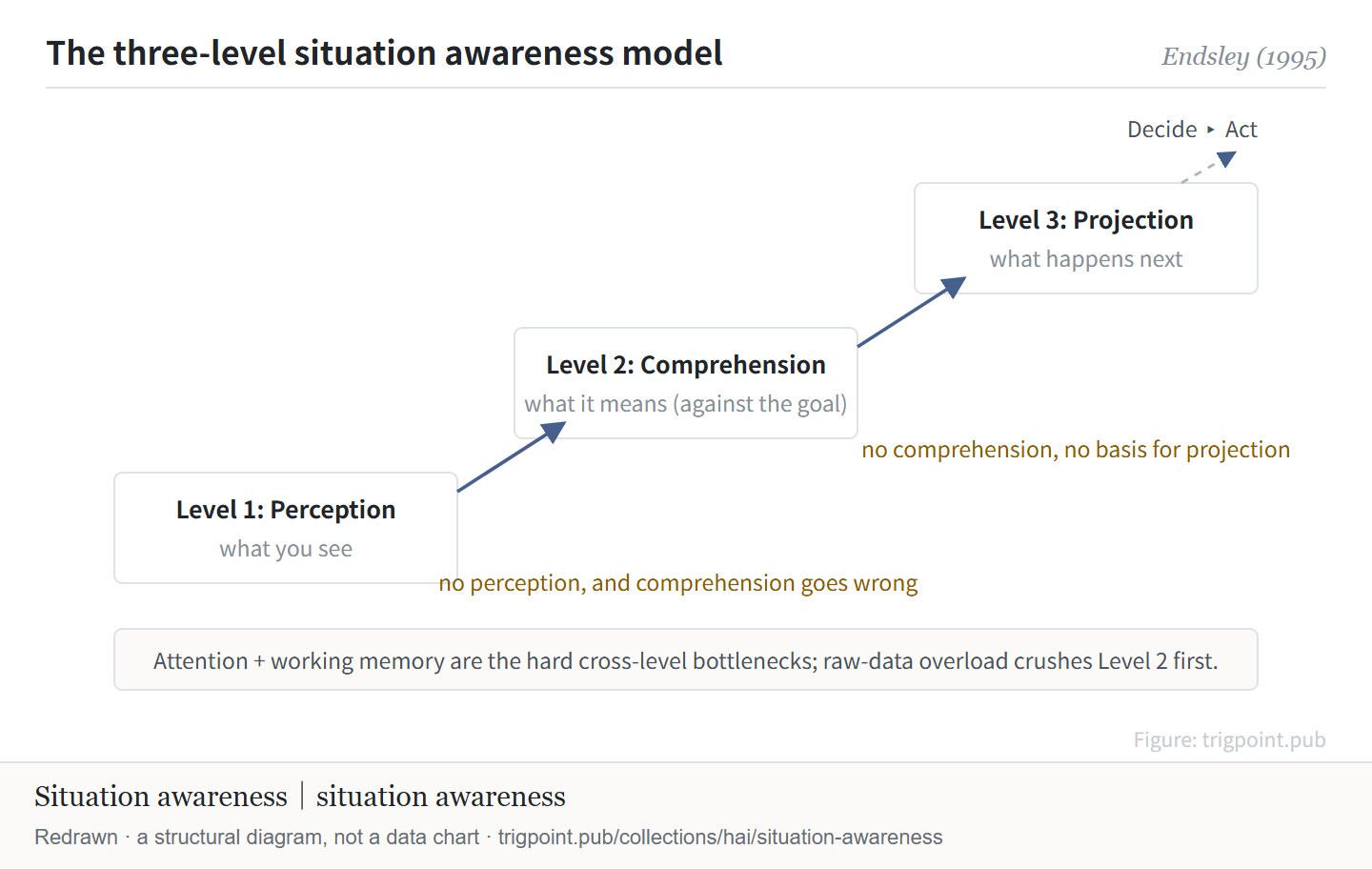
Knowing the situation is not the same as knowing what to do. Endsley took "knowing what is going on", which had been scattered through aviation human factors research, and formalised it into a workable three-level model. The definition of the three levels is usually traced to her 1988 work (by her own later account; this page has not read the 1988 original), and the 1995 paper extended it into a full theory covering attention, working memory, mental models and goal-driven processing[1]Endsley, M. R. (1995). Toward a Theory of Situation Awareness in Dynamic Systems. Human Factors, 37(1), 32–64. Bibliographic details cross-checked against multiple sources.. Level one, perception: detecting the state of the relevant elements in the environment. Level two, comprehension: integrating those elements into meaning relative to a goal. Level three, projection: predicting the near future on the basis of that understanding. The levels ascend, and higher means more complete awareness, but they are not strictly linear stages: a gap in perception makes errors in comprehension likely, yet goal-driven processing and mental models can still produce levels two and three when level one is incomplete. The whole structure is bounded by attention and working memory, most visibly for novices, while experts relieve the limit with mental models and pattern matching. That is why pouring in more raw information tends to crush level two rather than help it.
2. Why this matters to you
When you are running several AI workstreams in parallel, the bottleneck is rarely a shortage of information. It is almost always that the picture will not assemble. A dashboard supplies the raw material for level one, but comprehension and projection have to be designed in: state shown against the goal, staleness marked explicitly, next step readable directly. Dumping every agent output in front of yourself uses the volume of level one to smother level two.
Boundary: awareness is the input to a decision, so it cannot be inferred from whether the decision turned out right; the three levels ascend, so a level-one detection rate does not establish awareness; the account here stops at textbook-level agreement and has not been checked against the primary source.
Lab cases 2 first-hand cases from our studio
First look at start-up: how a solo operator builds a situation board
In a studio running several lines at once, every start-up has to answer the same question again: what is the situation now. We fixed the answer into a situation board: which line is in progress, which items are past due, and who decides the next step. The three levels of awareness map onto it in order: perception of the state, comprehension against the goal, and projection of the next step. The full case carries how the board was designed and what is deliberately kept off it.
After an interruption: the mechanism for rebuilding situation awareness across sessions
What to record at the end of a session and what to scan at the start of the next, so that the previous comprehension can be picked up again. We wrote this into a fixed mechanism rather than relying on memory.
Trigpoint Pass content · includes a continuation checklist
Full access to the lab cases. Trigpoint Pass ▸
How to read the source notes “Bibliographic details checked” means author, year, title and venue were confirmed. It does not mean the source's claims were checked. Definitions as of 2026-09-20.
- [1] Endsley, M. R. (1995). Toward a Theory of Situation Awareness in Dynamic Systems. Human Factors: The Journal of the Human Factors and Ergonomics Society, 37(1), 32–64. https://doi.org/10.1518/001872095779049543 ↩
Tell the editor privately: a correction, a counter-example or where it applies
An editor reviews submissions once a week. Once a note is handled, its summary and response are listed on the discussion and response record; nothing is published before then. No sign-up is needed, and the nickname may be left blank.
We have your note