Automation complacency and bias
1. What happened
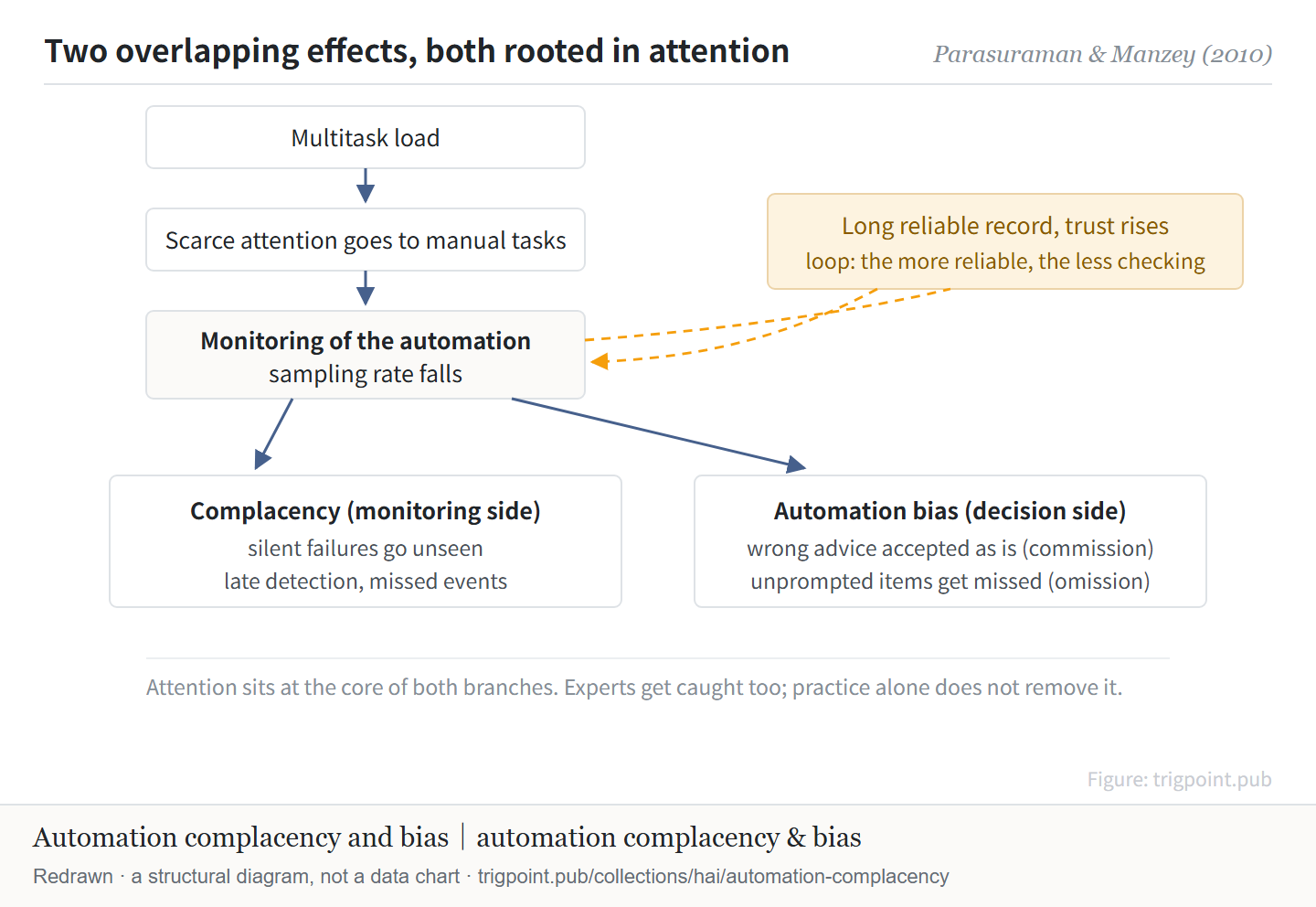
One failure sits on the monitoring side and the other on the decision side, so they look unrelated. In 2010 Parasuraman and Manzey reviewed years of empirical work and integrated two phenomena that had been discussed separately into a single model[1]Parasuraman, R., & Manzey, D. H. (2010). Complacency and Bias in Human Use of Automation: An Attentional Integration. Human Factors, 52(3), 381–410. Bibliographic details checked against the official record. Consistent with the abstract. Provenance double-checked across models.. The model does not cover every form of bias, only the part tied to inattention and selective attention; for that part, the authors hold that the two involve essentially the same attentional processes.
The chain runs like this. Multitask load makes attention scarce, people allocate it to the task that needs their hands, and the sampling rate for monitoring the automation drops.
The complacency branch: silent failures go unseen and detection is delayed. The bias branch: the system's prompt becomes a heuristic that replaces the person's own information search, so wrong recommendations are accepted (commission) and missing ones are overlooked (omission).
The more reliable the system, the higher the trust and the harder the sampling rate falls, which closes a self-reinforcing loop. The paper infers a second loop running the other way: having experienced an automation failure, trust and complacency potential fall back. Novices and experts are both affected, and extended practice does not eliminate the effect; the paper suggests that variable-priority training, and first-hand experience of automation failure, may reduce it.
2. Why this matters to you
The more consistently good the automation's output, the less often you check it, and that curve holds for you as well. The paper lists four directions for mitigation: making operators accountable for the outcome, allocating functions between person and machine flexibly, giving people practical experience with the specific automated system, and support that analyses information rather than recommending a decision (the evidence for the last is preliminary). Trying to beat an attentional structure by reminding yourself to stay alert is a fight with poor odds.
Boundary: bias refers specifically to commission and omission errors under imperfect decision aids and is not general over-trust; the mechanism here is checked mainly against the abstract, with four points checked against the full text, so a design that needs exact parameters cannot rest on this page.
Lab cases 2 first-hand cases from our studio
Automated prep works well, right up until you stop checking it
An automated line scans market data for us every week and prepares drafts. It is fast and it is stable. Because it is stable, we set a rule: automated prep is always treated as a first draft, and the sources must be checked by hand once before any judgement is made. The point is not that the tool is unreliable. It is that the more reliable it gets, the faster the human sampling rate falls. The full case carries how the rule was written and why it was made this strict on purpose.
Why this step is still done by hand: the collected clauses against blind trust
For every position that could be automated but is deliberately kept manual, we wrote down the reason. Collected together, they are the whole set of clauses against complacency.
Trigpoint Pass content · clause-level reference
Full access to the lab cases. Trigpoint Pass ▸
- 2026-10-07 · The page said that complacency and bias are one attentional mechanism. A cross-model review against the paper found that, taken as a whole, the two are overlapping and similar phenomena; the integration model covers only the part of bias tied to inattention and selective attention, and the claim of essentially the same attentional processes holds only for that part. The wording was changed to overlapping phenomena with attention at their core, and the model's coverage was added to the text.
- 2026-10-07 · The page listed a mandatory verification step, a sampling mechanism and a varying check rhythm as effective interventions. None of these is among the mitigations the paper lists, which are accountability, flexible function allocation, practical experience with the automated system, and support that analyses information rather than recommending a decision. The sentence now gives the paper's four.
How to read the source notes “Bibliographic details checked” means author, year, title and venue were confirmed. It does not mean the source's claims were checked. “Consistent with the abstract” means the claim agrees with the paper's abstract. It does not include sentence-by-sentence checking against the full text. Definitions as of 2026-09-20.
- [1] Parasuraman, R., & Manzey, D. H. (2010). Complacency and Bias in Human Use of Automation: An Attentional Integration. Human Factors: The Journal of the Human Factors and Ergonomics Society, 52(3), 381–410. https://doi.org/10.1177/0018720810376055 ↩
- [2] Mosier, K. L., & Skitka, L. J. (1996). Human Decision Makers and Automated Decision Aids: Made for Each Other? In R. Parasuraman & M. Mouloua (Eds.), Automation and Human Performance: Theory and Applications (pp. 201–220). Mahwah, NJ: Lawrence Erlbaum Associates. https://doi.org/10.1201/9781315137957
- [3] Parasuraman, R., & Riley, V. (1997). Humans and Automation: Use, Misuse, Disuse, Abuse. Human Factors, 39(2), 230–253. https://doi.org/10.1518/001872097778543886
- [4] Billings, C. E., Lauber, J. K., Funkhouser, H., Lyman, G., & Huff, E. M. (1976). Aviation Safety Reporting System (Technical Report TM-X-3445). Moffett Field, CA: NASA Ames Research Center. https://ntrs.nasa.gov/citations/19760026757 (as cited in Parasuraman & Manzey, 2010)
- [5] Wiener, E. L. (1981). Complacency: Is the term useful for air safety? In Proceedings of the 26th Corporate Aviation Safety Seminar (pp. 116–125). (as cited in Parasuraman & Manzey, 2010)
Tell the editor privately: a correction, a counter-example or where it applies
An editor reviews submissions once a week. Once a note is handled, its summary and response are listed on the discussion and response record; nothing is published before then. No sign-up is needed, and the nickname may be left blank.
We have your note