Out-of-the-loop performance problem
1. What happened
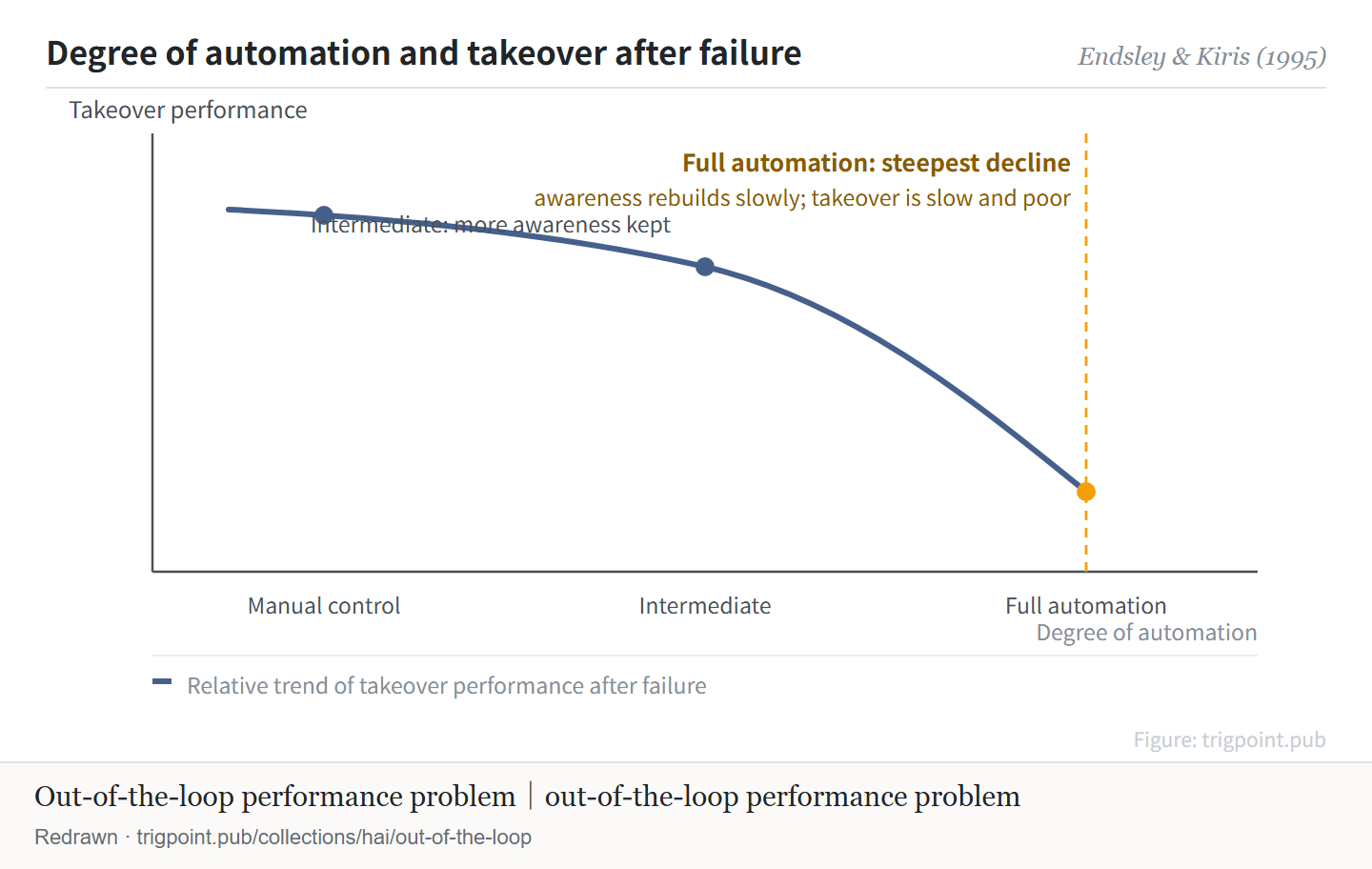
While automation runs normally, the person beside it only has to watch; when it fails, they have to take over at once. In 1995 Endsley and Kiris pinned the problem down with a controlled experiment. One navigation decision task, level of control manipulated across five settings, then the automation was failed and takeover performance measured[1]Endsley, M. R., & Kiris, E. O. (1995). The Out-of-the-Loop Performance Problem and Level of Control in Automation. Human Factors, 37(2), 381–394. Bibliographic details cross-checked against multiple sources. Consistent with the abstract. The core conclusion is corroborated against the full text of the same author's 1996 book chapter.. The fully automated group degraded most on takeover, while the intermediate levels retained more awareness and more ability to resume control.
The mechanism matters more than the result. According to Endsley's 1996 book chapter on the experiment, the display information did not change between groups, and vigilance and monitoring effects were not enough to explain the drop in awareness. The authors take the most likely cause to be the shift from active processing to passive reception itself. Turning a doer into an observer lowers awareness on its own.
2. Why this matters to you
"I can step in if anything goes wrong" is the most common piece of self-reassurance in an automated workflow. Stepping in presupposes that you still understand the situation, and understanding is exactly what full automation takes away. So a heavily automated line has two honest options: deliberately keep a human step in the decision loop, or accept that takeover will be slow and poor and budget for it. Doing neither bets the reliability of the system on someone who has already left the room.
Boundary: the conclusion is not "less automation is better" but whether the person stays in the active decision loop; this page reaches the 1995 article only at conclusion grade, so anyone needing the original wording or page numbers must obtain the full text.
Lab cases Written only where there is evidence
No field record for this node yet.
How to read the source notes “Bibliographic details checked” means author, year, title and venue were confirmed. It does not mean the source's claims were checked. “Consistent with the abstract” means the claim agrees with the paper's abstract. It does not include sentence-by-sentence checking against the full text. Definitions as of 2026-09-20.
- [1] Endsley, M. R., & Kiris, E. O. (1995). The Out-of-the-Loop Performance Problem and Level of Control in Automation. Human Factors: The Journal of the Human Factors and Ergonomics Society, 37(2), 381–394. https://doi.org/10.1518/001872095779064555 ↩
- [2] Endsley, M. R. (1996). Automation and Situation Awareness. In R. Parasuraman & M. Mouloua (Eds.), Automation and Human Performance: Theory and Applications (pp. 163–181). Mahwah, NJ: Lawrence Erlbaum Associates. https://doi.org/10.1201/9781315137957
Tell the editor privately: a correction, a counter-example or where it applies
An editor reviews submissions once a week. Once a note is handled, its summary and response are listed on the discussion and response record; nothing is published before then. No sign-up is needed, and the nickname may be left blank.
We have your note