Members' shelf
All 9 nodes on Naming & Classification are for members only.
Pay with the email you sign in with here, so the Pass is linked to this account.
Members' shelf
All 16 nodes on System Protection & Threat Modeling are for members only.
Pay with the email you sign in with here, so the Pass is linked to this account.
Signal and noise
1. What happened
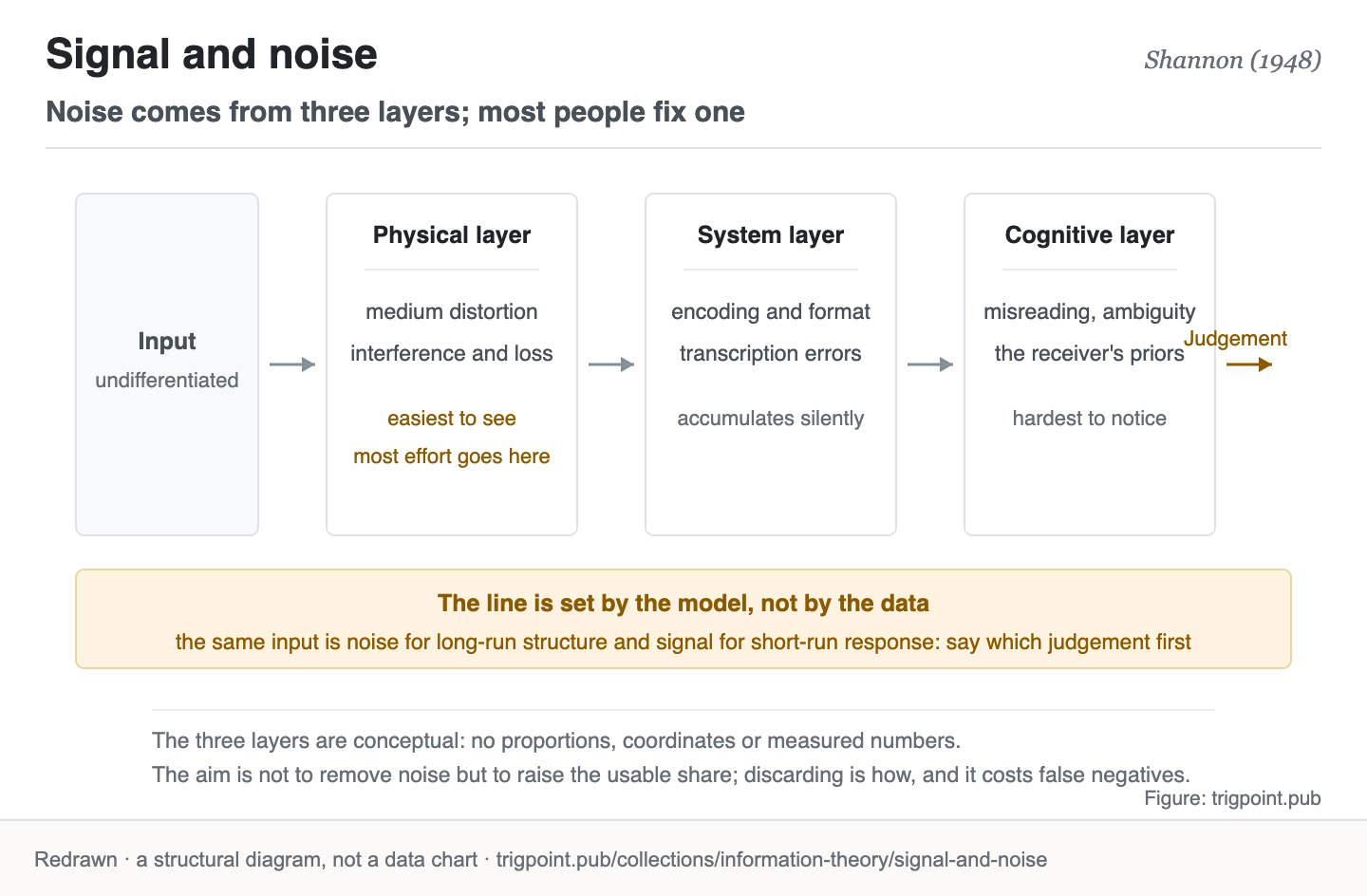
Whether a stretch of input counts as signal or noise depends on a prior choice of which judgement it is meant to serve: long-run structure, or short-run response. One decisive move in Shannon's 1948 paper was to write noise formally into the communication model[1]Shannon, C. E. (1948). A Mathematical Theory of Communication. Bell System Technical Journal, 27(3), 379–423; 27(4), 623–656. DOI 10.1002/j.1538-7305.1948.tb01338.x. Bibliographic details checked against the official record. Claims matched against the full text. Writes noise formally into the communication model (part II, the discrete channel with noise), making reliable transmission under interference an analysable problem; the capacity formula for a channel under white noise is in section 24, theorem 17. The opening sentence mentions modulation methods of the time, such as PCM and PPM, that exchange bandwidth for signal-to-noise ratio.. From then on noise was part of the model, and how much can still be transmitted reliably while interference is present turned into a question that can be analysed and pushed to a limit.
The importance of that turn is in the concession: it admits that noise will not go away, and then asks what can be done given that it is there.
Seen that way, the definition of signal becomes narrow: only input that reliably changes your probability distribution is signal. Changes, meaning it reduced uncertainty. Reliably, meaning it is not a random disturbance that moves things one way this time and back the next. Anything failing those two conditions is noise, however much it looks like data.
Noise comes from at least three layers, and they usually act at once. The physical layer is distortion in the transmission medium. The system layer is error introduced in encoding, formatting and transcription. The cognitive layer is misunderstanding, ambiguous terminology, and the receiving end's own prior convictions. Most people handle the first only, because it is the easiest to see.
One property is often missed, and it is the most useful sentence on this page: signal and noise are relative to a model. The same input is noise when you care about long-run structure and signal when you care about short-run response. That is not equivocation. This pair of concepts carries a frame of reference inside its definition. So any discussion of whether this is signal that has not first said which judgement it is signal for will reach no conclusion.
2. Why this matters to you
Most people handle information overload by adding gates: subscribe to more sources, produce more summaries, build more categories. This page says most of that effort goes into the wrong variable.
The quantity to watch is the proportion, not the total. If what reaches you grows while the share of it that can change a judgement does not, your position has not improved. You are busier.
Worse, an increase in total usually drives the proportion down, because newly added sources are generally more marginal than the ones you already had. Volume of input and signal-to-noise ratio are two quantities that can move in opposite directions, and only the second affects how accurately you judge.
That is particularly costly when working with a model, because the context you feed in has a quiet failure mode. You attach everything that might be relevant, the model does not tell you that eight parts in ten are noise, it takes the lot and produces a response that looks reasonable. You think you are supplying fuller background. You are diluting.
The test is simple: if this passage were removed, would my conclusion differ? If it would not, it is noise, and attaching it does not cost nothing.
The third thing is about time scale. Reading short-run fluctuation as a trend is the standard form of mistaking noise for signal, and it has a feature that is hard to shake: fluctuation is always the most recent, the most vivid, and the easiest to read as things are changing. There is no clever guard against this. You can only fix in advance which scale you are looking at and how long counts, then not change it midway.
Lab cases 2 first-hand cases from our studio
Three classes for the inbox: a digest already used is not kept as backup
Situation: an external agent regularly sends machine-compiled digests into our inbox: a weekly signal pool (one week in June held 59 items) and batches from two lead radars. The inbox also held one-off handoff notes and two standing files that an outside workflow reads from a fixed path, and the three kinds of item had no closing rules of their own. During an architecture self-review on 24 July 2026, two weekly pools from June were still in the inbox. One of them was an empty shell with 0 items, long since replaced by an archived version with 59.
Decision point: there were at least four workable options. One, empty the inbox once a month. Two, keep everything, in case something is missed. Three, set a closing rule for each class of item. Four, cap the number of items in the inbox and raise a reminder when the cap is passed.
What we did and what happened: we took the third option and wrote three classes that day. A one-off handoff is archived once it has been used. A periodic digest is archived once it has been used, and only the latest copy in a series stays as the working copy. A standing file is never moved. The two June pools were archived on the spot. The same review had also proposed moving the two standing files; a counter-check stopped it, because once moved, the outside workflow could no longer find them.
The rule did not stop the backlog. On 8 August the start-up loading view showed 9 deliveries from the external agent in the inbox not yet used, the oldest of them 8 days old. On 10 August, during a clean-up, an older lead digest was still sitting next to a newer one. A fourth class was added that day: material such as book files and images had no closing rule, and some of it had sat for six to ten weeks. The same day the weekly column was retired, and the standing-file class has had no members since.
Take-away: if a periodic digest has already been used, the old copy need not stay in the inbox as a backup. It no longer changes any judgement still to be made, and keeping it only dilutes the part of the inbox that is still useful. Once the rule is written, someone still needs to look regularly at the number of items and the age of the oldest.
The second gate: check what an external agent delivers against the source before using it
From July 2026, everything an external agent delivered to us was treated as a first pass, and a person checked it against the source before it was used. In late July two lead radars sent six leads, each already filtered by our criteria. There were at least four workable responses, and they differ in how many leads to check and what to check them against.
Trigpoint Pass content · includes applicable criteria
Full access to the lab cases. Trigpoint Pass ▸
- A common account says: remove the noise first, then analyse. In most cases noise cannot be removed, and what can be adjusted is the ratio of signal to noise. Setting the goal as eliminating noise usually leads to over-filtering, which strips out signal along with it. #
- A common account says that signal and noise are intrinsic properties of the data. They are not. The same input can fall on either side under different models and time scales. Before judging, say which model and which scale. #
How to read the source notes “Bibliographic details checked” means author, year, title and venue were confirmed. It does not mean the source's claims were checked. “Matched against the full text” means the claim was compared with the text of the source itself. Definitions as of 2026-09-20.
Tell me when a new shelf opens
Tell me when a new shelf opens
Shelf notices are sent only when a new shelf opens or when the reading rules change.
Tell the editor privately: a correction, a counter-example or where it applies
Submissions are read only by the editor, and nothing is published before they are handled. Once a note is handled, a summary and response written by the editor are published. No sign-up is needed, and the nickname may be left blank.
We have your note