Members' shelf
All 9 nodes on Naming & Classification are for members only.
Pay with the email you sign in with here, so the Pass is linked to this account.
Members' shelf
All 16 nodes on System Protection & Threat Modeling are for members only.
Pay with the email you sign in with here, so the Pass is linked to this account.
Channel and capacity
1. What happened
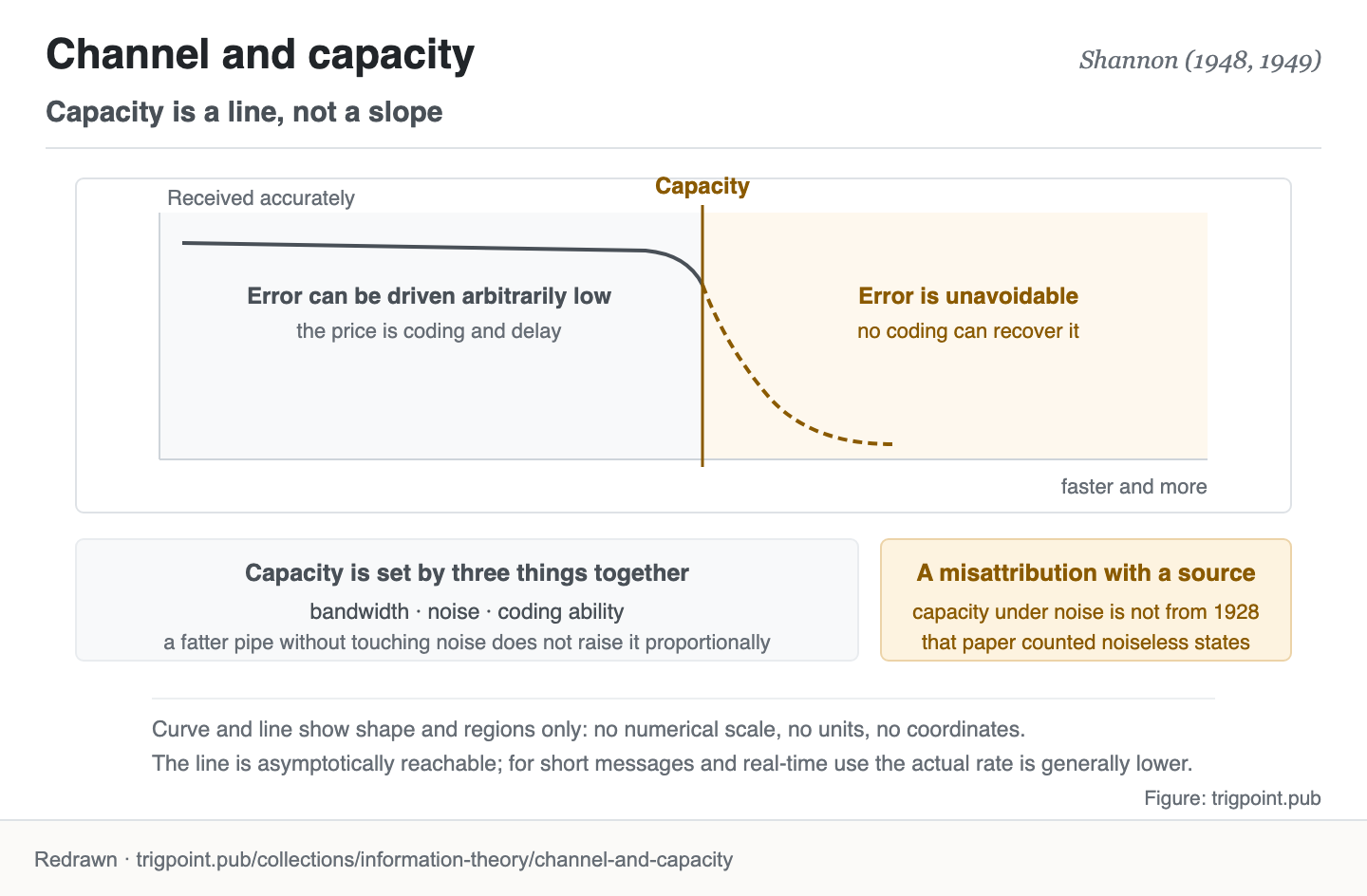
How much can be pushed into a channel and how much the other end can reliably reconstruct under noise are often taken as one number; the second has a hard ceiling. Shannon's 1948 paper proved something counterintuitive: on a noisy channel, the error rate is not something you can only grind down by raising power. So long as the transmission rate stays below a certain threshold, a coding scheme exists that drives the error rate arbitrarily close to zero. Once past that threshold, error is unavoidable[1]Shannon, C. E. (1948). A Mathematical Theory of Communication. Bell System Technical Journal, 27(3), 379–423; 27(4), 623–656. Bibliographic details checked against the official record. Claims matched against the full text. Provenance double-checked across models. Theorem 17 gives the capacity of a band-limited channel perturbed by white thermal noise when the average transmitter power is limited. Right after that theorem, the paper names Wiener, Tuller and Sullivan as having developed similar formulas on their own.. That threshold is capacity. Shannon's paper of the following year proved the result again by geometric means[2]Shannon, C. E. (1949). Communication in the Presence of Noise. Proceedings of the IRE, 37(1), 10–21. DOI 10.1109/JRPROC.1949.232969. Bibliographic details checked against the official record. Provenance double-checked across models. Proves the capacity formula under noise again, by geometric means..
The shape of that result is worth pausing on. It is not a continuous trade of the faster, the more error-prone kind. It is a line. To the left of the line, reliability is a problem of coding design. To the right of it, reliability is impossible. It took engineering decades more before coding methods came close to that line in practice, but the line itself was fixed in 1948.
Capacity is settled by three things together: the bandwidth the channel can carry, the strength of the noise, and your coding ability. None substitutes for another. Widen the pipe without addressing the noise and capacity does not rise in proportion; equally, no amount of ingenious coding breaks through a ceiling set by bandwidth and noise.
Two attributions need stating clearly. First, capacity under noise does not belong to Hartley's 1928 paper. That paper deals only with the number of distinguishable choices and says nothing about signal or noise, and attributing capacity under noise to it is a citation error whose source can be traced[3]Hartley, R. V. L. (1928). Transmission of Information. Bell System Technical Journal, 7(3), 535–563. Bibliographic details checked against the official record. Provenance double-checked across models. Measures information by the logarithm of the number of distinguishable choices and says nothing about signal or noise. Attributing capacity under noise to this paper is a citation error.[5]Rioul, O., & Magossi, J. C. (2014). On Shannon's Formula and Hartley's Rule: Beyond the Mathematical Coincidence. Entropy, 16(9), 4892–4910. DOI 10.3390/e16094892. Bibliographic details checked against the official record. Claims matched against the full text. Traces the attribution of Hartley's rule: Hartley's 1928 paper never sets signal against noise in a formula, and the oldest source that attributes the formula to Hartley appears to be a widely used textbook of 1965 (Wozencraft and Jacobs). The paper also proves that the formula is exactly the capacity of a channel with uniform noise and limited amplitude, and argues for the name Tuller-Shannon.. Second, several researchers derived similar formulas independently in the same period, and Shannon's 1948 paper names three of them. Tuller's contribution among these has long been little mentioned; but his derivation is a rough estimate from the number of distinguishable amplitude levels[4]Tuller, W. G. (1949). Theoretical Limitations on the Rate of Transmission of Information. Proceedings of the IRE, 37(5), 468–478. DOI 10.1109/JRPROC.1949.232323. Bibliographic details checked against the official record. Provenance double-checked across models. Journal version of the author's 1948 MIT doctoral (Sc.D.) thesis. The derivation estimates roughly from the number of distinguishable amplitude levels and arrives at a formula close to capacity under noise. According to a 2014 study (section 5, theorem 1), such a formula is the capacity of a channel with uniform noise and limited amplitude when the ratio of the amplitude limit to the noise bound is a whole number, which is a different setting from the Gaussian-noise, average-power-limited channel treated by theorem 17 of Shannon's 1948 paper.; Rioul and Magossi's 2014 study proves that such a formula is the capacity of a channel with uniform noise and limited amplitude, which is a different setting from the Gaussian-noise, limited-power channel of the 1948 theorem[5]Rioul, O., & Magossi, J. C. (2014). On Shannon's Formula and Hartley's Rule: Beyond the Mathematical Coincidence. Entropy, 16(9), 4892–4910. DOI 10.3390/e16094892. Bibliographic details checked against the official record. Claims matched against the full text. Traces the attribution of Hartley's rule: Hartley's 1928 paper never sets signal against noise in a formula, and the oldest source that attributes the formula to Hartley appears to be a widely used textbook of 1965 (Wozencraft and Jacobs). The paper also proves that the formula is exactly the capacity of a channel with uniform noise and limited amplitude, and argues for the name Tuller-Shannon..
2. Why this matters to you
Widen the word channel from wires to your own workflow and this page starts paying.
The stretch of context between you and a model is a channel. It has bandwidth (how much fits in at once), noise (irrelevant content, expired specifications, mutually contradictory instructions), and coding ability (how you organise that content). Most people adjust the first only: push in more, write longer, attach everything that might be relevant. Under this page's frame that is a nameable error. What you raise is the volume of input, what you lower is the signal-to-noise ratio, and capacity governs the second.
The same thing is more visible with people. A handover document, a meeting, a letter: their capacity is fixed not by how much you wrote but by how much the other end can reliably reconstruct.
And here is the cruel part: transmission past capacity does not report an error. Nobody tells you that they overflowed. They give you a response that looks reasonable, built on truncated input. That failure is silent, so it can only be guarded against by design in advance, never by detection afterwards.
In practice this page gives you three questions you can ask directly. What is the noise on this channel, meaning which content does not change any judgement. Am I adjusting the volume of input or the signal-to-noise ratio. And if the other end can reconstruct half, which half do I want it to be. The third question takes you straight into the section “How to shrink it: the three limits of compression” on this shelf.
Counter-examples and failure boundaries
The first boundary is how far the channel metaphor stretches. The capacity theorem holds for a probabilistic channel model with an explicit definition: an input alphabet, an output alphabet, and the conditional probabilities between them. Calling attention or organisational communication a channel is an illuminating analogy and not the domain of the theorem. You may borrow its structure to ask questions. You may not borrow its numerical conclusions. This boundary returns in the section “Who bears these limits” on this shelf, where we cite Shannon's own public warning about extrapolations of this kind.
The second boundary is the form in which capacity is reachable. Capacity is reachable asymptotically: the theorem guarantees that some coding approaches it, but that usually needs very long code blocks, which is to say a lot of latency. For short messages, and wherever immediacy is required, the rate actually achievable is generally below capacity. Treating capacity as a target you get by being clever enough ignores its price.
The third is the most common misuse in practice: comparing capacity as though it were an intrinsic property of the channel. Capacity depends on noise as well, and noise depends on the environment, so the same channel has different capacities in different environments. Claiming that some channel has more capacity without specifying the noise conditions is a sentence with no content in it.
Lab cases 2 first-hand cases from our studio
What a session reads at start-up, cut from eleven places to five
Situation: each of our working sessions starts by reading a fixed set of context: the rules of that line of work, the state across lines, threads in progress, the inbox, and a few more. From 25 June 2026 a program rendered these into one loading view, with seven classes of state in one place and any missing class marked as skipped. On 2 July a review of the whole knowledge base counted what was still required at start-up: 11 places, read unconditionally by every session, including sessions that asked only one question. Two pairs duplicated each other, and one check for instructions across lines of work had faced an empty list every time since 16 June.
Decision point: on 11 July 2026 there were at least four workable options. One, keep things as they were. Two, open a fast path for sessions that ask a single question. Three, fold the duplicated reads and the nearly always empty check into the one loading view, move the item whose answer never changed to once a week, and open the fast path as well. Four, trim the content of each of the eleven places and keep their number.
What we did and what happened: the person running the studio approved the third option on 12 July, and it went live on 18 July. For sessions that change files, the required reads at start-up fell from 11 places to 5; for sessions that read only one thing or ask one question, to 2. The annual-plan item moved to once a week: none of the nine lines of work had an annual plan, so every read returned the same answer.
One step that was due to be removed stayed. It rescanned the last 14 days of work logs for open items, and removing it assumed that another list already held all of them. A sample check before going live found that list about nine-tenths complete, and the missing items checked by hand were genuinely missing, so the step was kept and moved to once a week.
Take-away: if an item that must be read at every start-up is almost always empty, or always gives the same answer, read it less often or fold it into one place. Before removing it, measure whether the record meant to take its place is complete.
What overload looks like: an entry page buried under its own change history
In early July 2026 more than half the text on our knowledge base's entry page was a change log built up entry by entry. Only a recount showed that three current values on the page were out of date, and the page itself raises no error for that. Faced with a page like this, there were at least four workable responses, and they differ in whether the history is kept and on which channel.
Trigpoint Pass content · includes applicable criteria
- A common account says the capacity formula under noise comes from Hartley in 1928. Wrong. The 1928 paper deals only with the number of distinguishable choices, first assumes external interference away, and never sets signal against noise in a formula. Capacity under noise comes from theorem 17 of Shannon's 1948 paper, and Shannon's 1949 paper gives a geometric proof. According to a 2014 study, the oldest source that attributes the related formula to Hartley appears to be a widely used textbook of 1965. #
- A common account says capacity is bandwidth. Bandwidth is only one of the factors that set capacity; the other two are noise and coding ability. Swap in a wider pipe without addressing the noise and capacity does not rise in proportion. #
Records how far each claim was checked, not a guarantee that it is true.
Corrections- Several researchers derived similar formulas independently in the same period. Tuller was one of them, and Shannon's 1948 paper names him. His contribution has long been little mentioned; but his derivation is a rough estimate from the number of distinguishable amplitude levels; according to a 2014 study, such a formula is the capacity of a channel with uniform noise and limited amplitude, which is a different setting from the Gaussian-noise, limited-power channel of Shannon's 1948 theorem. Both things need saying: neither erase him nor inflate him.
How it was checked
The bibliographic details of all five sources on this page were checked against the official records, and Shannon's 1948 paper and Rioul and Magossi's 2014 study were also read in full.
Three findings on attribution fold in. First, capacity under noise comes from theorem 17 of Shannon's 1948 paper[1]Shannon, C. E. (1948). A Mathematical Theory of Communication. Bell System Technical Journal, 27(3), 379–423; 27(4), 623–656. Bibliographic details checked against the official record. Claims matched against the full text. Provenance double-checked across models. Theorem 17 gives the capacity of a band-limited channel perturbed by white thermal noise when the average transmitter power is limited. Right after that theorem, the paper names Wiener, Tuller and Sullivan as having developed similar formulas on their own., and Shannon's 1949 paper gives a geometric proof[2]Shannon, C. E. (1949). Communication in the Presence of Noise. Proceedings of the IRE, 37(1), 10–21. DOI 10.1109/JRPROC.1949.232969. Bibliographic details checked against the official record. Provenance double-checked across models. Proves the capacity formula under noise again, by geometric means..
Second, the claim that attributes it to Hartley's 1928 paper does not hold. According to Rioul and Magossi's 2014 study, the 1928 paper never sets signal against noise, and the oldest source that attributes the related formula to Hartley appears to be a widely used textbook of 1965[3]Hartley, R. V. L. (1928). Transmission of Information. Bell System Technical Journal, 7(3), 535–563. Bibliographic details checked against the official record. Provenance double-checked across models. Measures information by the logarithm of the number of distinguishable choices and says nothing about signal or noise. Attributing capacity under noise to this paper is a citation error.[5]Rioul, O., & Magossi, J. C. (2014). On Shannon's Formula and Hartley's Rule: Beyond the Mathematical Coincidence. Entropy, 16(9), 4892–4910. DOI 10.3390/e16094892. Bibliographic details checked against the official record. Claims matched against the full text. Traces the attribution of Hartley's rule: Hartley's 1928 paper never sets signal against noise in a formula, and the oldest source that attributes the formula to Hartley appears to be a widely used textbook of 1965 (Wozencraft and Jacobs). The paper also proves that the formula is exactly the capacity of a channel with uniform noise and limited amplitude, and argues for the name Tuller-Shannon..
Third, right after theorem 17 Shannon's 1948 paper names Wiener, Tuller and Sullivan as having developed similar formulas on their own[1]Shannon, C. E. (1948). A Mathematical Theory of Communication. Bell System Technical Journal, 27(3), 379–423; 27(4), 623–656. Bibliographic details checked against the official record. Claims matched against the full text. Provenance double-checked across models. Theorem 17 gives the capacity of a band-limited channel perturbed by white thermal noise when the average transmitter power is limited. Right after that theorem, the paper names Wiener, Tuller and Sullivan as having developed similar formulas on their own.; Tuller's derivation is a rough estimate from the number of distinguishable amplitude levels[4]Tuller, W. G. (1949). Theoretical Limitations on the Rate of Transmission of Information. Proceedings of the IRE, 37(5), 468–478. DOI 10.1109/JRPROC.1949.232323. Bibliographic details checked against the official record. Provenance double-checked across models. Journal version of the author's 1948 MIT doctoral (Sc.D.) thesis. The derivation estimates roughly from the number of distinguishable amplitude levels and arrives at a formula close to capacity under noise. According to a 2014 study (section 5, theorem 1), such a formula is the capacity of a channel with uniform noise and limited amplitude when the ratio of the amplitude limit to the noise bound is a whole number, which is a different setting from the Gaussian-noise, average-power-limited channel treated by theorem 17 of Shannon's 1948 paper.. The same study also proves that formulas from such estimates are exactly the capacity of a channel with uniform noise and limited amplitude, and argues for naming Tuller and Shannon together[5]Rioul, O., & Magossi, J. C. (2014). On Shannon's Formula and Hartley's Rule: Beyond the Mathematical Coincidence. Entropy, 16(9), 4892–4910. DOI 10.3390/e16094892. Bibliographic details checked against the official record. Claims matched against the full text. Traces the attribution of Hartley's rule: Hartley's 1928 paper never sets signal against noise in a formula, and the oldest source that attributes the formula to Hartley appears to be a widely used textbook of 1965 (Wozencraft and Jacobs). The paper also proves that the formula is exactly the capacity of a channel with uniform noise and limited amplitude, and argues for the name Tuller-Shannon..
Two residual uncertainties. This page makes no quantitative statement about how widespread that citation error is, because we have run no census of the citation chain. For the contents of Hartley (1928), Shannon (1949) and Tuller (1949), this page follows the account in Rioul and Magossi (2014) and has not checked them sentence by sentence.
How to read the source notes “Bibliographic details checked” means author, year, title and venue were confirmed. It does not mean the source's claims were checked. “Matched against the full text” means the claim was compared with the text of the source itself. Definitions as of 2026-09-20.
- [1] Shannon, C. E. (1948). A Mathematical Theory of Communication. Bell System Technical Journal, 27(3), 379–423; 27(4), 623–656. ↩
- [2] Shannon, C. E. (1949). Communication in the Presence of Noise. Proceedings of the IRE, 37(1), 10–21. ↩
- [3] Hartley, R. V. L. (1928). Transmission of Information. Bell System Technical Journal, 7(3), 535–563. ↩
- [4] Tuller, W. G. (1949). Theoretical Limitations on the Rate of Transmission of Information. Proceedings of the IRE, 37(5), 468–478. ↩
- [5] Rioul, O., & Magossi, J. C. (2014). On Shannon's Formula and Hartley's Rule: Beyond the Mathematical Coincidence. Entropy, 16(9), 4892–4910. ↩
Tell me when a new shelf opens
Tell me when a new shelf opens
Shelf notices are sent only when a new shelf opens or when the reading rules change.
Tell the editor privately: a correction, a counter-example or where it applies
Submissions are read only by the editor, and nothing is published before they are handled. Once a note is handled, a summary and response written by the editor are published. No sign-up is needed, and the nickname may be left blank.
We have your note