Members' shelf
All 9 nodes on Naming & Classification are for members only.
Pay with the email you sign in with here, so the Pass is linked to this account.
Members' shelf
All 16 nodes on System Protection & Threat Modeling are for members only.
Pay with the email you sign in with here, so the Pass is linked to this account.
Information theory and thermodynamics
1. What happened
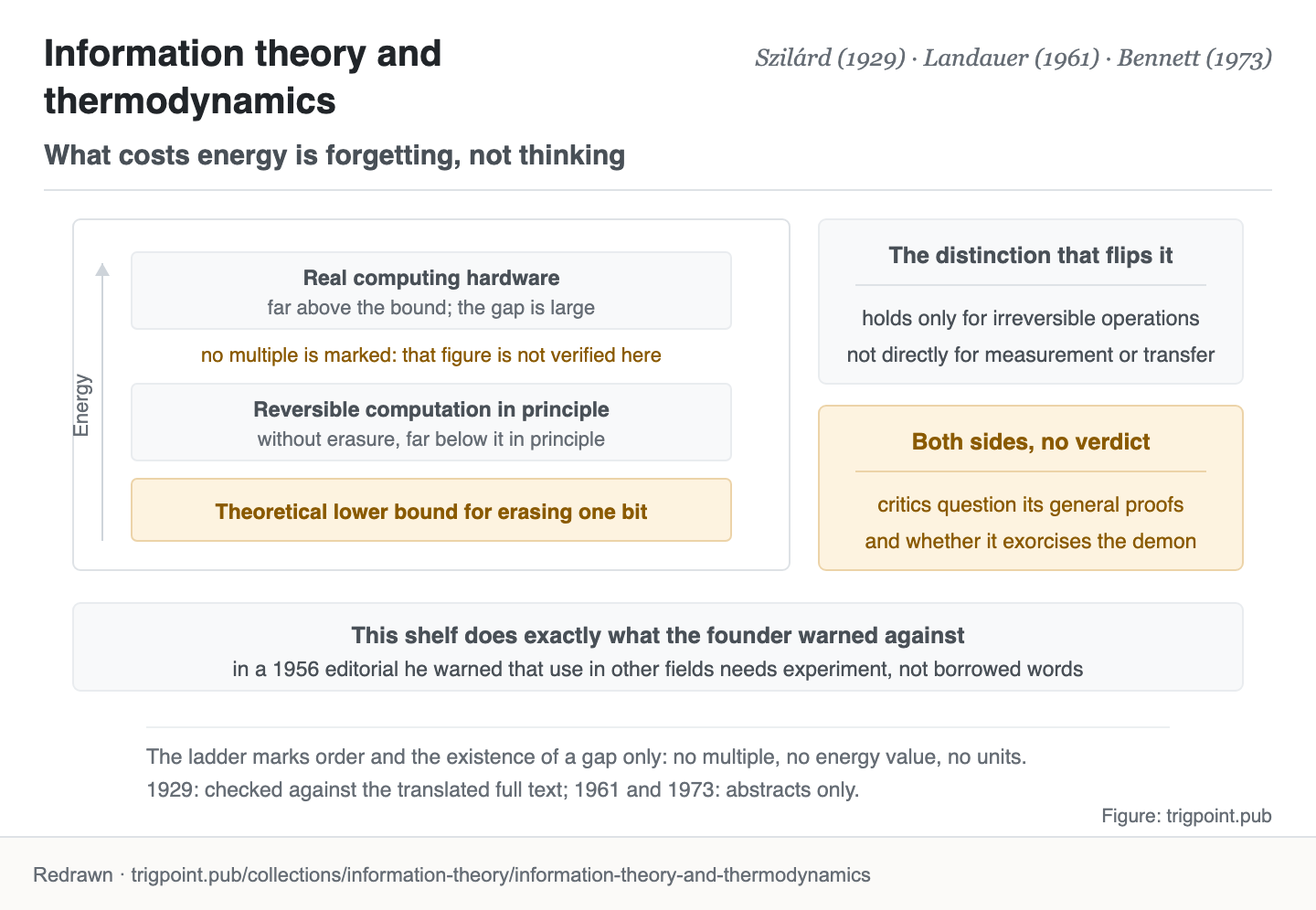
Computation itself and wiping data out cannot share one energy account: the lower bound this page deals with falls only on erasure. This line does not start with computers. It starts with a thought experiment. In the nineteenth century someone imagined a gatekeeper able to tell fast molecules from slow ones and so create a temperature difference without doing work, which looks like a direct violation of the second law. Szilárd's 1929 paper supplied the decisive step: to tell them apart the gatekeeper has to acquire information, and acquiring information itself enters the entropy account[1]Szilárd, L. (1929). Über die Entropieverminderung in einem thermodynamischen System bei Eingriffen intelligenter Wesen. Zeitschrift für Physik, 53(11–12), 840–856. DOI 10.1007/BF01341281. English translation: On the decrease of entropy in a thermodynamic system by the intervention of intelligent beings. Behavioral Science, 9(4), 301–310 (1964). Bibliographic details checked against the official record. Claims matched against the full text. The paper argues that the kind of memory faculty on which measurement relies could cause a permanent decrease of entropy, were it not that measurement is necessarily accompanied by a production of entropy; the entropy produced turns out to be exactly enough for full compensation. The editors' note to the English translation calls it one of the earliest, if not the earliest, papers of its kind.. From then on, the way out of the paradox lay with the observer rather than with the physical system.
Landauer's 1961 paper settled the account more precisely, and more counterintuitively: what must pay heat is not computing but erasing[2]Landauer, R. (1961). Irreversibility and Heat Generation in the Computing Process. IBM Journal of Research and Development, 5(3), 183–191. DOI 10.1147/rd.53.0183. Bibliographic details checked against the official record. Consistent with the abstract. Logical operations without a single-valued inverse (logically irreversible operations, such as erasure) necessarily involve a minimal generation of heat.. The reason is that a logically irreversible operation collapses several possible input states into one output state, and that collapse has to be repaid to the environment as heat. Bennett (1973) pushed one step further, showing that computation can be made logically reversible at every step, and pointing out on that basis that computation without erasure could in principle bring the dissipation of each step far below the order of that bound[3]Bennett, C. H. (1973). Logical Reversibility of Computation. IBM Journal of Research and Development, 17(6), 525–532. DOI 10.1147/rd.176.0525. Bibliographic details checked against the official record. Consistent with the abstract. Shows that a general-purpose computer can be made logically reversible at every step; on that basis the author holds that thermodynamically reversible computers dissipating far less than the order of that bound per step are plausible.. Taken together, the three steps give a clean conclusion: what consumes energy is not thinking but forgetting.
Note that this line is not without opposition. A body of criticism in philosophy and physics holds that the general proofs of the principle do not succeed: one criticism, for example, is that those proofs illicitly treat memory devices holding different data as a single statistical ensemble, and that the existing arguments are not enough to exorcise the gatekeeper in general[4]Norton, J. D. (2005). Eaters of the lotus: Landauer's principle and the return of Maxwell's demon. Studies in History and Philosophy of Modern Physics, 36(2), 375–411. DOI 10.1016/j.shpsb.2004.12.002. Bibliographic details checked against the official record. Consistent with the abstract. One criticism of the principle: the author holds that it is valid only for a particular class of erasure processes, that its general proofs depend on illicitly treating memory devices holding random data as a single statistical ensemble, and that the existing theory is not enough to exorcise the gatekeeper in general. Earman, Norton, Shenker and others have made related criticisms. It is a live philosophical argument, and this site sets both sides out without ruling.. That argument is live today, and this site sets both sides out without ruling.
Finally, the shared formal ancestry belongs in its proper place. That information entropy and the entropy of statistical mechanics share a mathematical form is not disputed. Whether their units, interpretations and ontological standing are the same is still argued and remains unsettled, and this site already handled that in layers on the entropy page.
2. Why this matters to you
The other pages of this shelf were about limits and trades. This page is about why those limits are not a personal failing.
Keeping an ordered system takes continuous input, and that input has a physical lower bound. In everyday use that sentence has the tone of a motivational poster. On this page it is a quantifiable statement: clearing old states, overwriting expired records, gathering scattered things back into structure, at the most abstract level all of these are erasure, and erasure has a price.
Your knowledge base, your projects and your workflow do not hold themselves in order, and not because you lack discipline. Keeping order is a continuous expenditure by nature. Stop spending and order starts to come apart.
The second thing follows from the counterintuitive result that forgetting costs more than remembering. It has a human counterpart: deciding what to throw away is much harder than deciding what to keep. Keeping needs no judgement; throwing away does. So in any system that accumulates, the real bottleneck was never collection but deletion, and deletion gets postponed not out of laziness but because its unit cost genuinely is higher. Knowing that, the right move is first to tell which leftovers get in the way of something still in use: those go into the budget and get cleared; the rest stay.
The third thing connects this line to the shelf as a whole. The section “First pin down the word ‘information’” defined information, “Why it degrades: noise and capacity” said it does not get through, “How to shrink it: the three limits of compression” said how to compress it, “What measures relatedness and error” said how to measure relation and error, “Who bears these limits” asked who bears them. This page supplies the last bearer: the physical world itself. None of these limits is a convention. They all land on energy in the end.
Lab cases 2 first-hand cases from our studio
Before clearing something, ask first: whose way does it get in?
Situation: in November 2026 a brand line we had retired still left behind a few account settings, a domain registration and a site on an analytics platform. We could clear them all at once, put them into a cleanup budget, or first check whether each was still in use.
What we did and what happened: we set a rule: clear something only if leaving it would affect something still in use. Still in use means someone reads it, a program depends on it, or it still serves an identity function such as sign-in or account recovery. Checked item by item, none did, so all of them stayed and the domain was left to expire. The rule follows this node's structure: erasure carries a lower bound on cost, and computation that does not erase can in principle run far below it; our cost is records and working hours instead. The physical numbers do not apply here; this is the kind of cross-field borrowing that Shannon (1956), cited on this node, warned against. Others have made similar borrowings before; this is not original.
Takeaway: something with no readers, no dependants and no identity function can stay; live sign-ins and access rights are still cleared.
One cleanup, two groups of fields, two reasons
In November 2026 a field cleanup ran into a rule set three days earlier: leftovers that get in the way of nothing in use stay. One group of fields made readers think someone was checking; the other had no readers, but its deletion had been decided before the rule existed. Which should the review follow?
Trigpoint Pass content · includes applicable criteria
Full access to the lab cases. Trigpoint Pass ▸
- A common account says information entropy and thermodynamic entropy are the same thing. Their mathematical forms share an ancestry, but whether they are ontologically equivalent is still argued and remains unsettled. This site sets the question out in layers on the entropy page and on this page, without taking a side. #
- A common account says computation itself costs energy. According to the principle above, the cost comes from logically irreversible operations, erasure above all; computation that is reversible in principle is not subject to the same bound. That distinction is the key to the whole line, and erasing it gives the opposite conclusion. #
- A common account says that information therefore has mass, or that information is physical. What this page supports is a narrower proposition: erasing information has a lower bound in energy. Jumping from there to a stronger metaphysical conclusion needs an argument this page does not provide. #
How to read the source notes “Bibliographic details checked” means author, year, title and venue were confirmed. It does not mean the source's claims were checked. “Consistent with the abstract” means the claim agrees with the paper's abstract. It does not include sentence-by-sentence checking against the full text. “Matched against the full text” means the claim was compared with the text of the source itself. Definitions as of 2026-09-20.
- [1] Szilárd, L. (1929). Über die Entropieverminderung in einem thermodynamischen System bei Eingriffen intelligenter Wesen. Zeitschrift für Physik, 53(11–12), 840–856. English translation: Behavioral Science, 9(4), 301–310 (1964). ↩
- [2] Landauer, R. (1961). Irreversibility and Heat Generation in the Computing Process. IBM Journal of Research and Development, 5(3), 183–191. ↩
- [3] Bennett, C. H. (1973). Logical Reversibility of Computation. IBM Journal of Research and Development, 17(6), 525–532. ↩
- [4] Norton, J. D. (2005). Eaters of the lotus: Landauer's principle and the return of Maxwell's demon. Studies in History and Philosophy of Modern Physics, 36(2), 375–411. Bibliographic details checked against the official record. Consistent with the abstract. Listed as a representative paper of the criticism of the principle. ↩
- [5] Shannon, C. E. (1956). The Bandwagon. IRE Transactions on Information Theory, IT-2(1), 3. ↩
Tell me when a new shelf opens
Tell me when a new shelf opens
Shelf notices are sent only when a new shelf opens or when the reading rules change.
Tell the editor privately: a correction, a counter-example or where it applies
Submissions are read only by the editor, and nothing is published before they are handled. Once a note is handled, a summary and response written by the editor are published. No sign-up is needed, and the nickname may be left blank.
We have your note